Team Scotland unveils official Commonwealth Games tartan

 BBC
BBCTeam Scotland has unveiled its official tartan for the Glasgow 2026 Commonwealth Games.
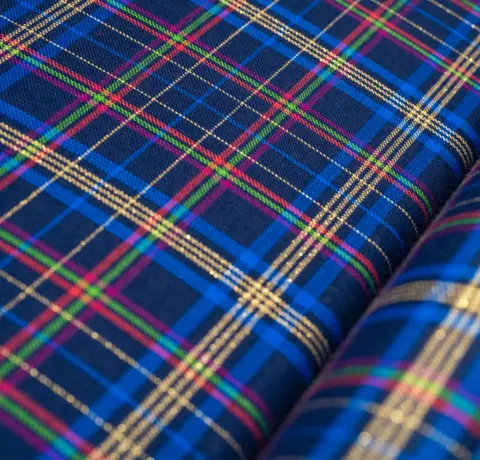
The design has a deep navy blue base mixed with purples, pinks, greens and metallic gold thread which symbolises Scotland's ambitions for the games.
Created by award-winning designer Siobhan Mackenzie, it also draws on the Team Scotland thistle.
Glasgow 2026 will run from 23 July to 2 August, with more than 3,000 athletes from 74 nations and territories competing across 10 sports and six Para sports.
Mackenzie began her career as a tailoring technician at the Glasgow 2014 Commonwealth Games.
She later designed Team Scotland's womenswear for the Gold Coast in 2018 and the full design for the tartan and opening ceremony outfits for Birmingham 2022.
Named Best New Scottish Designer in 2016 and in 2018, her kilts have been worn by Justin Bieber and Judy Murray.
Mackenzie said it was an "incredible honour" to create a tartan for the games' return to Glasgow.
She said: "I wanted to create something that respects tradition but also moves it forward, with bold colours and the introduction of metallic gold to reflect the drive and determination of the athletes who will wear it."
The tartan has been made in Scotland using local textiles and manufacturers.
"It's also really important to me that everything is made in Scotland. From the weaving through to the final pieces," she added.
"This is a celebration of Scottish craftsmanship as much as it is of Team Scotland."
The tartan will feature across Team Scotland's official kit for Glasgow 2026, including the ceremony outfits worn by athletes and team officials.
Glasgow stepped in to stage the games after the original host, the state of Victoria in Australia, backed out for financial reasons.
Due to the shortened length of time to organise it and cost constraints, the number of events has been cut back to 10, compared with 17 in the 2014 edition.
