Residents repeatedly woken by Waymo test gone wrong
Residents living on an east London street are still being woken by the "hideous siren" of a noisy self-driving car mistakenly driving up and down their cul-de-sac in the early hours, despite attempts to stop them.
The cars - made by US tech firm Waymo - are mapping out London's streets as part of tests to prepare for launching driverless minicabs in the capital.
The issue was first raised by BBC London last month but residents say at least one car has continued to get stuck on Elder Street in Spitalfields at night, with the vehicles emitting loud automated noises when reversing out.
Waymo again apologised to residents and said it had blocked off roads on its systems to prevent it happening.
'Nice wake-up call'
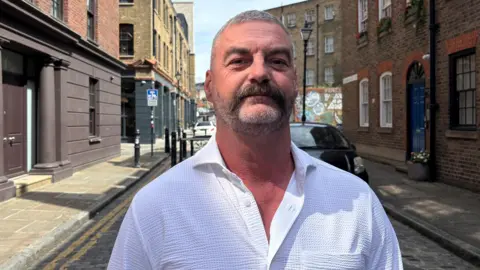
Resident Chris Lloyd told the BBC he had often been woken by a Waymo test car since the beginning of May.
"I knew it was Waymo instantly from that hideous siren and reversing noise," Lloyd said.
The 56-year-old, who has lived on the street for 16 years, said the road being in a conservation area meant most homes did not have double-glazing and were more exposed to noise.
He said: "At 05:30 last week, another [Waymo] car came down the street, stopped about halfway down, tried to reverse, tried to turn around, couldn't, and reversed all the way down the street again.
"I just thought, 'Oh God, here we go again... a nice wake-up call for everyone'."
Waymo apologised after complaints were first made, but the issue has persisted.
A spokesperson said it had blocked vehicles from entering Elder Street, but they were able to use another connecting road, which also had a dead-end.
The cars must then "initiate multipoint turns to exit", Waymo said. The company added it had blocked further roads in the area "to prevent future traversals" on Elder Street and "we will continue to monitor our driving".
Waymo previously said it planned to operate its self-driving fleet in London by September.
While the cars are tested, a human may sit behind the wheel, but only takes control if needed.

On Tuesday, the London Assembly Transport Committee heard expert evidence on how autonomous vehicles could impact Londoners.
Dr Nick Reed, founder of Reed Mobility and member of the Department for Transport's science advisory council, told politicians the public had high expectations of the vehicles' safety.
"The evidence from US cities, we're seeing an 80 to 90% reduction in crashes compared to human drivers," he said.
"But London is very different to US cities so you have to be careful about comparisons."
Steve McNamara, general secretary of the Licensed Taxi Drivers Association, said London was a "mish-mash of medieval villages that joined together" and "jaywalking in this city is a national sport".
Earlier this week, British firm Wayve said it planned to launch self-driving minicabs in London this summer, in partnership with Uber.
The firm said its cars were being tested in London to learn routes and make sure its systems were safe.
Listen to the best of BBC Radio London on Sounds and follow BBC London on Facebook, X and Instagram. Send your story ideas to hello.bbclondon@bbc.co.uk
