How to run a marathon, from those who have done it

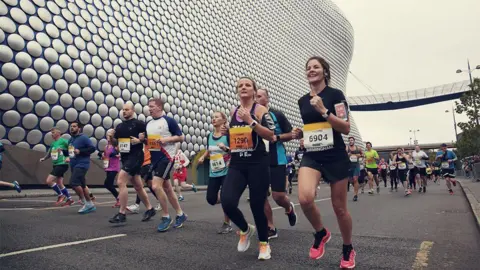 AJ Bell
As the days are get brighter and warmer, millions of runners have been taking to streets and trails to get ready with peak racing season under way.
As well as the iconic Manchester and London marathons, taking place last weekend and this, the West Midlands has its own calendar of races across the year.
From the AJ Bell Great Birmingham Run and the Birmingham Black Country Half, to the Shropshire Way 80k, Coventry Half, Potters 'Arf and Shakespeare Marathon and Half - many people will be taking on races for the first time.
Experienced runners have shared their top tips on preparing for race day and how to keep running when the going gets tough:
Gill Punt, from Bromsgrove, Worcestershire, began running nearly 30 years ago after losing her dad to cancer.
She took part in the 1999 London Marathon for him and said things snowballed from there.
The 55 year-old has raised almost £2m for cancer charities and hopes to reach her goal when she runs the London Marathon again this month.
She has also completed the six world marathon majors and earned two Guinness World Records for fastest marathon in an animal costume and fastest ice marathon.
"Respect the distance," she said, "Train steadily and don't panic if every run isn't perfect."
"Start slower than you think - the marathon rewards patience.
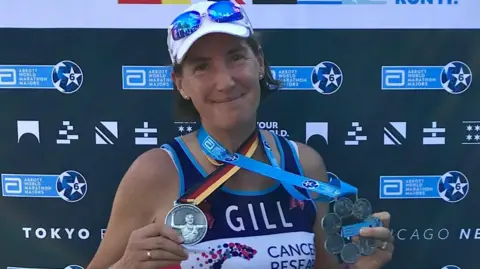 Gill Punt
"Fuel early, drink often, don't wait until you're thirsty or tired," she added.
She said that "knowing your why" for taking part was vital.
"It will carry you further than any training plan," she said.
Punt said breaking down the distance into small chunks helped mentally.
"Think: 'One mile at a time', look up, smile, take in the crowd... the energy you give out comes back to you," she told the BBC.
"When it gets really tough, dedicate each mile to someone who needs you to keep going."
'Race day is your victory lap'
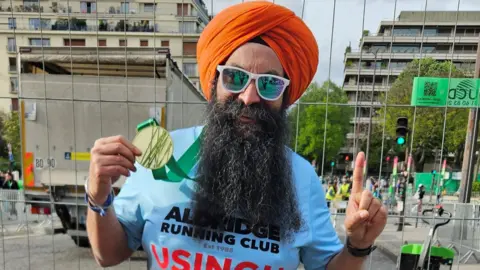 Kulwinder Cheema
Barinderjit Singh Cheema - or Barry as he's known - is from Walsall and first ran the Great North Run in 2006 followed by his first marathon - London - in 2007.
The marathon is his favourite distance - he has run 69 of them along, with about 80 half marathons.
He has raced London many times, as well as locally in the Birmingham Half, and travelled abroad to places like Paris, Berlin, Tokyo and New York. Much of the time he raised money for charities like the Teenage Cancer Trust.
Cheema runs under the name Usingh Bolt after being given the nickname by a cousin in 2011.
"The race day is your victory lap, it's the culmination of all the hard work and sacrifices you've made up until that point," he said.
"In that last week, when it comes to your diet, don't make any drastic changes... decrease your protein, increase your carbs... don't suddenly try something completely different that you've never tried before."
'Focus on one mile at a time'
He recommended chatting to people at the start line to combat nerves, or listening to music or a podcast.
"While you're running it, try not to listen to music, because the energy from the crowd is the best thing," he said.
"If you can somehow have your name or nickname on your running shirt, that can be such a help... having random strangers constantly shouting your name at you.
"If you start to struggle and you're feeling that your pace is dropping, just focus on one mile or one kilometre at a time."
Like Punt, he said remembering your "why" is vital.
"I think when you're running for charity, that's a big help - focus on why you're running, who you might be running for," Cheema said.
Eyes on the finish line
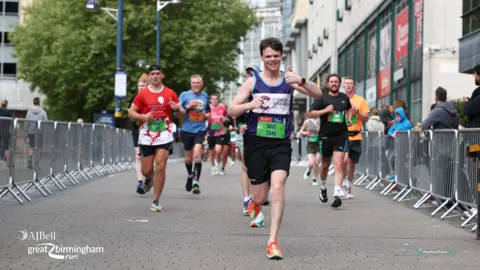 Dave Pullin/Marathon Photos Live
Dave Pullin, from Bedworth, Warwickshire started his running journey in school, before taking part in half marathons from 2015.
He has run in the Special Olympics in Birmingham, winning gold in both the 100m and 200m.
Pullin challenged himself to cover 30km (18.6 miles) each month from his 29th birthday until his 30th birthday in June, to raise money in memory of his mum Marcia, who died from cancer in 2022.
Pullin hopes to run his first full marathon next year, but said he loved completing half marathons.
He recommended carb-loading the week before a race, and doing shorter runs in the lead-up to the actual event.
"The 5ks and 10ks, a lot of people don't use energy gels... but in half marathons I would recommend it, I would recommend using them in your training... and then usually take one every 20 minutes for a half marathon," he said.
Pullin said visualising the finish line helped when things get tough.
"Even if they don't get a fast time, just completing it, they should be so proud of themselves," he said.
"In big races like the Coventry Half and like the London Marathon... the crowd will keep you going.
"I've got a saying, and it is that 'every stride tells a story'... so every footstep a person takes in the race, that tells a little bit more of their story.
"When they reach that finish line, that is the end of their story... they've done what they wanted to do."
Follow BBC Birmingham on BBC Sounds, Facebook, X and Instagram.
