Turner Prize nominee's artwork unveiled at station

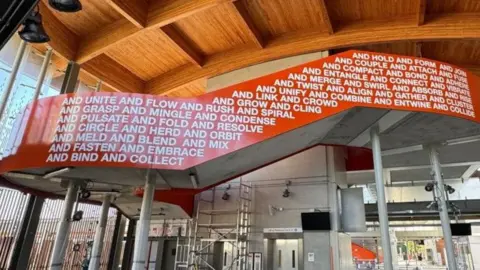 Network Rail
A Turner Prize nominee has created a piece of public artwork for a new railway station that is due to open on 28 June.
Mark Titchner was nominated for the prize in 2006 and his work focuses on an exploration of words and language.
The "Together We" artwork at Cambridge South station draws upon his research into the physician William Harvey, who studied at the University of Cambridge in the 1590s and was the first physician to recognise the full circulation of blood in the human body.
"This commission has enabled me to create a long‑form public text work, something I've wanted to pursue for a long time," the artist said.
"I hope the piece gradually reveals itself to those who use the station offering moments of reflection as they move through their daily journeys."
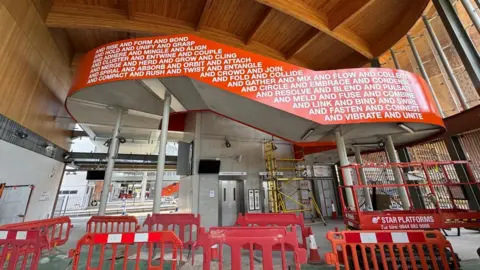 Network Rail
Titchner's artwork, which was commissioned by the regional rail company GBR Anglia and the project steering group, has been installed on the balustrades of the station's stairways.
It focuses on the circulation and coming "together" of people, with its origins in circulatory systems, both medical and in transport, according to Network Rail.
As part of the commission, Titchner will lead assemblies in three city primary schools to help them develop posters inspired by his art.
Cambridge South will be the third railway station for the city and is next to Addenbrooke's Hospital/Cambridge Biomedical Campus, and the expanding housing estates at Trumpington.
Grace Thorne, director at visual arts consultancy Commission Projects, said she was "delighted" to have brought "his practice to a wider Cambridge audience".
Sanjay Patel, GBR Anglia sponsor for the station project, said: "When customers enter the station, they will be presented with Mark's concept giving them an opportunity to enjoy and consider what it means to them before catching their train service."
Do you have a story suggestion for Cambridgeshire? Contact us below.
Follow Cambridgeshire news on BBC Sounds, Facebook, Instagram and X.
