Will King's US visit lead to lasting reset in relations with UK?
The jokes landed, the warm words resonated, the pageantry looked good on the evening news.
But as the applause fades and the plates are cleared from the White House banquet, what from the King's historic visit to the United States will sustain? How much of the pomp will translate into politics?
Before King Charles arrived in the US, British diplomats were pragmatic about how much the state visit could achieve. They knew it could not reset the UK-US relationship entirely. The differences over Iran, Nato, Ukraine, trade and President Donald Trump's rhetorical barbs against Sir Keir Starmer were too deep to be overcome by one royal tour.
Diplomats hoped instead the visit could at the very least change the tone and lower the temperature between London and Washington.
Sir David Manning, a former UK ambassador to the US, told the BBC before the trip the King was "a stabiliser, a shock absorber" who could "provide a better climate for re-engaging with the Trump administration over some of the very difficult bilateral issues".
To that end, the King may have achieved his task.
With a charm and humour that many British politicians would envy, he used his two speeches to praise the US, its people and its leaders in a way that perhaps only an outsider could venture.
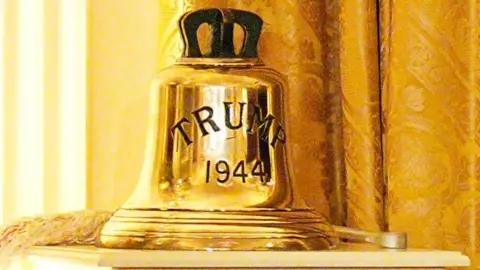
His gift for the president of an "HMS Trump" ship's bell was a masterstroke of deft diplomacy.
And before an audience that is so polarised, the King gently reminded Americans of where they came from and what united them as a nation. He spoke of "the living mosaic of the United States", praising it and the UK both as "vibrant, diverse and free societies".
The Republican senator and Trump supporter, Lindsey Graham, said the King had given a "much needed morale boost" for US politicians.
"Most members of Congress feel better after the speech than they did before," he said on social media. "I will admit it was a bit odd that the unifying feeling had to come from the King of England… but so be it!"

 PA Media
The King's second task was to try to pour some oil on turbulent political waters across the Atlantic.
He went about this by making a virtue of past differences, saying the strength of the relationship was demonstrated by its ability to overcome disagreements.
"Ours is a partnership born out of dispute, but no less strong for it," he told Congress. "We can perhaps agree that we do not always agree."
With such words, the King was attempting to frame the current diplomatic rows in a broader, historical context. The hope among British diplomats is that idea will sink in.
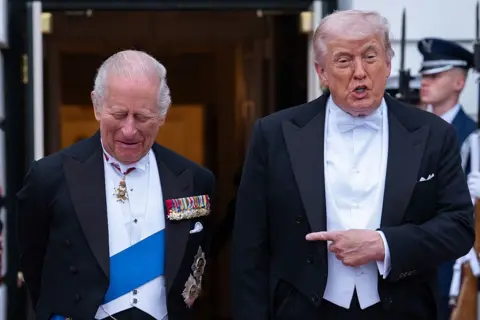
Then His Majesty cut to the chase.
 AFP via Getty Images
Amid the self-deprecating humour and romp through history, the King landed some hard arguments.
Nato, he said, had not only supported the US "shoulder to shoulder" after the 9/11 attacks, it also helps us "meet the challenges of an increasingly complex and contested world".
He said "unyielding resolve" was needed for "the defence of Ukraine and her most courageous people".
He praised "the international rules that have allowed us to trade and have kept power in balance for 80 years", rules Trump and his administration have repeatedly denigrated.
Then the King made his argument explicit: "The challenges we face are too great for any one nation to bear alone."
In that one, single line, the King challenged the very essence of Trump's entire ideology.
He emphasised the point time and again.
The Atlantic partnership was "based on twin pillars: Europe and America" and was "more important today than it has ever been".
He prayed that alliance would continue to defend its shared values "with our partners in Europe and the Commonwealth and across the world" and that "we ignore the clarion calls to become ever more inward-looking".
The King's message was more Alliance First than America First.
So the test of this state visit will not be how well the ceremonies, speeches and walk-abouts pass off.
 Pool/Getty Images
There have been a few hiccups: the leaked remarks of the UK ambassador, Sir Christian Turner, questioning the idea of a "special relationship"; Trump's claim the King agreed with him Iran should not have a nuclear weapon. But those are just bumps on the diplomatic road.
Nor is it likely this state visit will guarantee Trump will not badmouth Starmer sometime in future. This is, of course, a president willing to pick a fight with the Pope.
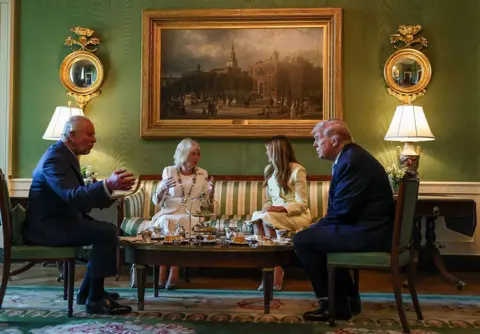
What may matter more is whether the legacy of the undoubted personal warmth between the British sovereign and his American counterpart can be leveraged into a more stable relationship between their governments.
That will depend in part on what the UK does. Will it avoid cheap shots at Trump that go down well politically at home? Will it spend more on defence so it can once again be the independent security actor it once was?
No amount of royal soft power will reassure US generals worried about the UK's lack of hard power.
Brett McGurk, former Middle East adviser to four presidents, told CNN: "If the King's speech could actually translate into some shared interests and burden sharing, there is an opportunity. If you look at what's happening with Ukraine, we really need the Brits - and their Navy with us in the Strait of Hormuz."
Much too, though, will depend on Trump and his administration and whether they are swayed more by the King's arguments than his charm.
Will they once again come to realise the value of alliances – or will they continue to plough their own path? On that, the proof of the state banquet pudding will be in the eating.
In the last 24 hours, the King has shown his class. It's now up to the politicians to make it count.
