Grandchildren of Monty revisit his WW2 caravans

 PA Media
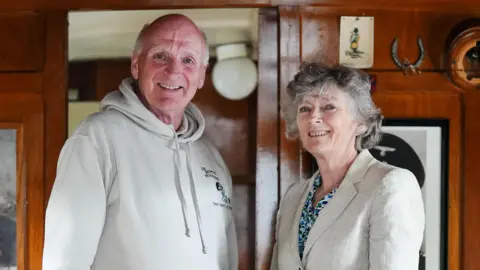
Three caravans used as mobile headquarters by the decorated World War Two general, Field Marshal Bernard Montgomery, have been visited by two of his grandchildren.
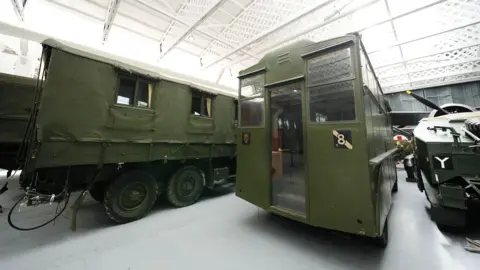
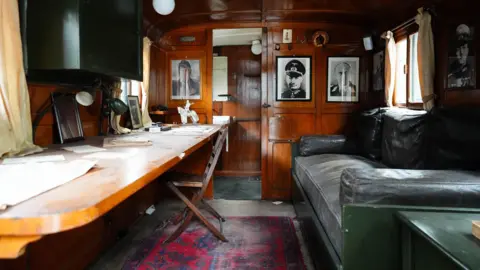
Field Marshal Montgomery, known as Monty, conducted his campaign in north-west Europe from three command caravans – one for his office, one for his bedroom and one for his map room.
All are currently undergoing restoration work at IWM Duxford in Cambridgeshire, and are expected to go on display as part of a new exhibition.
His grandson, Henry Montgomery, 72, said visiting the caravans on Wednesday was a "special opportunity to evoke such wonderful childhood memories, dating back to the early 1960s".
Henry Montgomery is currently travelling around Britain in the footsteps of his grandfather, gathering stories for his podcast and fundraising for Operation Remembrance — the education programme of the British Normandy Memorial.
The 4,000-mile challenge, called In Monty's Footsteps, aimed to uncover personal memories of D-Day and World War Two.
 PA Media
Montgomery, who died in 1976 aged 88, bequeathed the caravans to Imperial War Museums (IWM).
The mobile headquarters allowed him to be close to the front line, sometimes only a few miles away from the battle, and separate himself from the rest of tactical headquarters.
For a time after the war, they were kept in a large shed in his garden and his grandchildren recalled playing inside them.
Henry, who worked in agriculture all his life, was joined by his sister, and Montgomery's granddaughter, Arabella Stuart-Smith, 69, at the museum.
"My sister Bella and I were given an enormous amount of freedom to play in his garden, particularly in his campaign caravans, which were kept in a large shed," he added.
"My favourite was the map room.
"I think that is where Bella and I played most of the time."
 PA Media
Stuart-Smith also recalled visiting the caravans as a child, adding: "We'd always go to the caravan shed after lunch.
"One had a bed and a writing desk, another a table and chairs, and the map room fitted out with field telephones.
"I am amazed that we didn't scribble some of our own 'graffiti' on those maps!
"Later, I visited grandfather on my own sometimes and always found my way to the caravan shed, by then more aware of where the caravans had been and the significance of them."
Do you have a story suggestion for Cambridgeshire? Contact us below.
Follow Cambridgeshire news on BBC Sounds, Facebook, Instagram and X.
