GPS tracking of bailed suspects to start next year, says Swinney

 Getty Images
GPS tracking of people on bail, including those suspected of domestic abuse, is to begin in parts of central Scotland next year, John Swinney has confirmed.
The first minister updated parliament on his plans for a pilot scheme in Tayside, Fife and Central during a Scottish Parliament debate on tackling violence against women.
It came after he spoke to domestic abuse survivors and relatives of victims at a Holyrood meeting hosted by Scottish Conservative leader Russell Findlay.
The government has been criticised over the slow rollout of GPS equipment, which is used far less in Scotland than in some other countries.
Swinney announced plans for the GPS tracking pilot in the annual programme for government earlier this month.
He confirmed to parliament on Tuesday that regulations to launch the pilot scheme in the Tayside, Central and Fife sheriffdoms - to be led by Sheriff Principal Gillian Anne Wade KC - would be laid before the October recess, and that ministers were aiming to begin the rollout next year.
He insisted the pilot would be "subject to robust local arrangements" to ensure public safety.
The programme for government also included plans to make permanent a £2m fund providing practical and financial support to women and children escaping abusive partners.
The government has further vowed multi-year funding for charities that deliver crisis support to women and girls.
And it announced plans to recognise misogyny as a "distinct form of prejudice and abuse", alongside a public health campaign to target toxic male behaviour.
However, the brother of a woman murdered by her estranged husband in Renfrewshire this year said previously that the proposals were not "anywhere near good enough".
Stacy Hunter, 35, was killed by Jim Mair, 43, at her home near Houston in July while he was on bail for attacking her. His body was found nearby.
Sean Hunter - who attended the meeting at Holyrood before the debate - has called for immediate action to prevent further deaths.
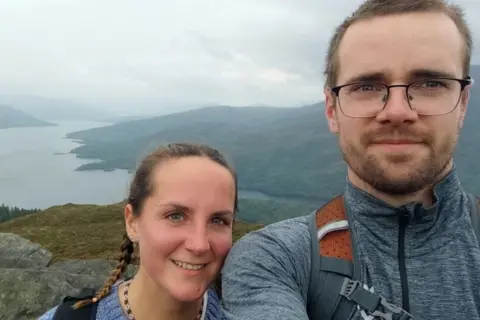 Hunter family
Speaking to BBC Scotland News the day after his sister would have celebrated her 36th birthday, he said GPS monitoring would "absolutely make a difference".
But he called for authorities to consider more specific offences when making decisions about bailing domestic abuse suspects.
"There's so much - strangulation, attempted murder - that's going on that's being overlooked because it's coming under this umbrella of domestic violence," Sean said. "That shouldn't be the case.
"When these people commit these crimes they need to be looked at for what they are and kept from harming more people."
Liz Shanks, whose former partner Chris Forrest was jailed in 2022 for attacking her over a three-year period, also spoke to the first minister at Holyrood.
The campaigner said survivors and victims had been let down by the justice system and that the meeting must not be a "media stunt".
She called for reforms to tackle domestic abuse, and warned that victims may be reluctant to come forward if they do not feel the justice system is dealing with the issue robustly.

Opening the debate, Swinney said the so-called "manosphere" and extreme pornography had "warped views and attitudes in disturbing and profoundly harmful ways".
He vowed the government would take a "public health preventative approach" to tackle violence against women and push for stronger regulations of social media sites.
The first minister told MSPs: "We will work to build a Scotland where everyone is safe, accepted, and respected, where women and girls live free from all forms of violence, abuse and exploitation, and where all are free of the attitudes and stereotypes that perpetuate inequality."
GPS 'not necessarily a solution'
However, opposition MSPs noted a 14% annual increase in domestic abuse charges last year.
Scottish Labour's Jackie Baillie agreed with Swinney's "sincere" willingness to tackle violence against women, but said a "multi-faceted" approach was required, including a misogyny reduction unit, extra work in schools and investment in police.
Conservative MSP Stephen Kerr warned that GPS tracking was a "technology, not necessarily a solution", calling for more investment in community resources.
Scottish Tory leader Russell Findlay praised the "extraordinary bravery" of survivors but urged ministers to strengthen bail laws and "robustly enforce breaches".
He also called for ministers to scrap "ludicrous" sentencing guidelines that encourage rehabilitation rather than jail terms for under-25s.
Scottish Green co-leader Ross Greer said extra measures were required to ensure that education in schools about harmful attitudes was being consistently delivered, and raised concerns about low reporting rates.
He also called for men to "contest" harmful views expressed by their peers.
Liberal Democrat MSP Yi-pei Chou Turvey called for the government to immediately launch its plans for special sexual offences court. Swinney told MSPs ministers planned to provide funding for the scheme in the next financial year.
Reform UK Scotland's Amanda Lindsay questioned whether "some groups" committed more sexual crimes than others, calling for more data on offences against women and girls.
How does electronic tagging work in Scotland?
In Scotland, electronic tagging has mainly relied on older radio frequency (RF) equipment which is focused on home curfews or detention.
These devices are linked to a receiver in the offender's home and cannot track movements away from the property.
In 2016, an expert group recommended that Scottish authorities adopt GPS monitoring.
However, last year, the independent public body Community Justice Scotland (CJS) issued an urgent National Improvement Recommendation to the government urging it to accelerate the expansion of more sophisticated monitoring systems, including GPS.
The technology has been widely used in England and Wales since 2018 and there are plans to start imposing new restriction zones on offenders this autumn.
Victim Support Scotland welcomed the Scottish government's GPS tracking pilot, but warned it relied on a "swift emergency response to be effective" and would not be a "catch-all solution".
Carol Eden, the organisation's head of communications and external affairs, said that it had "deep concerns about the safeguards in relation to bail".
She added that more needed to be done to "protect women who are subject to domestic violence in particular, including strengthening risk assessments and incorporating victim feedback".
If you have been affected by any of the issues in this story, help is available at BBC Action Line.
