What are my children exposed to? Why I want testing for cancer-causing chemicals

 BBC
BBCWhen she moved to the countryside two years ago, Natalie Dugdale thought it would be the perfect spot to raise her family.
Close to a lagoon in north Wales, she thought she could walk her baby, toddler and dogs on public footpaths.
But when she watched Michael Sheen's BBC documentary revealing the lagoon's history as a dumping ground of cancer-causing chemicals known as PCBs, Natalie was shocked.
Now she is part of a group of people who are worried they may have been poisoned by years of exposure to toxic waste, and are campaigning for voluntary blood testing across Wales.
But Wales' public health body has said it does not recommend blood testing for PCBs, saying it would cause more concern.
 BBC/Wall to Wall
Public Health Wales (PHW) said the tests did not provide "a reliable means of assessing an individual's exposure to contamination or the potential health impact".
Members of a newly formed campaign group for those living alongside some of the sites concerned have told BBC Wales they had been left "frightened and upset" and said testing would help provide "peace of mind".
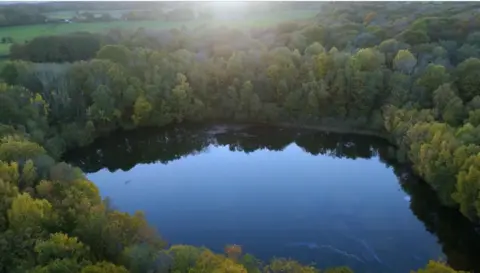
Natalie could not believe her local lake in Llwyneinion, just outside Wrexham, had actually once been a dumping ground for potentially dangerous chemicals and wants to see blood testing introduced.
"I was really upset because having young children, what are they being exposed to?," said Natalie, 33.
Llwyneinion lagoon was recently branded "a shame on Britain", following the documentary into historical dumping of PCBs by US chemical giant Monsanto, which had factories in Wrexham and Newport.
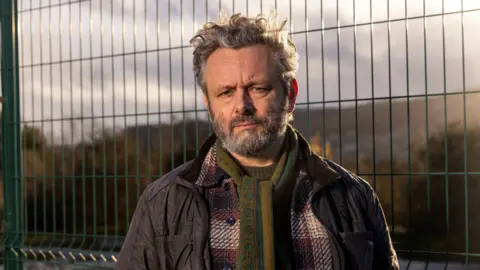
Michael Phillips played at the lagoon as a child and decades later developed a rare cancer in his shoulder. He said many of his other friends had died because of similarly rare cancers, which he now suspects were linked, although no proven link has been established.
"I would say every person that played in the pool that was close to me, apart from one friend who had an operation to get rid of it, is dead," said Michael, 63.
"It's got to stop."
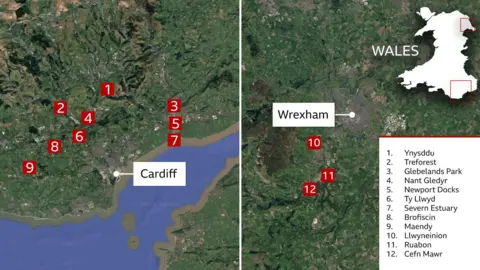
Sheen's Buried programme team found elevated levels in soil samples taken in an area open to the public beyond the fenced-off lagoon, as well as at 13 other suspected dumpsites for the firm's toxic waste across the country.
 BBC/Wall to Wall
Michael Phillips was also found to have "very high" levels of PCBs in his blood, after private testing commissioned for the documentary.
The banned chemicals were once widely used and revered for being non-flammable and hard to break down – but are seen today as the first "forever chemicals" - which are building up in the environment, threatening wildlife and human health.
Michael and Natalie have both now joined a newly formed campaign group - made up of hundreds of residents living alongside the former Monsanto works in the villages of Cefn Mawr, Acrefair and Trevor in north-east Wales.
One of their calls - alongside a national soil testing programme - is for voluntary blood testing, led by Public Health Wales.
One of the group's founders pointed to the fact the documentary had to rely on a large-scale study from the US to assess and compare PCB levels in the local residents it had tested.
"There's a huge potential here for Wales... to really lead the way and show the rest of the UK how to handle this risk," said community councillor Katie Witherden.
"It would give people answers about what they have or haven't been exposed to - and I think all of us deserve the right to have the choice to know that."
Nel Byers said that blood testing was needed "for people's own peace of mind" as well as showing "on a national scale" whether these communities had heightened results.
"If they get the blood testing done they might actually start doing something about [the dumpsites]," said the 33-year-old from Trevor.
 Google
Public Health Wales issued a statement in response to calls from residents and politicians - including the Welsh Affairs Select Committee of MPs - saying a programme of blood testing was "not recommended".
It argued that testing would "not tell us how or where people may have been exposed" as there were many potential PCB sources in the wider environment - including food, and materials in homes and buildings.
There was no treatment for higher levels of the chemicals so there was a risk too of "causing worry among people who are found to have PCBs in their blood", it added.
Natalie said she found the response "disappointing", adding: "I think a lot of people are already frightened and it's more frightening not knowing."
Katie agreed that "people are already worried" and said: "We know they can't treat PCBs and that's not what we're asking for."
Her husband Steve Witherden is the Labour MP for Montgomeryshire and Glyndŵr and described PHW's response as "chilling".

"My hope is that they revise their position," he said.
"There's a real strength of feeling from people who've lived near to these sites or worked in them, a real clamouring."
The debate comes after privately funded testing found high levels of other so-called forever chemicals in dozens of people living near a chemical factory in Lancashire.
Dr Dave Megson, of Manchester Metropolitan University, who was also involved in the Buried documentary testing, argued the US and other countries in Europe were well ahead of the UK in advancing the use of blood testing for alleged chemical contamination.
While it could not prove that cancers and other health impacts were caused by PCBs, he argued: "There's so much information that we can pull out if you use those non-standard tests and do some advanced science."
Public Health Wales has acknowledged the health authority's refusal to back calls for blood testing was "a difficult message".

"We appreciate that the communities are worried and that is understandable, but the testing isn't necessarily going to give any good answers," said Prof Sarah Jones, consultant in environmental public health at PHW.
"Generally when we do any sort of testing we want to be able to put things right for people and that's what we can't do here."
She argued that there were too many "unknowns" about the impacts of concentrations of PCBs on the body and no treatment for those found to have elevated levels in their blood.
"All we could do is give [people] a number that we can't really interpret and then we can't make right."
She felt this could "create even more worry and that is a health harm in itself."
"There is nothing that blood testing can do that would magically take those worries away - it would only potentially magnify them," Jones said.
Asked whether the cost of implementing a blood testing regime was also a factor, she said: "No... this is not about money."
Rather than blood testing, Jones argued public authorities should focus on taking "whatever steps need to be taken to make these [suspected dumpsites] as safe as possible".
Dr Will Mackintosh, from the Royal College of GPs Cymru, said it may be that "additional support" will be required for GPs in communities where concerns have been raised about alleged contamination in future.
"It's clearly something which obviously large numbers of people are concerned about, and general practice has a role in responding to that as best as we can," he said.
The Welsh government has said that "addressing the issue of contaminated land is a key priority for this government".
"We will develop a Wales-wide strategy to progressively restore post-industrial land so that communities are no longer exposed to potential risks," the government said.
"This will include strengthening the 'polluter pays principle' while we continue to press for environmental justice by raising the importance of seeking UK Government funding direct with the UK Treasury.
"This should be used to continue our joint efforts to address the legacy of Wales' industrial past through restoring coal tips and remediation of contaminated land."
Monsanto does not exist any more and Eastman Chemical Company, responsible for the firm's legacy production in the UK, has not responded to BBC Wales' requests for comment.
