EMR services 'unacceptable', says transport secretary

 BBC
BBCTransport Secretary Heidi Alexander has apologised for East Midlands Railway (EMR) services being "unacceptable" due to problems with a new fleet of trains.
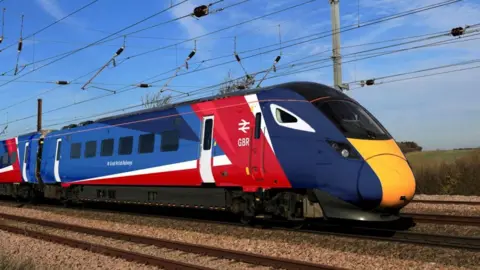
Issues with the new Aurora (Class 810) fleet led to months of delays, cancellations and overcrowding on services, as well as strike action by RMT union members.
During a visit to Derby on Thursday for the announcement of the location of the new Great British Railways (GBR) headquarters, Alexander said: "I recognise people have received an unacceptable service this summer and I apologise for that. It's not good enough."
She also told the BBC the company "must improve" before it is expected to be renationalised by the end of 2027.
EMR's new Aurora (Class 810) fleet, made by Hitachi Rail, entered service in December 2025 but has experienced problems since then which prompted calls for strike action back in April.
Planned 24-hour walkouts on16-17 September were called off following talks between EMR and the RMT union.
"Action Short of Strike" from RMT members is still in place which means trains may be subject to short notice alterations and cancellations, EMR said last month.
 PA Media
In July, the operator announced a temporary reduction in services due to reliability and maintenance issues with the new trains.
Its Intercity timetable running to and from London St Pancras, was reduced to 87%, meaning some services were cancelled and others had fewer carriages, which led to delays for passengers and overcrowding on trains.
The RMT union that represents EMR staff announced strike action later in July, while the managing director of the rail firm stepped down amid problems with the Aurora fleet.
EMR increased its Intercity operation to 92% on 1 September, following "improved operational stability" and said it now had "greater confidence" in increasing services to 96% from 19 October.
Despite this, Alexander said she was still "determined to proceed with the renationalisation of the railway".
Renationalisation is part of the government's plan to improve rail infrastructure, cut train delays and improve experiences for passengers.
Eventually, all rail passenger services delivered under contracts with the Department for Transport (DfT) are expected to become part of a new organisation called Great British Railways (GBR).
The government said the move would save £150m a year, by ending payments to private sector operators.
Several rail firms are already publicly owned, including Great Anglia and South Western Railway, while Avanti West Coast train services will be nationalised from March.
The process to transfer EMR into public ownership can start from Sunday, which is the core term expiry date, the earliest date the government can choose to end EMR's contract without a penalty.
 East Midlands Railway
However, Alexander said GBR would not resolve issues, such as driver and staff shortages, delays, cancellations and punctuality overnight.
"I've always been clear that the renationalisation of the railways is not going to be a silver bullet that transforms things overnight," she said.
"This is going to take time because you have to get the basics right of investing in the infrastructure, making sure that you've got reliable infrastructure, you also need to be investing in rolling stock.
"So we've been clear with East Midlands Railways that, prior to that private company coming into public ownership next year, they have to improve the quality of the service that people are receiving.
"That is why we're renationalising those private train operating companies and we will make sure that we get the basics right and that we put the railways at the heart of building strong, sustainable local economies, giving great opportunities for the next generation."
EMR said the DfT had not formally told the company the date it would be transferred into public ownership.
A spokesperson for EMR said: "The reduced timetable became necessary due to a three-year delay to the delivery of the new Class 810 trains and after the performance the new trains and Hitachi Rail's maintenance of EMR's existing Class 222 fleet has significantly impacted upon EMR's ability to run a consistent Intercity service for customers.
"Last month, we were able to raise the number of services back up to 92 per cent of the planned Intercity timetable and on October 19 they will return to 96 per cent. In the meantime, we are continuing to work closely with Hitachi Rail, a world-renowned manufacturer and maintainer, and the DfT Operator to identify the steps needed to support further increases to the timetable.
"We are sorry for the disruption and inconvenience that our reduced timetable and Intercity fleet issues have caused our customers, and we are committed to restoring our full-service level as soon as possible."
Listen to BBC Radio Derby on Sounds and follow BBC Derby on Facebook, on X, or on Instagram. Send your story ideas to eastmidsnews@bbc.co.uk or via WhatsApp on 0808 100 2210.
