How Isle of Man became home to the world's most dangerous road race

 Manx National Heritage
Each year quiet villages, open countryside, and public roads transform into a symphony of roaring engines, bustling crowds, and pure speed - at the Isle of Man's TT Races.
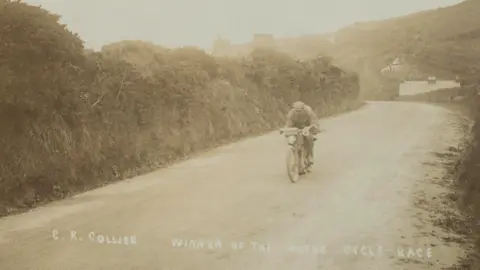
The motorcycle event has taken place since 1907, and is widely regarded as the most dangerous and exhilarating road race in the world, with 270 deaths between it and the annual August Manx Grand Prix.
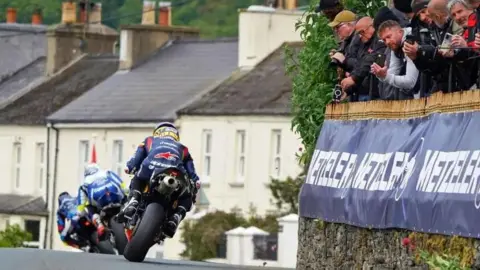
Riders take to the 37.75-mile (60-km) course on closed public roads, with spectators able to watch just feet away from the hedges, verges, and viewing platforms around the island.
But how did a small island in the middle of the Irish Sea become home to a race unlike any other?
Social history curator Matthew Richardson at the Manx Museum said the answer lay in politics, tourism, and a stroke of luck.
How did it start?
Richardson explained that by the early 1900s, wealthy car enthusiasts were looking for somewhere to test their machines, but the UK government opposed road racing on public roads.
The Isle of Man however, with its own parliament, could make different laws.
"The chairman of the RAC was a cousin of the governor so he could get the necessary legislation through Tynwald," Richardson said.
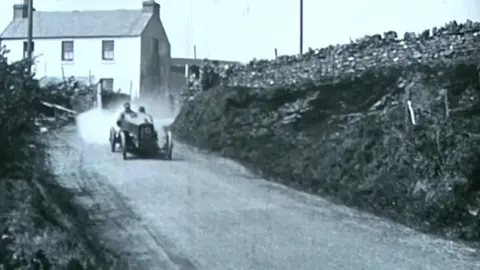
The motorbike race therefore "grew out of the motorcar race", which had been on the island since 1904.
It became the solution to the search from motorcycle enthusiasts for a place to hold their race, with the relevant permissions already granted on the island.
The first ever TT motorcycle race in 1907 was "slipped inside the programme for the motorcar race the same year" and over time the motorcar race "gradually died out".
 Manx National Heritage
One surviving relic from that first TT still sits in the Manx Museum - a hip flask presented to winner Rem Fowler.
Richardson said the gesture was apt, as Fowler had admitted in his memoirs that nerves got the better of him and he took "a slug of brandy" before setting off.
'For the working man'
At the time motorcycles, unlike motorcars, were not for the elite.
"The motorbike was the working man's form of transport," Richardson explained.
As a result, the race felt more accessible than many other sporting events of the era, he explained, with fans able to watch riders compete on the same machines they drove to work.
It meant the TT retained a degree of accessibility, where fans could interact with competitors freely in the paddock area near the Grandstand in Douglas, Richardson said.
He added: "The riders and the spectators come from the same place. They all share this common passion for racing and the history and the heritage."
When did it become famous?
Richardson said that by the 1930s the Tourist Trophy had become the biggest motorcycle race in the world.
From the beginning, the event helped draw visitors to the island - which was heavily reliant on tourism - and it quickly became one of the biggest moments in the Manx calendar, Richardson said.
"Right from the outset the Manx people took the TT to their heart," Richardson added.
It was also a massive boost to the economy.
It had become so important that, after World War One, political leaders intervened to stop the races being moved to Belgium.
"The Isle of Man sent a political delegation to London to secure the TT for the Isle of Man. It was deemed to be that important," Richardson said.
While technology has developed exponentially over the past 119 years, the challenge itself has barely changed.
Since 1911, competitors have tackled what is essentially the same course, despite motorcycles evolving from what Richardson describes as "basically just push bikes with an engine" to highly specialised machines.
 IOM TT
The TT's impact on manufacturing
Richardson said there was "no racing circuit in the world that's as tough as this".
"There isn't one that's got a mountain, a genuine mountain that you have to climb to get over the course."
For that reason, the races became a test of the machines' ability, which pushed manufacturers to improve reliability, speed, and engineering, he said.
Manufacturers travelled to the island to test new technology against steep climbs, changing weather and unforgiving roads.
"The challenge was to build a motorbike that could be successful at the TT," Richardson said, adding that success on the course became a mark of engineering credibility.
The TT also played a role in reshaping the global motorcycle industry.
When Japanese manufacturer Honda arrived in 1959, it came with ambitions to break into European markets and by the end of the 1960s, Richardson said, the company had "won everything there was to win".
More recently electric motorcycle teams have also used the TT as a testing ground, with the island remaining "a place where testing and improvement go on continually", he added.
'Symbol of independence'
More than a century later, the event has become deeply woven into the island's identity.
Richardson said: "We say it's part of the Isle of Man's DNA really now."
He also said it was especially unique because of the system that allowed it to exist in the first place.
With the island's independent parliament able pass laws to close roads in the early 20th Century, the TT had become a "living symbol of the Isle of Man's independence", he said.
Read more stories from the Isle of Man on the BBC, watch BBC North West Tonight on BBC iPlayer and follow BBC Isle of Man on Facebook and X.
