Will Aberdeen's energy future decide the by-election?

 BBC
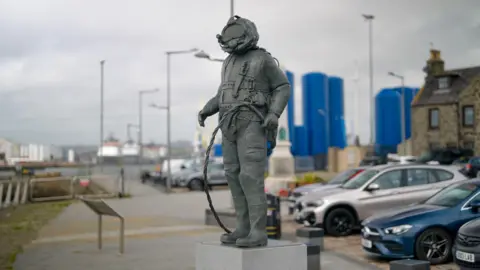
BBCAs the ships at Aberdeen Harbour come and go, they pass a memorial to 103 deep sea divers who lost their lives working in the North Sea.
That's where we met James, who was cleaning the bronze figure.
A former diver himself, he was actually the model for the statue. His career saw him descend to depths of over 200 metres, sometimes carrying explosives, to carry out pipeline repairs.
It was a dangerous job which he concedes could "bite you" if you were not careful.
And he's keen to reflect on the significance of oil and gas, an industry he says is "massively important" to this part of the world.
Perhaps that's why it seems to be the terrain on which a looming by-election is being fought.
Voters in Aberdeen South will head to the polls on 18 June.
It's one of three by-elections that day. There's one in nearby Arbroath and Broughty Ferry and another in Makerfield, Greater Manchester.
That final contest could have big political ramifications, with Andy Burnham trying to get into Westminster to rock the Labour Party boat.
But we shouldn't underplay the importance of Aberdeen South.
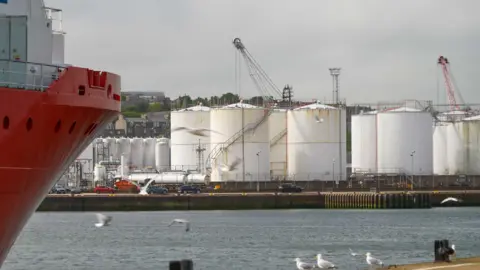
It's at the heart of the debate around the UK's energy future. A fact emphasised when the UK government chose the city as the home of GB Energy, the fledgling publicly-owned energy company.
Despite Labour's intervention here, this seat, which is up for grabs after the SNP's former Westminster leader Stephen Flynn made the switch to Holyrood, is likely to play out as a fight between the Conservatives and the SNP.
And candidates from both parties are insisting they are best placed to push forward Aberdeen's energy potential, whether in renewables or oil and gas.
But there are voices in both parties who think their own side has been getting the debate wrong.
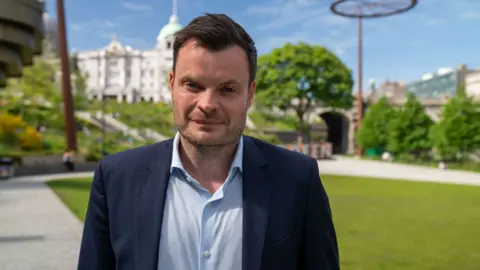
Geoff Aberdein used to be Alex Salmond's top advisor - he was chief of staff to the former first minister of Scotland.
These days he's an energy consultant, advising both oil and gas and renewables companies.
He's keen to stress he's fully behind renewables. But he believes oil and gas need to be maintained to oversee the transition to different types of energy.
And he's furious that the SNP government under Nicola Sturgeon adopted an "assumption against" new oil and gas drilling.
He accuses the party of "going with the latest fad" when they made that policy shift.
"I just can't believe any leader of a national party of Scotland would take that decision," he says, branding it a "completely misguided" call that cost thousands of Scottish jobs.
We're still waiting on the Scottish government to outline its current energy strategy. That's been overdue for some time.
Energy policy is reserved to the UK government, but there's an expectation that Scottish ministers state clearly their position on the North Sea.
They want more devolution in this area, after all.
Aberdein says he detects a little bit more positivity on oil and gas from the current SNP leadership and he's calling on them to make clear they'll support the industry as transition to renewables takes place.
John Swinney recently said that proposed projects "must take into account the need for energy security for households and businesses in Scotland", suggesting he's becoming more sympathetic to Aberdein's position.
Aberdein thinks more positivity on oil and gas can secure the SNP victory in this by-election, but warns "the Tories are really smelling blood".
When it comes to messaging in this area, not everyone is on the same page inside the Scottish Conservatives.
They characterise this by-election as a "referendum" on oil and gas. And UK party leader Kemi Badenoch has pledged to "get Britain drilling".
It's not quite Donald Trump's "drill, baby, drill", but it sits uneasily as a slogan for some.
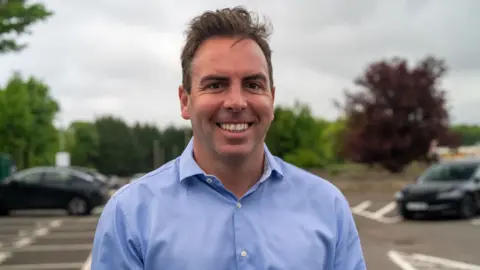
Maurice Golden is a former Conservative MSP who represented the north-east of Scotland until the recent election, when he stood down from Holyrood.
Golden was always a bit of a "green" Tory, and he finds some of his party's slogans "deeply concerning" on this topic.
He worries it's "bordering on jingoism and Trump-esque language" and shows the Conservatives are looking to "mimic Reform" in moving away from net zero.
He thinks the Conservatives previously led the way when it came to the environment and would like to see them go back in this direction.
After all, this is the party that introduced the energy profits levy, often called the "windfall tax".
All the discussions we've had so far have been about balancing carbon industries with renewables, but some in Aberdeen think there has to be a much swifter pivot to the latter.
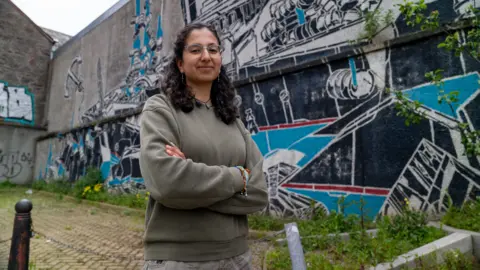
Ainhoa Burgos Aguilera is an environmental campaigner who lives in the city. She's frustrated that the debate at this by-election seems to be about weighing up fossil fuels and renewables.
"Keeping oil and gas as an industry is just going to delay achieving the climate targets and will only make global warming worse," she warns.
And she believes that only renewables can ultimately lower bills in Scotland, since any increased drilling in the North Sea will lead to oil and gas being sold on international markets.
By-elections are, by their nature, localised events. But sometimes they tap into broader issues that go far beyond constituency boundaries.
At the heart of the contest in Aberdeen South is the future of the North Sea, our energy security, and what that could mean for our bills.
It may be that constituents here want their say on the transition from an oil and gas industry that brought significant jobs and investment to a renewables future they hope will do the same.
But how quickly do they want to do that? And which party best reflects that desire?
