Ireland facing EU court case over peat extraction

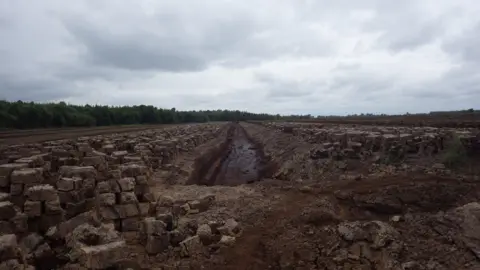 Irish Peatland Conservation Council
The European Commission (EC) is taking the Republic of Ireland to court, accusing Irish authorities of failing to properly enforce EU regulations on peat extraction.
The sale of peat as a form of fuel was banned in Ireland three years ago due to environmental concerns, but it is still commercially extracted to produce compost.
The EC acknowledged "significant action" by Ireland to reduce peat cutting by large operators but claimed it is not enforcing rules at smaller sites of under 50 hectares.
Ireland's Department of Climate, Energy and the Environment has insisted that commercial peat extraction is "a regulated activity".
However, the EC said it "considers that efforts by the Irish authorities have been insufficient" and it is referring the case to EU's highest court - the Court of Justice.
The court's mission is to ensure that EU law is followed and applied in the same way across all of the bloc's 27 member states.
Peat extraction is not illegal under EU law but it is subject to tight regulations because of the potential damage it can cause to the natural environment.
Peatlands are considered an important habitat for wildlife but they can also help mitigate the effects of climate change because they store large amounts of carbon.
Environmental campaigners from the Irish Peatland Conservation Council have welcomed the EC's legal action.
The charity's policy officer Tristram Whyte told BBC News NI that "brown deserts" had been created across the Irish midlands because of commercial peat extraction.
"They go into a bog, strip off the surface and then also drain the bog into the local rivers and lakes," he explained.
He said this has "long-reaching implications because the peat silts up the waterways but it also converts to ammonia as well which is destructive for the aquatic life".
Whyte added Irish peat extraction was "very profitable" for the horticultural industry but claimed much of this natural resource was being exported out of the country, leaving behind pollution problems and decimating wildlife habitats.
 Irish Peatland Conservation Council
What is Ireland accused of?
All EU member states must carry out an environmental impact assessment (EIA) of any project which is likely to have a significant negative impact on the environment.
But the EC has claimed that is not happening in Ireland in practice, raising particular concerns over a lack of regulation at smaller peatland sites.
In a statement announcing legal action, it said it was aware of "significant" peat cutting which was "not subject to planning permission or environmental impact assessment, especially in relation to sites below 50 hectares".
"Despite evidence of these ongoing illegal activities, enforcement action at the local level is not being taken," the statement added.
However, the EC acknowledged that over the past six years Ireland "has taken significant action to halt peat cutting by the state-owned operator Bord Na Móna".
It also acknowledged Ireland's Environmental Protection Agency (EPA) has been "undertaking enforcement action against operators on privately-owned commercial sites of over 50 hectares" which led to some firms stopping peat extraction.
What has the Irish government said?
A spokesperson for the Department of Climate, Energy and the Environment said the department "notes" the EC's announcement regarding the infringement case.
They also said the EC had acknowledged the "significant enforcement" carried out by Ireland's EPA against unauthorised peat extraction "at the largest sites".
They pointed out that the EPA inspects peatland sites and its inspection reports have been published on its website and shared with the EC.
The department explained that in Ireland, a pollution control licence is required before commercial operators can extract peat from sites which exceed 50 hectares.
For sites stretching between 30 and 50 hectares, planning permission from a local authority is required in addition to an EIA.
It said in the case of sites of under 30 hectares, planning permission "may" be required if extraction is likely to have a significant effect on the environment.
The department added that enforcement at smaller sites was a "matter for planning authorities and the Department of Housing, Local Government and Heritage".
However, the Department of Housing told BBC News NI it has "no role" in enforcement or imposing penalties "outside of providing the legislation".
Its spokesman added that city or county councils are responsible for the planning system, including "enforcement relating to breaches of planning legislation".
"Where an individual does not comply with an enforcement notice, the planning authority can take the matter to court," the Department of Housing said.
They said if found guilty "an individual may face a criminal conviction and a fine and/or a prison sentence".
Domestic turf cutting 'not affected'
Peat - when it is cut and dried for fuel - is known as turf in Ireland.
Turf-cutting is a deep-rooted tradition and for centuries generations of rural Irish families dug their own turf from local bogs to heat their homes and cook hot meals.
More than a decade ago, the introduction of EU restrictions on turf-cutting at 53 protected bogs led to defiant protests in some rural communities.
In 2022, the Dáil (Irish Parliament) voted to restrict the commercial sale of turf but the rule allowed exemptions for small-scale turf cutting for domestic use.
The Irish Peatland Conservation Council's policy officer said the EC's current legal action will not affect domestic turf cutting exemptions in any way.
Whyte said the case was aimed at regulating industrial-scale peat mining which was still being allowed to proceed "despite its well‑documented environmental impacts".
"Ireland must demonstrate that it takes its environmental responsibilities seriously," he added.
