Teen was 'anything but safe' in mental health unit
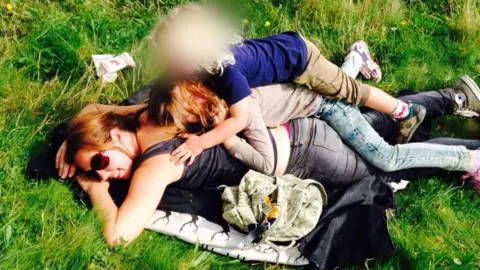 Family photograph
A teenager admitted to a mental health unit was able to burn himself and injure his head - despite requiring supervision by staff, his mother has said.
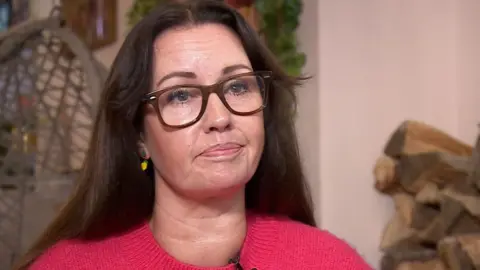
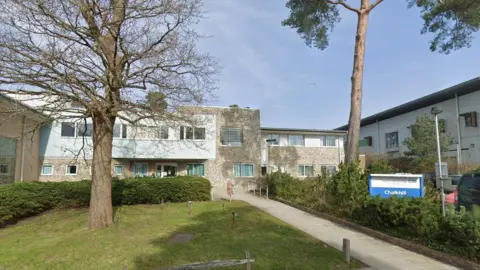
Lucy said Chalkhill Hospital in Haywards Heath, West Sussex, where her teenage son was admitted in September 2024, was supposed to be a safe place but "was anything but".
Chalkhill - which was temporarily closed but is set to reopen later this year - is a hospital for young people between the ages of 12 and 18 who need assessment and treatment for acute mental health needs.
Sussex Partnership NHS Trust's chief medical officer, Dr Oliver Dale, has apologised to the family and said he was "completely shocked" by their experiences.
On one occasion, Lucy described her son needing a CT scan after repeatedly banging his head.
She said her son had also been able to access a boiling water tap.
"He was able to hold his hand under this tap for 30 seconds and cause a second-degree burn," she said.
There was another occasion where she said he lay under the covers of his bed and "managed to tie a ligature and was left there, unobserved, for 20 minutes".
Lucy does acknowledge that her son's behaviour could be challenging and that he engaged in "very risky behaviour".
She said: "He was on two-to-one eyesightand arm's reach, which means that at all times he should have had two staff there within arm's reach, who are able to see him as well.
"Clearly that wasn't happening."
Lucy said that after her son - who is now 18 - was admitted, it soon became clear he was not getting the support the family had hoped for.
"Within the first week, he was being restrained quite brutally and I know this because I've actually witnessed it myself," she said.
"Often it would take six grown adults to restrain him.
"He would also be injected multiple times during restraints with various different medications to tranquilise him quickly."
She said it was "something nobody should ever have to see or witness, seeing my child in so much pain and being treated inhumanely some of the time".
She emphasised is was not by all the staff, but said "there was some staff who were - there is no other word for it other than brutal".
 Mark Norman BBC
Dale said it was important to understand "some of the challenges we have to work with, in terms of looking after people when they are a risk to themselves".
He said sometimes medication and restraint was required when looking after people with "very serious, complicated needs in great distress" and it could be "very challenging for the individual, the family and the staff".
He added: "Our patients are sometimes intent on harming themselves. We need to work in a way which is compassionate and calm.
"When you restrain people, it's a very difficult thing to do. Our staff are trained to do it safely, [but] sometimes that requires a group of six people to do it in a way that is safe, otherwise people can get injured."
'Ineffective observations'
A year before Lucy's son was admitted to Chalkhill, the Care Quality Commission (CQC) carried out an inspection of the facility after receiving "information of concern".
The CQC reported a number of safety issues including high levels of incidents leading to harm, poor staff training and competence, low staffing numbers, ineffective observations of young people, and poor leadership and support.
The hospital was temporarily closed by the trust in 2025, which said at the time it was working with children, young people and families to review and improve the model of care it provided at Chalkhill.
 Google
Dale said when he met Lucy's family, he was "completely shocked" by the experiences he heard.
He said: "The care at the unit wasn't delivered consistently in a way that we would aspire to in terms of being compassionate, thoughtful and inclusive of those using the service."
Explaining what had gone wrong at Chalkhill, he said the issue was complicated.
"Some of it has to do with the fact that our estates were substandard and it was difficult to make improvements whilst the hospital was open," he said.
"But some of it is also about the clinical model that people were working with, and by that I mean the ways the different staff work together, the way we involve families."
The trust plans to re-open the unit towards the end of 2026.
"We will be opening with an entirely new team," Dale said.
"We will be also drawing on our parents and young people in appointing that team and supporting them in reopening it, and the running of the hospital going forward."
- If you have been affected by any of the issues this article has raised, there is advice and support available on the BBC Action Line pages.
Follow BBC Sussex on Facebook, on X, and on Instagram. Send your story ideas to southeasttoday@bbc.co.uk or WhatsApp us on 08081 002250.
