Fires still burn in charred landscape as focus turns to wildfire prevention

 RSPB Scotland
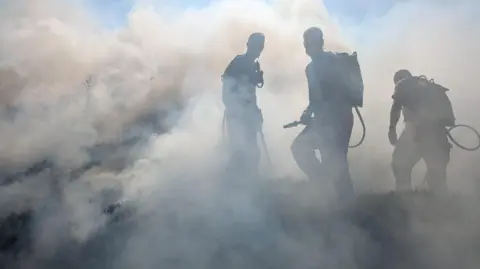
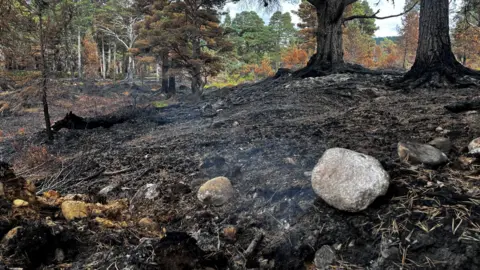
As we're driving in a pickup truck to see the aftermath of a huge fire which burnt for more than a month in the Cairngorms, I spot fresh smoke coming from the ground.
My guide - RSPB Scotland's site manager at the Abernethy nature reserve, Ben Oliver-Jones - puts the vehicle in reverse and we jump out to see what's happening.
It's one of several hot-spots which keeps emerging a full week after firefighters left the scene, which Ben likens to a game of whack-a-mole in an already charred landscape where the smell of burning still hangs heavily in the air.
But while the small pockets of smouldering vegetation are still being dealt with, attention is turning to improving wildfire protection.
More than 2,500 hectares of moorland and forest - about 10 square miles - was destroyed in the fire, which led to the evacuation of an entire village and where the smoke could be seen and smelt 60 miles (96.5km) away in Aberdeen.
Like a growing number of Scotland's estates, the Loch Garten and Abernethy nature reserve is being managed for ecological restoration - what others might describe as 'rewilding', a now polarising term which the RSPB avoids using.
Opponents have argued that the process leaves areas more vulnerable to uncontrollable fires, which the charity disputes, but it has identified significant land management changes it plans to make.
The changes focus on four key areas: fire breaks, wetlands, heather management and tree planting.
Wider fire breaks
While the estate's network of tracks functioned as a fire break in some locations, in other areas strong winds helped high flames jump the gap.
Experts say fire from burning heather can reach heights of six metres and that fire breaks need to be three times the flame height.
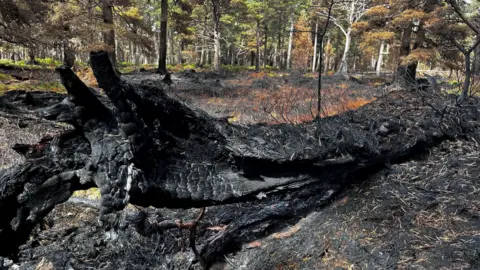
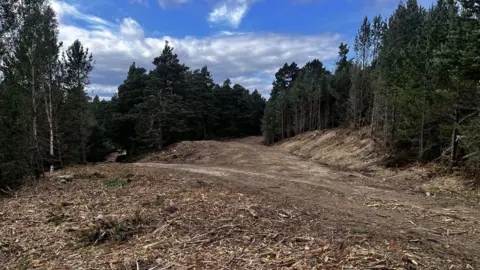
RSPB Scotland says it now acknowledges that fire breaks need to be wider and has already started that process on its long network of forest trails.
Machines have been used to remove vegetation on either side of the track with the hope that what remains would not create such high flames if it were to ignite.
While it might look desolate now, the hope is that some insects and plant species will eventually colonise the ground either sides of the tracks.
Wetter ground and water
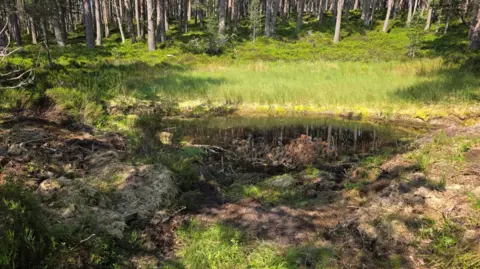
It also plans to create more ponds and wet areas around the site which can be used as a source of water to pump onto fires.
A small fire on the reserve in June was extinguished using water from a pond created with cash from the Scottish government's nature restoration fund as a habitat for species like rare dragonflies.
The charity says it's working to raise water tables where bogs have been drained and create new areas of standing water for fire fighting.
Peatlands have proved problematic for wildfires because the fire can spread through the peat, deep underground as well as on the surface.
It's a problem for degraded peatland which makes up about 80% of Scotland's total, but for those in a near-natural state the peat can act as a defence.
In good condition, they keep the water level high, bringing moisture to the landscape.
Its effectiveness was demonstrated during a large fire near Melvich, Sutherland, in 2019 which reached an area that had been re-wetted 20 years earlier.
 RSPB Scotland
Roxane Anderson from the University of the Highlands and Islands (UHI) studied the land before and after the fire and says any damage to wet peatland was superficial and on the surface.
She argues that's a reason for accelerating peatland restoration which is currently targeting 400,000 hectares - about 1,500 square miles - by 2040 and describes it as "a complete no brainer."
"We should do it as much as we can, as quickly as we can and as strategically as we can, especially in the context of this changing climate."
Grazing cattle
On Monday, Scotland's chief fire officer published an open letter calling for better wildlife planning and urging a "more formal and proportionate fire safety regime" to match that for businesses in urban settings.
It comes as the Scottish government enters the final stages of introducing licences for muirburn - the controlled burning of heather on moorland primarily managed for grouse shooting.
Ministers have brought in the licences to make moorland more "environmentally sustainable", but Scottish Land and Estates say the practice is a valuable tool for reducing vegetation which can act as fuel to a wildfire.
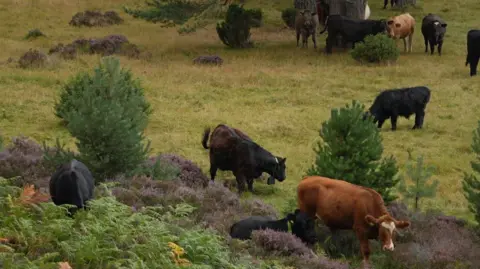
RSPB Scotland does not practice muirburn but accepts that the "fuel load" does need to be managed.
It has been doing that through grazing cattle, which eat the vegetation, while in other areas land managers have used machines to cut and mulch the grass, gorse, bracken and heather.
While some sporting estates remain opposed to "rewilding", others have embraced some of the elements of ecological restoration.
The Rottal estate in the Angus Glens has been working with the RSPB for several years now and owner Dee Ward believes there is a lot of common ground.
He has been re-wetting peatland, planting trees and encouraging wading birds and says that while the "ideological extremists" have been holding the narrative, a lot more estates are trying to find the middle ground.
He added: "There are people that are very anti-grouse shooting. Fair enough, that's your choice. But that's clouding their view about muirburn because they're saying because grouse shooters do it, it must be bad."
Dee urges both sides to begin looking at land management practices through the lens of preventing wildfires and consider sharing appropriate methods.
More broadleaved trees
The fourth move RSPB Scotland plans is the introduction of more broadleaved trees in its woodlands.
It says that while pines contain flammable resins, species such as alder, rowan, aspen and birch are higher in moisture content which means they do not burn as easily.
Abernethy hosts the largest and most important remnant of Scotland's ancient Caledonian pine forest and so the Scots pines are an important part of the mix.
But the charity wants to explore the option of increasing the proportion of other species, which would have occurred naturally in the original forest anyway.
Michael Bruce, director of the Glen Tanar estate in Aberdeenshire, is a wildfire consultant who specialises in controlled burning of moorland and helps the Scottish Fire and Rescue Service with its wildfire forecasting.
He says that there hasn't been enough academic research and modelling in the UK on how wildfires behave to make land management changes meaningful.
While two significant studies have been carried out in Scotland over the past 25 years, neither has been long-term or consistent and he believes events of the summer demonstrate the need for improved understanding.
He believes there is no silver bullet which will prevent a wildfire starting or spreading but that estates "need to build up layers of defence".
"Wildfires find the gaps," he added.
In April, the Cairngorms National Park Authority introduced a bylaw making it illegal to start a fire or a BBQ during the summer months to prevent wildfires.
Despite the huge blaze, figures suggest that move has been effective at reducing potential sources of ignition, with the number of campfires or barbecues recorded so far this year totalling 36 compared with 94 in the same period last year.
That's still too many but the reduction perhaps emphasises the importance of preventing a fire's spread.
Wildfires have been described to me as an "intermittent problem" because they're seasonal and we don't see large ones happening every year.
If they happened every year, it would become an obvious priority.
Preventing and tackling them both cost money and there are obvious questions around striking the balance between spending on both, not to mention wider affordability.
But climate change is predicted to bring more long, dry spells which create the tinderbox of summer 2026 and so all of this may be seen as an investment in the future.
For five weeks, land managers with very opposing views on how the uplands should be managed stood side by side battling the enormous blaze which was sweeping through the Cairngorms.
They found a common purpose and it's hoped that now seeing the countryside through a prism of wildfire risk may now be the unifier which sees them exchanging at least some practices - even if their end goals for the landscape still differ wildly.
