Philippines accuses Chinese fishermen of dumping cyanide in South China Sea

 Reuters
The Philippines has accused Chinese fishermen of dumping cyanide in waters around the SpratlyIslands, a fiercely contested area in the South China Sea.
Manila described the alleged poisoning as an act of "sabotage" on Monday, intended to "kill local fish populations" and deprive Filipino troops stationed at Second Thomas Shoal of a crucial food source.
China dismissed the claim as a "farce". The allegation follows years of tense stand-offs and occasional violent confrontations between Philippine and Chinese vessels in the disputed waters.
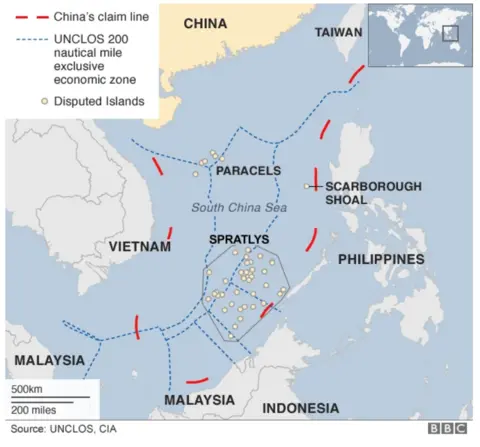
The South China Sea is at the centre of a territorial dispute between China, the Philippines and other countries.
Chinese foreign ministry spokesman Guo Jiakin said the accusation was "completely unbelievable and not even worth refuting".
"The Philippines has illegally harassed Chinese fishing vessels engaged in normal fishing activities," he added.
The Philippine National Security Council (NSC) said the alleged poisoning began last year around Second Thomas Shoal, part of the Spratly archipelago in the South China Sea.
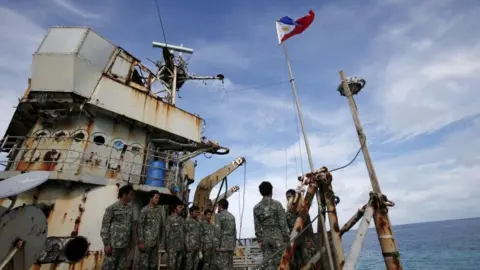
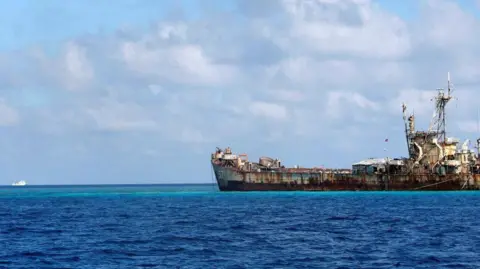
The reef is home to a small Philippine military outpost aboard the BRP Sierra Madre, a rusting World War Two-era ship deliberately grounded there in 1999 to assert Manila's claim to the territory.
NSC assistant director-general Cornelio Valencia said the use of cyanide was intended to "kill local fish populations, depriving Navy personnel of a vital food source".
He told a press conference on Monday that it also posed health risks to troops by contaminating the water and fish, and could damage the coral reefs that help support the vessel's structural foundations.
Valencia added that Manila had raised the alleged poisoning with Beijing at a recent meeting but had received no formal response. The NSC intends to submit a report to the foreign ministry that could form the basis of a diplomatic protest.
The navy and coastguard have been ordered to increase patrols in the area.
 UNCLOS/CIA/BBC
Philippine Navy spokesman Rear Adm Roy Vincent Trinidad said Filipino troops had seized 10 bottles of cyanide from sampan boats allegedly launched from Chinese fishing vessels in February, July and October last year.
He said military personnel had spotted another Chinese sampan crew poisoning waters near the shoal last month, and that samples later tested positive for cyanide.
Cyanide fishing has historically been used in parts of Southeast Asia to stun or kill fish, often for the live reef trade. It is illegal under Philippine law and widely banned across Southeast Asia because of its destructive impact on marine ecosystems.
The South China Sea is at the centre of overlapping territorial claims by China, the Philippines, Vietnam, Taiwan, Malaysia and Brunei.
It is a vital shipping route, and home to rich fishing grounds that support the livelihoods of millions of people across the region. More than half of the world's fishing vessels operate in the area.
The Paracel and Spratly Islands are also believed to sit atop stores of natural resources and potential energy reserves.
China claims the sea nearly in its entirety, despite a 2016 international tribunal ruling that found its sweeping claim had no legal basis. Beijing rejected the decision.
The Philippines invokes its geographical proximity to the Spratly Islands as the main basis of its claim for part of the grouping.
Both the Philippines and China also lay claim to the Scarborough Shoal (known as Huangyan Island in China) - a little more than 100 miles (160km) from the Philippines and 500 miles from China.
 Reuters
Tensions between Manila and Beijing have escalated sharply in recent years.
In June 2024, Chinese coastguard personnel armed with knives and sticks boarded Philippine navy boats near Second Thomas Shoal in a violent clash that injured several Filipino sailors.
China has repeatedly attempted to block Philippine resupply missions to the grounded Sierra Madre warship.
Last week, the Philippines held joint maritime exercises with the United States and Australia in the disputed waters, ahead of the annual Balikatan war games. Japan will also join this year as a full participant.
Beijing has repeatedly criticised such drills, saying they raise regional tensions.
In March, the Philippines signed a military deal with France that will see Paris send a contingent of 15 to 20 troops to join the Balikatan exercises on 20 April.
