Radiopharmacy set to boost medical scan capacity

 Siemens Healthineers
The UK's most powerful radiopharmacy to help NHS patients get timely access to scans used to detect cancer is in the advanced stages of construction, Siemens Healthineers has said.
The company's new £26m site in Foster Avenue, Dunstable, will deliver eight times the capacity of its two standard radiopharma sites, and create up to 40 jobs.
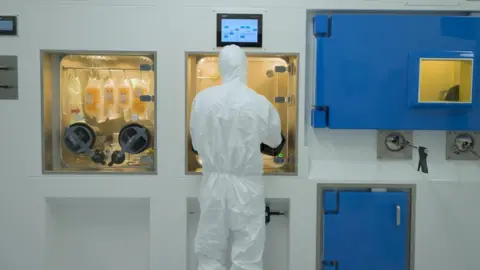
Hundreds of thousands of doses of biomarkers will be produced at the facility, which are injected into patients before a PET/CT scan to allow doctors to spot problems.
Ghada Trotabas, managing director of Siemens Healthineers Great Britain and Ireland said: "The radiopharmaceutical market is accelerating, and supply must not become the limiting factor."
The company said its other sites in Nottingham and Northwood, in London, were only capable of producing tens of thousands of doses of biomarkers.
The new facilty is expected to reduce waiting times for NHS patients, giving them "the confidence that access to critical diagnostics will keep pace with growing clinical demand, today and into the future," Trotabas added.
 Siemens Healthineers
A PET/CT scan can spot problems that a standard X-ray, CT or MRI cannot see.
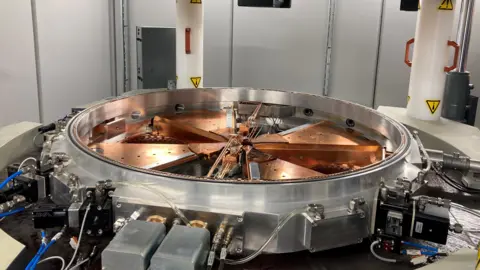
At the heart of the facility will be two advanced machines called cyclotrons, which are used to produce the materials needed to make the biomarkers.
They have been designed to operate independently so production can continue even if one has to undergo some maintenance.
The biomarkers, also known as radiotracers, must be manufactured close to where patients are treated, and delivered the same day due to their very short shelf life.
The company said it chose the Dunstable site as it is close to the M1 enabling "rapid distribution to hospitals and scanning centres across the country".
It is located within the Oxford-Cambridge Growth Corridor, an area the government believes will add up to £78bn to the UK economy by 2035.
 Siemens Healthineers
The site has also been designed with the future in mind.
Siemens Healthineers said it positions them at the forefront of a type of precision medicine known as theranostics, where the same technology used to diagnose a disease can also be used to treat it.
Rather than simply detecting a condition such as cancer, doctors could use these techniques to target and treat it with far greater accuracy - opening up new possibilities for personalised patient care.
Councillor Adam Zerny, leader of Central Bedfordshire Council, said: "This investment in radiopharmacy from Siemens Healthineers is a real vote of confidence in Dunstable and Central Bedfordshire.
"It's a facility which will be able to support patients across the country while bringing jobs and training opportunities to our area."
Do you have a story suggestion for Beds, Herts or Bucks? Contact us below.
Follow Beds, Herts and Bucks news on BBC Sounds, Facebook, Instagram and X.
