When is the next UK general election?

 Getty Images
Prime Minister Sir Keir Starmer is under pressure after Labour's poor performance in the May elections.
Labour MPs are split on his future, and he could face a leadership challenge.
But even if Sir Keir were replaced, a new Labour leader and prime minister would not be required to call a general election.
Who decides when an election takes place?
UK general elections need to be held at least every five years.
The 15 August deadline for the next election is five years from the start of the current Parliament (9 July 2024) plus 25 working days to run an election campaign.
That means it must be held no later than 15 August 2029.
However the prime minister can decide to call an election at any point before this.
This was not always the case.
Between 2011 and 2022, the PM's power to choose the timing of the next election was removed. An early election before the end of the five-year term could only be held under certain circumstances, such as if two-thirds of MPs agreed.
Since 1935 every general election has been held on a Thursday. However, this is a convention and, by law, they can be held on any weekday.
How does the PM call a general election?
The PM formally asks the King to "dissolve" Parliament - the official term for closing Westminster ahead of an election.
At the point of dissolution, the 650 MPs in the House of Commons lose their status and have to campaign for re-election if they wish to continue.
Government also enters a pre-election period which restricts ministerial and departmental activity during the campaign, to avoid influencing the outcome.
Can opposition MPs or members of the public force a general election?
If there is a Labour leadership election, the winner would become the prime minister, without the need for a general election.
This was also the case during the last Tory government. There was no automatic general election when Theresa May, Boris Johnson, Liz Truss and Rishi Sunak each took over as party leader and prime minister.
However any PM must have the "confidence" of the House of Commons to govern, which means they must be supported by a majority of MPs.
At present, 403 out of 650 MPs represent Labour, giving the party a large majority.
MPs can challenge the PM by holding a motion of no confidence vote, which lets politicians from all parties decide whether they want the government to continue.
If the leader of the opposition, currently the Conservatives' Kemi Badenoch, introduces such a motion, the government is expected to provide parliamentary time for a debate and a vote.
To succeed, the motion needs just one more MP voting in favour than against.
If the government loses the vote, a general election is usually called.
There is no constitutional mechanism for voters to trigger a general election.
For example, in January 2025, MPs debated an online petition which called for another election to be held, after it received more than three million signatures. However, the debate had no practical outcome.
How is the UK general election decided?
The UK is divided into 650 areas, called constituencies. Each of these elects an MP to represent local residents in the House of Commons, in London.
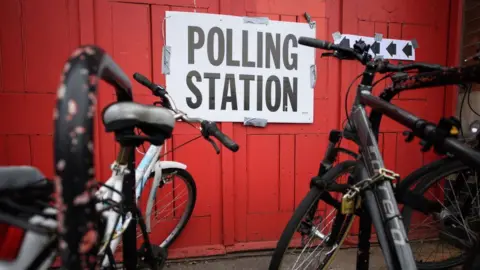
On election day, registered voters in each constituency vote for their preferred candidate in their local polling station. Some people vote by post in advance.
Most candidates represent a specific political party, but some stand as independents.
In a general election, each person has one vote. Under a system called "first past the post", the candidate who gets the most votes becomes the MP for that area.
After the votes have been counted, the King typically asks the leader of the party with the most MPs to become prime minister and to form a government.
The leader of the party with the second highest number of MPs usually becomes the leader of the opposition.
If no party has a majority of MPs - meaning it cannot pass legislation with just its own MPs - the result is a hung Parliament.
At this point, it is possible that the largest party could form a coalition government with another party or operate as a minority government, relying on votes from other parties to pass any laws.
Who can vote in a UK general election?
 Getty Images
Anyone who wants to vote must join the electoral register. The process takes about five minutes and you will need your National Insurance number.
Currently, you have to be 18 to vote in a general election.
But 16-year-olds can vote in local council elections in Scotland and Wales, as well as in elections to the Welsh Senedd and Scottish Parliament.
In July 2025, the government said it planned to lower the voting age to 16 for all elections across the UK before the next general election deadline.
This means that anyone on the electoral register on polling day who is aged 16 or over will be able to vote as long as they are:
- a British, Irish or qualifying Commonwealth citizen
- resident at an address in the UK (or a UK citizen living abroad who has previously been registered to vote in the UK or has lived in the UK)
- not legally excluded from voting (including members of the House of Lords and prisoners serving a sentence)
The Electoral Commission, which monitors UK elections, estimates that about seven million people are not correctly registered to vote at their current address.
It says private renters and young people are disproportionately affected.
To tackle this problem the government wants to create an automatic voter registration scheme, although people will be able to opt out.
It is not compulsory to vote in any UK election, including general elections.
What ID do you need to vote in a general election?
Voters in England are required to show valid photo ID to vote in person in UK parliamentary elections, as well as in local elections and police and crime commissioner elections.
Voters in Scotland and Wales need ID to vote in UK parliamentary elections, but not in Senedd or Scottish Parliament elections.
There are currently more than 20 acceptable forms of ID, including passports, driving licences, bus passes and Armed Forces Veteran Cards.
The government has said voters will also be able to use a UK-issued bank card as ID in future elections, but this has not yet taken effect.
Anyone without valid ID can apply for a free document called a Voter Authority Certificate.
The rules are different in Northern Ireland, where voters have had to show photo ID since 2003.

Sign up for our Politics Essential newsletter to keep up with the inner workings of Westminster and beyond.
