'Magical' and rare barn owl has bumper breeding season

 Ulster Wildlife
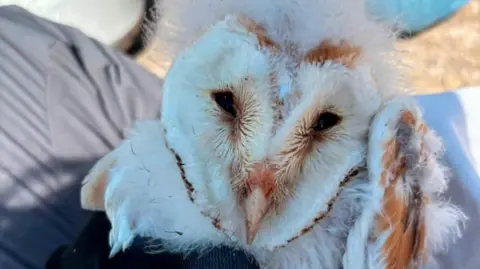
Barn owls have had a bumper summer in County Fermanagh, with 10 chicks recorded across two sites.
The breeding success follows years of conservation work by Ulster Wildlife with local farmers installing nest boxes and improving habitat for the elusive bird.
There are thought to be fewer than 30 breeding pairs left in Northern Ireland. The chicks have had rings placed on their legs so that they can be recorded in any other areas they turn up in after leaving the nest.
People are being encouraged to report any sightings of barn owls across Northern Ireland, particularly in the west, to help fill in gaps in the records and even help protect important breeding areas.
First recorded chicks in 50 years
 Ulster Wildlife
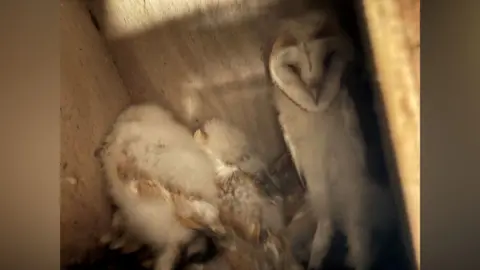
The Fermanagh chicks are thought to be the first recorded ones in the county for half a century.
Most of Ulster Wildlife's barn owl records come from the east of Northern Ireland.
The two broods of five chicks appeared in nest boxes that had been installed at different sites, after more than a decade of work with landowners.
The locations are being kept secret to help protect the rare, locally endangered bird.
Katy Bell, a senior conservation officer from Ulster Wildlife, said nest boxes play a part, but the willingness of farmers to adapt to the needs of the "magical, mystical" barn owl has been important too.
"We've been working closely with landowners, advising on land management and also putting up boxes," she said.
"So it's the combination of both - really you need nice thick hedgerows, lots of kind of rough areas and long grass for them to hunt over and then somewhere for them to nest. And that's really exciting."
The charity has worked closely with BirdWatch Ireland and has seen the population start to spread up from County Cavan.
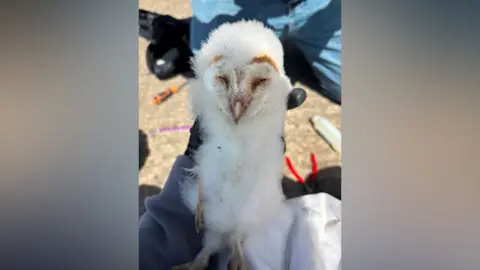
The chicks have had small identification rings placed round their legs so that they can be traced when they are spotted again.
It is the first time chicks are known to have been ringed in Fermanagh under licence from the Northern Ireland Environment Agency, with support from the British Trust for Ornithology.
The farmer's friend
 Ulster Wildlife
Over the past 50 years, barn owl numbers have declined across the UK.
The birds are now red-listed - classified as being at risk of extinction - largely due to a loss of habitat but also the use of pesticide.
Bell has been closely involved in the project to support barn owls.
"They face so many challenges," Bell said.
"They get poisoned with rodenticides, the loss of trees for them to nest in, the loss of nice big hedgerows for them to hunt over, the loss of rough ground for them to hunt over. They do get hit on our roads.
"They're just really up against it, so anything that we can do to create little safe havens for them here Is just they really need."
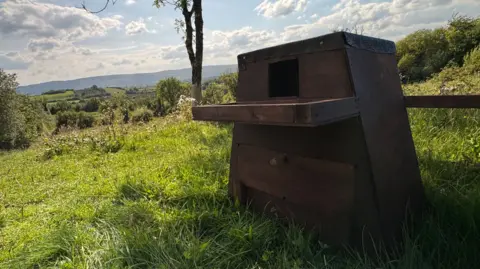
Those safe havens come in the form of nest boxes, specially designed to resemble the tree cavities barn owls nest in that are disappearing from our countryside.
They are shaped to keep water out.
Conservationists can access the nests to check on any chicks and ensure their wellbeing.
And there is a platform on the front, where the young birds will exercise and practise flying before leaving the nest.
Bell has "a long, long list" of farmers applying to have boxes installed.
"Of course, they're the farmer's friend - if you have them on the farm, that's free rodent control.
"They're eating your rats and your mice and everything on your farm.
"They work in harmony with us, which is just wonderful."
What do barn owls need?
They usually nest in cavities that form in large, old trees like oaks.
And they need to be near rough ground that offers habitat for the small rodents they hunt.
But the number of the right type of tree near the right type of area is falling.
That is why the boxes are so important.
Bell said suburban back gardens are just not suitable.
"We either need barns - we put some in barns - or big, mature trees and open ground.
"So usually we go out and visit farms in the autumn, see if they're suitable and then if they are, we'll put up boxes in the winter time."
But people can still play a part in supporting barn owls by reporting sightings.
And Bell said the birds are a sight that cannot be forgotten.
They're actually quite small birds, about the size of a wood pigeon, but they look much bigger - they have a wingspan much bigger in comparison to most other birds to their body size.
"So you see them hovering over the field and you'll get this just big flash of white.
"And it's just like nothing else you'll see."
