Will plug-in solar panels help cut bills for many?

 Getty Images
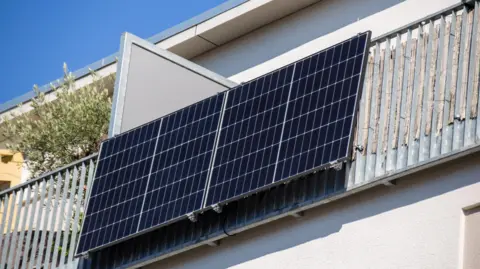
Plug-in solar panels will soon be available to buy in supermarkets across the south. Anyone living in flats or homes without suitable roofs for traditional solar panels will be able to use the plug-ins.
They can be installed on balconies, gardens or any other outdoor space. The Government is hoping the new kits will help homeowners significantly cut energy bills.
Recent figures show there are now more than 180,000 solar installations across the region. This could be anything from a single panel on a house to a whole solar farm.
Government research shows a household could save up to £70 - £110 a year on their energy bills from installing plug-in solar. The plug-in panels are expected to start at around £400.
'We were able to power the whole house during the day from panels'
Plug-in solar panels are already widely used by households across Europe, with Germany seeing around half a million new devices plugged in every year.
The free solar power can be used directly through a mains socket like any other device, without an installation cost, thereby reducing the amount of electricity taken from the grid and cutting energy bills.
Kevin Ray from Headley bought his own plug-in panels from Germany last month, he says they're already making a big difference:
"It's remarkable really. A couple of weeks ago we had a really good period of sun and we were able to power the whole house during the day from these panels. Now there's only two panels but it's up to 800 watts which covers most of the background load you have in your home during the day."
 Kevin Ray
The move comes as the Government steps up its drive for clean homegrown power to get the UK off dependency on fossil fuel markets in response to the Iran war.
Just weeks ago new rules were introduced to ensure the majority of new homes in England will come with solar panels fitted as standard.
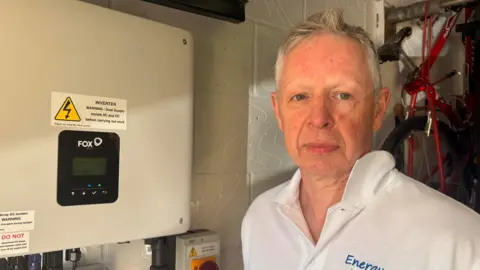
Angus Berry, an energy specialist from Alton, invested in 10 roof top solar panels last year he says in the summer he can power most of his house from them including his car.
"The majority of our energy consumption throughout the year and most of it in the summer period is coming from the solar panels stored in the battery and then in the house.
"When it is producing more power than we are using in the house it charges the battery and when the battery is charged I just leave the car to be charged with the surplus, if the car isn't connected it just exports to the grid and you get paid to export it."
British homes will need air-conditioning
With the frequency of hotter summers increasing, solar panels could become even more important in years to come enabling households to power more appliances like air conditioning units at a lower cost.
The Climate Change Committee recently warned all British homes will need air conditioning to survive predicted levels of global warming. In a landmark report climate advisers suggested air conditioning should be installed in all care homes and hospitals within 25 years.
Climate adaptation expert Professor Emma Tompkins from Southampton University says we will all have to think about adapting our homes.
"We can create shade over our windows. If we have a garden we can think about planting trees or planting things in our garden to cast shade on the southern or westerly facing parts of our homes to block out that heat that tends to come through our windows during the day.
"We can think about putting out awnings, we could be painting our roofs white to try and reduce the heat in our cities."
