Pavement surfing makes roads 'exceptionally dangerous'

 BBC
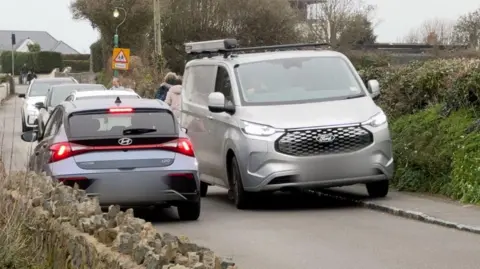
BBCOutside a primary school, a van mounts the kerb and a pedestrian ducks out of the way.
Farther along the same stretch, a bus edges along the pavement behind someone walking down the street.
This is the reality of life during the school drop-off in Guernsey where families, cyclists, vans and cars jostle for space on the narrow carriageway.
It is a scene repeated elsewhere on the island, so common that locals have a name for it: "Pavement surfing".
"I don't even allow my stepson to walk up on his own," says Christine Bangor-Jones, describing the road she lives on as "exceptionally dangerous" due to pavement surfing.
"There's a particular bit on the brow of the hill where cars ride over [the pavement] and my partner's nearly been run over five times."
Meanwhile, Jacob Maurice says going out with his baby in a pushchair can be "quite threatening when you've got a vehicle that has to come up behind you."
He adds: "You've gotta keep your head on a swivel on most of the roads."
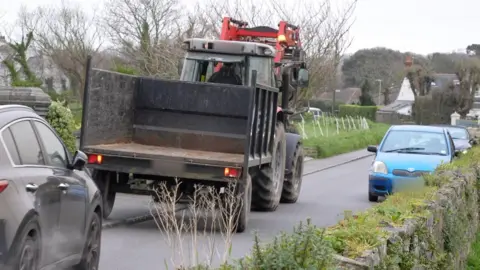
Pavement surfing is illegal in Guernsey and carries a £65 fine.
But figures obtained by the BBC show the number of fines for the offence have more than halved over the past decade.
Ch Insp Adam Parry-Jones, from Guernsey Police, said there were "caveats" around enforcing the law due to the island's infrastructure but the force's response remained proportionate and robust.
"The guidance given is if there is an obstruction in the road, then road users can mount the pavement, whether that's at very slow speeds or at a stop to either let the obstruction pass them or to pass the obstruction slowly," he said.
'Hostile place for walking'
The government agrees the island's narrow road network presents a "unique challenge" in tackling pavement surfing and police say traffic needs to keep moving to avoid congestion.
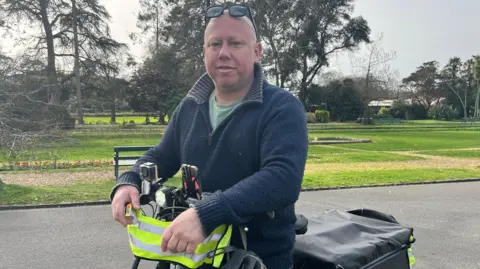
Guernsey's newest deputy Ross Le Brun, who won a by-election in April, says he did not notice the issue until he became a parent himself.
"They're using [the pavement] as a road extension to not have to slow down," he says.
"You are walking along the pavement with a buggy and wing mirrors are almost smacking into the handle of the pram."
Lorry driver Le Brun says people are reluctant to use alternative methods of transport as a result.
"It makes Guernsey quite a hostile place for active travel for walking and cycling. It puts a lot of people off, which is why we've got hundreds of people... driving kids to school for short distances, even less than a mile."
People in Guernsey are conflicted about the issue, claiming pavement surfing is, at times, unavoidable.
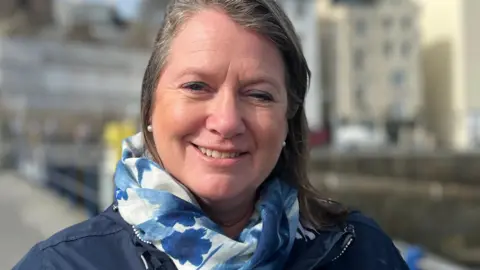
When she finds herself in a situation where she has no option but to mount the kerb, Helen Le Cheminant says she is careful.
She adds: "I always try and get off the pavement again quickly because of pedestrians."
But Doreen Laine says not everyone follows suit.
"You do see some people, they just get on the pavement and just stay on it the rest of the way up the road," she explains.
Campaigners in the Channel Islands say the size of modern vehicles has put pressure on roads designed long before SUVs became commonplace.
Research by campaign group Transport & Environment found new cars in Europe grow about 1cm wider every two years, from 177.8cm (46.4in) in 2018 to 180.3cm (71in) in early 2023.
In other parts of the world, there are charges for driving larger vehicles. Paris has tripled parking fees for SUVs, Cardiff has approved higher permit charges for heavier cars and London is also considering charging SUV drivers more.
Tim Dexter, from Transport & Environment, says cars are getting wider and taller.
"While they may make the people driving them feel a bit safer, we know these offer much more risk to other road users," he says.
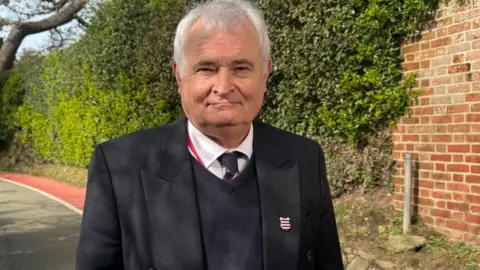
While pavement surfing is less of an issue in Jersey, Miles Jude, president of the island's Motor Trades Federation, says new car models have been growing in size for 30 years, "which for our island is actually not a good thing".
"For some families and some people they're necessary, for other people, they're not and you could almost say that potentially some people are only driving a larger vehicle for a status symbol - but obviously that's their prerogative," he adds.
Grouville constable Mark Labey says Jersey's country lanes will always be under pressure from larger vehicles because "they weren't designed for the cars that we have today, they were designed for a horse and cart".
'Limited scope for change'
Both island governments say historic road layouts make change difficult.
Jersey's head of highways, transport and infrastructure, Tristen Dodd, says not only do larger, heavier cars damage the roads, they present challenges in 50-year-old car parks that weren't made for such wide cars.
"It's a heritage road network. It is built up heavily on most sides of the road, so the scope to actually change that infrastructure is limited. What we can do is change how it's used," he adds.
Jersey points to investment in buses, active travel and road safety schemes as a possible solution.
Adrian Gabriel, Guernsey deputy and president of the committee for the environment and infrastructure, says policies encourage smaller, lower-emission vehicles better suited to island roads, including dedicated parking spaces.
"As private vehicles, especially SUVs, grow wider, these vehicles are likely to have a greater impact than in larger jurisdictions," he adds.
As for pavement surfing, Le Brun believes one-way roads could provide a solution in some areas.
"There's a lot of conflict on our roads because we're trying to prioritise two-way vehicle movements over the safety of people," he says.
"Things do have to change. [Drivers] cannot be bouncing up on the pavement and thinking that that's normal - because it's not normal."
Additional reporting by Robert Hall and Charlotte Cox
Follow BBC Guernsey on X and Facebook and Instagram. Send your story ideas to channel.islands@bbc.co.uk.
