Italy suspends defence agreement with Israel

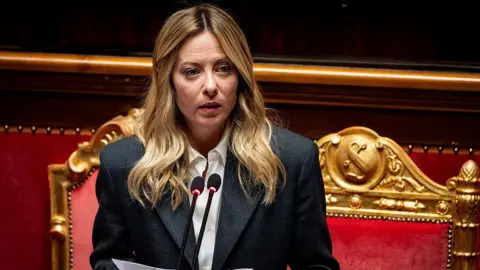 SOPA Images via Getty
Italy will not renew its defence agreement with Israel, Italian Prime Minister Giorgia Meloni has said.
Meloni said her government had decided to suspend the renewal, which happens every five years, "in view of the current situation", without offering specifics.
Relations between Italy and Israel, which have historically been solid, have recently soured.
Last week, the Italian government summoned the Israeli ambassador to Rome after warning shots were fired by Israeli forces at a convoy of Italian UN peacekeepers in Lebanon, damaging one vehicle but causing no injuries.
On Monday, Israel in turn summoned Italy's ambassador to protest comments by Italian Foreign Minister Antonio Tajani, who had condemned Israel's "unacceptable attacks" on civilians in Lebanon.
Defence ministry officials told the BBC they were still examining how the government's position would translate into concrete legal and practical consequences on the framework of Italian cooperation with Israel.
Italy is the third-biggest arms exporter to Israel, according to figures from the Stockholm International Peace Research Institute (Sipri). But that still only accounts for 1.3% of Israeli arms imports between 2021-2025. The US and Germany are the top exporters.
Several European countries paused or restricted arms exports with Israel during its military action in Gaza.
The offensive was triggered by the Hamas-led attack on Israel on 7 October 2023, which killed about 1,200 people, while 251 others were taken to Gaza as hostages.
More than 72,330 people were then killed by Israeli military action Gaza - including 757 since the ceasefire began on 10 October 2025 - according to the territory's Hamas-run health ministry.
Over the past few years, many Italians have asked their government to do the same, with hundreds of thousands have taking to the streets or going on strike in protest.
Yet Meloni's right-wing coalition government has remained one of Israel's closest allies in Europe, refusing to join the growing number of countries recognising Palestinian statehood.
But in late March, her camp lost a referendum on a judicial constitutional reform, which many interpreted as a vote on her government's popularity - not least in terms of its relations with Israel and the US.
With only 18 months to go before the next general election, Meloni has been tweaking her rhetoric in order to distance herself from these associations, which are becoming increasingly unpopular among the Italian electorate.
Since the referendum result, she has described the US-Israeli war with Iran as part of a growing and dangerous trend of interventions "outside the scope of international law".
On Monday, she issued a rare criticism of Donald Trump, describing the US president's disparaging comments about Pope Leo XIV as "unacceptable". She later added that the pontiff had her "solidarity".
That led to a swift rebuke from Trump, who told Italian newspaper Corriere della Sera that he was "shocked at her".
"I thought she had courage, but I was wrong," he said, adding Meloni "does not care whether Iran has a nuclear weapon and would blow Italy up in two minutes if it had the chance".
Meloni may be hoping the first cracks in the Italy-US relationship will help her claw back votes as next year's general election approaches.
At one point, Trump's evident sympathy for Meloni appeared to have earned her special recognition as a potential privileged interlocutor among EU countries, and was touted by her supporters as an asset.
But now, with Trump becoming an increasingly unpopular figure, that association risks being damaging. In January, a survey showed 63% of the Italian electorate holds a negative opinion of the US.
Following Trump's comments, Meloni's allies rushed to her defence. Foreign Minister Antonio Tajani said on X that Italy's alliance with the US was "built on mutual loyalty, respect, and honesty."
"And on Pope Leo XIV she said exactly what all of us Italians think. The prime minister and the government defend and will always defend only and solely the interests of Italy," Tajani said.
"Being allies does not mean accepting everything in silence, but having the courage to clearly state what one believes to be right," defence minister Guido Crosetto said.
Update 20 April: This report has been amended having implied, incorrectly, that Tel Aviv is the capital of Israel
