Fire crews to remain at Arthur's Seat for days after blaze

 Craig Duncan Photography
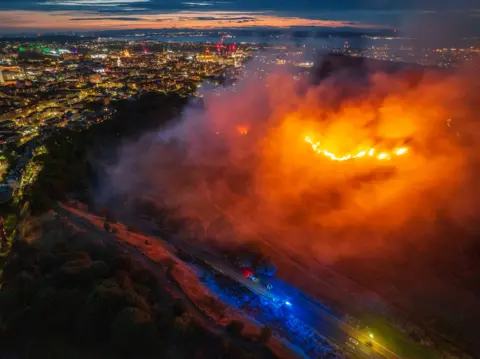
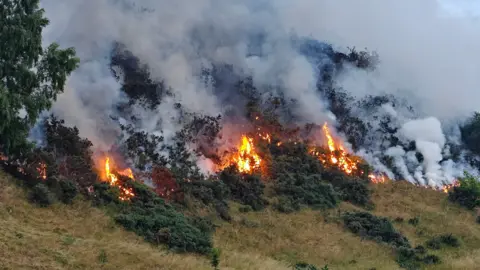
Firefighters are expected to remain at Arthur's Seat in Edinburgh "for a couple of days" following a large blaze on Sunday evening.
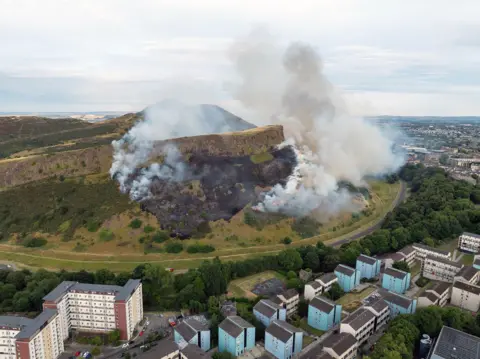
Small plumes of smoke could still be seen on Monday morning along Salisbury Crags and large swathes of vegetation below the cliff face had been burned black.
Six fire engines were sent to tackle the the grassfire with crews working overnight to douse the flames and dampen hotspots.
The Scottish Fire and Rescue Service (SFRS) said there were "no reported casualties" but Police Scotland said Queen's Drive, the road that encircles the Holyrood Park hills, remained closed to all vehicles.
It is the second fire in the last three months at the landmark, an ancient extinct volcano that offers panoramic views of the Scottish capital.
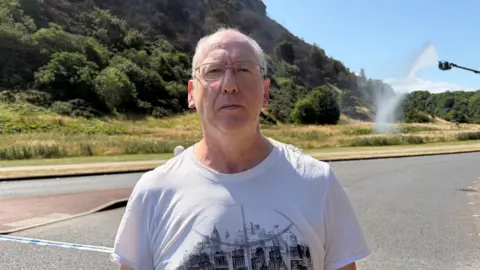
Edinburgh University student Mahek Jayantilial, who lives near Arthur's Seat, said she could see the fire from her window.
"I was a bit worried because I thought the fire would come this way, but thankfully there's enough concrete here to stop it," the 24-year-old said.
Jayantilial said it was "upsetting" to see Arthur's Seat on fire but she believed it was almost unavoidable as there has not been much rain recently and the grass had dried out.
"It was bound to happen," she added.
"A small bit of glass or a poorly snuffed-out cigarette butt would have ignited it, and then something so small creates such a big fire."
The sound of chainsaws could be heard on Monday morning, believed to be from work to clear vegetation.
On the ground, firefighters were concentrating efforts on the area of Queen's Drive closest to the Pollock Halls of Residence, the largest student accommodation site for Edinburgh University.
 PA Media
 Malcolm McFadyen
Jon Henderson, SFRS assistant chief officer, said the service had dealt with a number of incidents over the course of the weekend.
"We had crews at Arthur's Seat on Sunday evening and then overnight," he told BBC Radio Scotland Breakfast.
"At first light we stepped up that response again when the conditions were favourable for that.
"The feeling from the ground there is that we will probably be there for a couple of days continuing to tackle it and dampen out hotspots."
Henderson said it was too early to speculate on the cause of the fire.
"Our focus at the moment is dealing with the fire and the response but there will be a full fire investigation," he said.
"The difficulty we have with open fires is that they can be difficult to assess where they started because of the scale and sometimes these do happen naturally."
 Craig Duncan Photography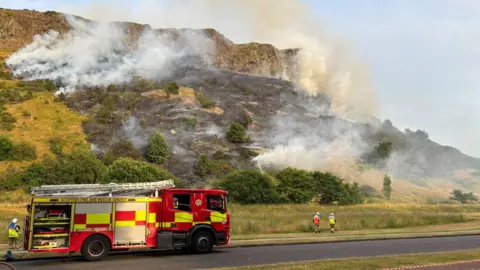
Callum Smith, who also lives near Holyrood Park, said he was concerned about the impact the fire will have on a nearby peregrine falcon nesting site.
"Peregrine falcons have been nesting here for four, five, six years, possibly longer," he said.
Smith said there were two adults and two chicks in a nest where the fire was along the cliffs and the youngest chick had not fledged yet.
"Possibly the two adults and the eldest chick would have been able to fly away, but the outcome for the youngest one is unclear," he added.
"Unfortunately, the smoke traversed over the top of the cliffs and onto the cliffs, so the smoke would have gone directly onto the nest site."
 PA Media
Cairngorms wildfire
It is the latest call out for the Scottish fire service during the recent stretch of warm, dry weather which has seen a heightened risk of wildfires.
Hundreds of firefighters, two helicopters and specialist resources were sent to the Cairngorms National Park where a blaze has been ongoing for four days.
Six square kilometres of land had been affected resulting in homes and businesses, including campsites and a ski resort in the Glenmore Forest Park area, being evacuated as a safety precaution.
A high volume pump has been used to draw water from Loch Morlich to support firefighting efforts.
On Sunday, fire crews said the fire was now "surrounded" and police began escorting residents and campers back to properties and campsites to collect personal belongings.
Henderson said resources remain on site but "significant progress" has been made.
"The activity over the rest of the day is to maintain a four kilometre long fire break and to search out and extinguish hotspots," he added.

