Concern at impact of £162m science research 'cuts'

 BBC
BBCThousands of science jobs and world-leading research programmes could be at risk, according to an MP.
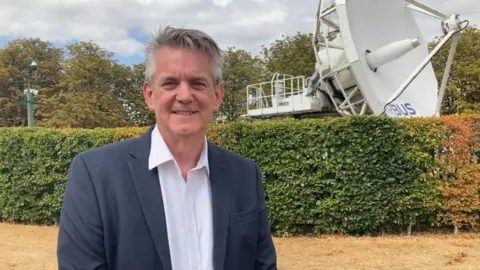
Didcot and Wantage MP, Olly Glover, whose constituency includes Milton Park, Culham and Harwell science parks, has called for a review of the decision to allocate funding away from the Science and Technology Facilities Council (STFC).
With increasing running costs, it means the sector, which includes innovation in areas including defence and satellite technology, is facing a funding shortfall of £162m.
The government said funding was remaining flat in the current spending review but it is "committed to working to ensure the UK sustains its world-leading research capabilities".
UK Research and Innovation (UKRI) is the body responsible for allocating government funding from the Department for Business, Innovation, Science and Trade.
It will deliver £38.6bn of public investment in research and innovation over the next four years. But according to the government, priorities have changed with more money now going towards things that "drive research that delivers real impact for the public".
It means funding has remained flat for the STFC - which includes research into particle physics, astronomy and nuclear physics.
An STFC spokesperson said: "Faced with growing costs that will exceed available budgets over the next four years, we have to act now to avoid more serious disruption later."
Nationally, it's led to the potential closure of the Jodrell Bank Observatory, home to the UK's largest telescope.
Executive director of the Royal Astronomical Society, Ian Russell, said Oxfordshire's research hubs are now facing "huge risks", with some facilities facing 20%, 40% or 60% cuts "or even facing closure completely".
According to Russell, the ultra powerful microscope, the ISIS Neutron and Muon Source - based at Harwell Campus - is reducing its running time and there's a risk the team may "lose the Muon source altogether".
The device can be used for things like developing new pharmaceuticals and improving battery technology.
An STFC spokesperson has rejected the idea, saying the microscope is still continuing to operate as normal "undertaking phenomenal research and supporting a community of very highly skilled staff who are expert engineers, scientists and researchers".

Glover is also concerned about potential jobs cuts at Oxfordshire's science hubs.
"Multidisciplinary scientific research is crucial to driving economic growth. These funding cuts threaten thousands of jobs across Oxfordshire and the UK, impacting many of our constituents," he said.
There are also fears about the impact on international relations with scientists across the world.
Russell said the cuts were a "drop in the ocean" for UKRI, but risked undermining the UK as "trusted partners in international collaboration".
He said: "We're talking about sciences that the UK is already a world leader and there's plenty of research that says the funding that goes into that research and development has a massively beneficial impact on the economy.
"For every £1 spent on fundamental research we get about £8 back for the economy, so it's actually great value to UK PLC."
In a letter to Jonathan Reynolds, the secretary of state for business, innovation, science and trade and co-signed by Conservative and Labour MPs, Glover said the cuts threaten world leading scientific research and job opportunities for young people.
"Ultimately, our scientific leadership on the world stage, higher education sector and skills pipeline are all currently at risk of being irreparably damaged. Now is the time to prevent that from happening," he said.
A government spokesperson said: "We are not cutting the STFC budget: it is remaining flat over the course of the current spending review.
"To ensure we can drive research that delivers real impact for the public, we are funding R&D at record levels, including £38.6bn invested in UKRI over the coming years.
"UKRI is responsible for taking specific funding decisions, but we are committed to working to ensure the UK sustains its world-leading research capabilities."
