A man wrongfully served 17 years for rape. Now another man has been convicted

 BBC
BBCIn the early hours of 19 July 2003, a 33-year-old mother of two was walking home alone through a semi-rural part of Salford after a blazing row with her boyfriend.
As she came to Little Hulton, a tight-knit community, she heard a male voice call out from the bushes. The man said he had a gun.
She hurried away, texting her boyfriend. Soon she realised she was being followed by a man.
He was wearing a white shirt that was unbuttoned. The man caught up with her by a motorway bridge.
What followed was an appalling attack. He dragged the woman down an embankment and strangled her unconscious. He then struck her face, fracturing her cheekbone so severely she needed surgery.
When the woman came to, it was apparent to her - and later doctors - that she had been raped. Police and prosecutors initially classified the crime as attempted murder.

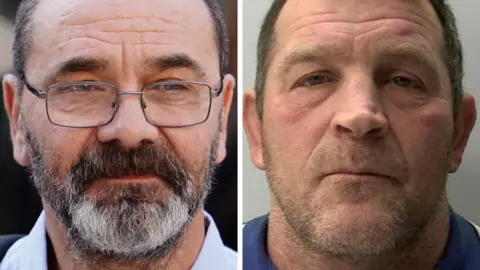
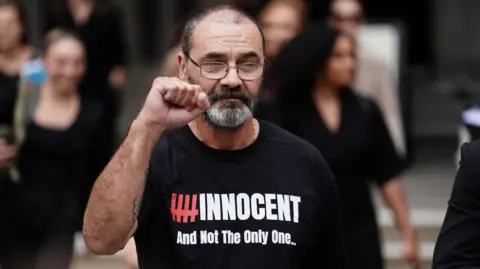
For 20 years, Andy Malkinson was blamed for the attack in one of the worst miscarriages of justice this century, serving 17 years in prison.
The delay in identifying Quinn came after detectives fixated on the wrong man.
Malkinson, from Grimsby, was living temporarily in the area because of a short-term job.
Police saw him as the prime suspect purely because he had been stopped by two officers some time earlier. They thought he matched the victim's description.
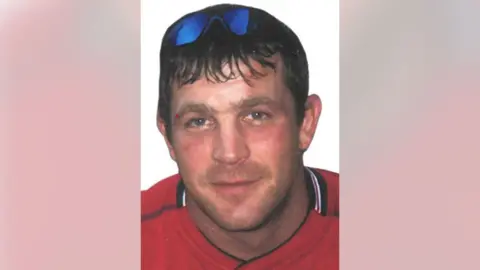
Quinn, meanwhile, lived on the Kenyon Way estate, a few minutes' walk from where the woman was first stalked.
"Nobody came forward with any information in 2003, or during the span of that investigation, with Paul Quinn's name. That was categorical," says Det Ch Supt Rebecca McKendrick - the senior officer at Greater Manchester Police who has overseen the inquiry into him.
'Miscarriage of justice'
In 2004, a jury convicted Malkinson solely on the basis of eyewitness accounts.
From the day of his arrest, he protested his innocence. And from around 2007, England's criminal justice agencies should have started to realise he was telling the truth.
At that time, a nationwide initiative called Operation Cube had been re-examining crime scene samples thanks to advances in DNA testing.
When scientists looked at material from the Little Hulton rape, they got a hit on male DNA. But instead of it matching Malkinson, it was from an unidentifiable man.
The find was from saliva left on the victim's vest top, close to where she had been bitten.
"It didn't match Andy, and it was from an area which even the prosecution was describing back then as crime specific," says James Burley, the investigator who worked on the Malkinson case at Appeal, a charity that looks into potentially wrongful convictions.
"That should have been the point where it was crystal clear that there'd been a miscarriage of justice."
 PA
PABut nobody did anything. Not Greater Manchester Police (GMP), the Crown Prosecution Service (CPS) nor the Criminal Cases Review Commission, the miscarriages of justice body that thought the DNA would not undermine Malkinson's conviction.
The breakthrough only came 12 years later, when Appeal was able to instruct scientists to take the sample and look again.
It took the results to the Criminal Cases Review Commission which finally agreed to do some further work and arranged a search of the National DNA Database in 2022 - which identified Quinn.
There were three key elements to the DNA evidence against him.
The first was the profile from the vest top saliva - it was a billion times more likely to be from him than someone else.
Second, was a less precise test - one that is valuable in identifying male profiles in sexual assaults - of another saliva sample recovered from the victim's bra. It supported the first finding, albeit with less confidence.
The third find, however, was extraordinary. In May 2023, a speculum, a medical instrument used to examine the rape victim, was taken from the evidence bag it had been stored in for 20 years.
Scientists recovered a very small but partial match to Quinn from a part of the device that had been sterile before it had been used and had not been touched since.
So why did the police have Quinn's DNA to find the match in 2022?
BBC News can now report that he was a convicted sex offender.
When Quinn was 16, he was charged with two counts of unlawful sexual intercourse with a 12-year-old girl. That offence would today be charged as rape, according to detectives.
He was convicted and received a community order in November 1991 - four years before the launch of the National DNA Database, which now stores millions of DNA profiles and samples collected from around hundreds of thousands of crime scenes.
In 2010, Parliament passed a law ordering people convicted of sexual offences before the database was set up to provide samples. And two years later, officers knocked on Quinn's door.
We don't know what he thought in that moment - but by 2019, the trial heard, he was showing an unusual interest in Malkinson.
The trial heard his internet history showed he had looked up news reporting of the 2004 trial - and then he searched "wrongly convicted cases uk".
Why would Quinn be interested in a 15-year-old case, prosecutor John Price KC asked in court.
In July 2022, investigative journalist Emily Dugan, now with the Sunday Times, reported there had been a new forensic find in the Malkinson case - a reference to the DNA work carried out by Appeal.
"How long is dna kept in database," Quinn soon searched. And later "why am I sweating so much all of a sudden".
At that time, he was living in Exeter, having split up from his wife. And detectives say that when they knocked on his door in 2022, he'd had ample time to come up with a story and deny rape.
"How has your DNA, which is one in one billion, ended up on her top?" he was asked in a police interview.
"I really don't know, because I did not do this offence," he replied.
"I weren't loyal. We did go out partying. We did have a lot of female friends. We never seemed to have a night out where we didn't end up at a house party, or we cop off with girls. I admit I've cheated on my wife hundreds of times with girls that we've met on nights out."
'Paul liked the ladies'
The BBC has spoken to people who knew Quinn at the time.
"Paul liked the ladies," one source said. Quinn's weekends would sometimes see him dancing until the early hours at the Chuffers nightclub, in nearby Farnworth.
One former friend said: "He had a lot of women in his life, he cheated on his wife every time he went out, in some way or another. That was just normal."
Drugs were also part of his life. In 2013, Quinn was cautioned for production of cannabis. And detectives say a row over a drugs debt was the catalyst for him leaving for Exeter in around 2017.
Two community sources - one from the extended family - have told the BBC that Quinn was accused of stealing a cannabis crop.
The BBC understands that account chimes with police intelligence.
During the trial, Quinn minimised suggestions that he was a heavy drugs user and placed his philandering at the heart of his defence.
He conceded he did not know the victim - and she did not know him. And she gave uncontested evidence that her lifestyle was a world away from his claims of casual pick-ups.
Quinn ultimately accepted the DNA recovered from the vest top was his - although he disputed the finding from the medical speculum.
 GMP/PA Wire
But there was also other evidence for the jury to consider.
His ex-wife, Catherine Quinn, told the trial that she remembered the attack and that he had come home at the time having lost one of his few good shirts. She had joked that the shirt better not be found near the crime scene.
She told the jury how Quinn would regularly unbutton or take off his shirt - mirroring the victim's account of a man stalking her with an open shirt.
She said he shaved his chest clean in the summer to deal with heat. The victim, attacked at the height of summer, had been raped by a man with a shiny hairless chest.
Quinn's previous convictions were not introduced into the evidence.
Jurors were not told of his 1991 conviction for unlawful sexual intercourse - and they were also not told that he was cautioned for sexual assault when he was just 12.
In 1992, he was convicted of assault occasioning actual bodily harm - and jailed the following year for arson with intent to endanger life after setting fire to a wheelie bin outside the back door of an ex-partner.
"Clearly he is a very disturbing or disturbed man capable of high levels of violence, sexual violence, really a dangerous individual," says Det Ch Supt McKendrick.
"As it stands right now, we do not have any definitive links with Quinn and other offences, but it is something that we are continuing to investigate."
She appealed for anybody with information about Quinn and his offending to contact the force.
The one question this trial could not answer was why Malkinson was wrongfully convicted.
The victim told officers preparing the case against Quinn that she first had doubts Malkinson attacked her after seeing him in court.
The victim has maintained over the years that she scratched her attacker's face - but police did not tell her in 2003 that Malkinson had no such injury. Quinn's trial did not produce evidence that he had that injury either - and his wife could not remember a scratch.
Quinn's trial heard the victim's clothing - including the vest top - had been destroyed in 2016. It is not clear why GMP did this when it was apparent that Malkinson was protesting his innocence.
The DNA testing that exonerated him was only possible because cut-out samples of fabric had been stored separately.
Eyewitness changed mind
The jury was also not informed of well-documented doubts about an eyewitness called Beverley Craig.
In 2003-04, she gave police a description of a man matching the one provided by the victim. She said she and her partner, Michael Seward, were out before dawn.
She then picked Malkinson out of a video ID parade - but only after changing her mind. In court this time around, she said her original pick had "messed up" the police's case.
In 2023, when the Court of Appeal quashed Malkinson's convictions, it ruled the jury at his trial should have known that Craig and Seward had dishonesty convictions.
Seward did not identify Malkinson until six months after the attack. Shortly after he did so, several charges he was facing were dropped. The BBC has sought to contact Craig.
All these elements of what did or did not happen in 2003-04 are being investigated by the Independent Office of Police Conduct (IOPC) and a wider judge-led inquiry.
To date, the IOPC has told five former officers they are under investigation for potential gross misconduct - and one serving officer is being probed for possible misconduct.
One of the former officers is also under criminal investigation for potential misconduct in public office and perverting the course of justice.
GMP has confirmed that one of the officers who retired is working on police staff.
Today, GMP says it is full of remorse for the impact on both the victim and Malkinson.
"We are profoundly sorry," says Assistant Chief Constable Steph Parker of GMP - the first senior officer to speak publicly about the case.
"The fact that Andrew was imprisoned for 17 years for a crime he didn't commit is clearly a failing of Greater Manchester Police and the wider criminal justice system, and for that, we are absolutely sorry.
"We are determined that this cannot happen again, and we also offer our apologies to the victim who we've let down.
"There is a difference between corruption and human error. We really need to understand how those errors occurred and why those errors occurred, and only at that point will we be able to understand whether there is blame for the police, for anybody else."
Throughout his trial, Quinn gave little away. He sat still for long periods, occasionally fidgeting - but largely impassive and quiet.
The victim was quiet in a different way - speaking softly and with dignity as she relived events from 23 years ago. She declined the offer to be screened in court - Quinn could see her throughout, she could see him.
She told her truth. Quinn, on the other hand, could not face the truth.
John Price KC, the senior prosecutor in this case, said the reason was simple: "There were two people who knew it was a wrongful conviction. Him [Andy Malkinson] and you."
