Thumbs up from the mountain rescuer dragged by a helicopter

 Judith Cantrell
For mountain rescue teams, jeopardy comes as standard. But, on a cool Saturday in April 1991, a group in the western Lake District faced a confluence of events that seemed guaranteed to be fatal when the blades of their rescue helicopter hit the side of a remote crag and splintered through the windshield.
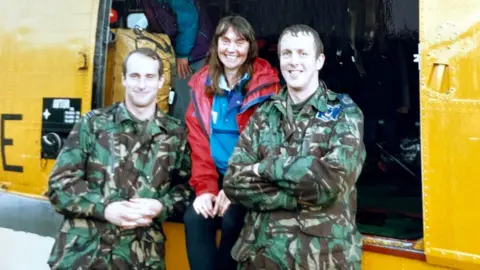
Hanging from a winch under that RAF helicopter, being dragged through the air, mountain rescuer Judith Cantrell did not know what had happened but was keen to let the crew know she was alive.
"I remember thinking I'm okay, but I don't want them to think I'm a body, I'm not dead," she says.
"[So] I put my thumb out."
Cantrell worked at the outward bound centre in Eskdale, Cumbria, and was on what she describes as a rare day off when the call came through. A climber had fallen on Esk Buttress and was lying injured on a ledge. A Sea King helicopter was on its way from RAF Boulmer in Northumberland to pick up her and a colleague to help him.
"We would have just gone in what we were wearing," she remembers. "It felt quite urgent because the casualty was potentially unconscious."
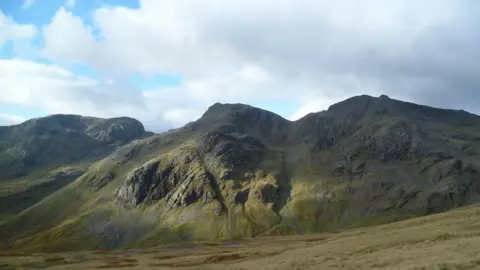
Cantrell says, although Esk Buttress is popular with climbers, it is a "serious crag" and a remote one, so she knew the call-out was going to be significant.
She and her colleague John Dominey - known as JD - boarded the helicopter, flying up the "dramatic" valley towards the 1,600ft (490m) crag. Dominey was lowered down via a winch cable to the casualty below and Cantrell followed. She just "never made it to the ledge".
"I remember seeing JD's face and he looked horrified," she recalls.
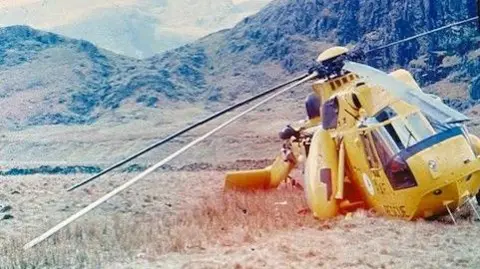
What Cantrell did not know was that the Sea King's rotor blades had hit the crag, partially splintering and flying through the windshield, hitting pilot John Evans on the head.
 Dave Malkinson
Cantrell, still attached the winch, was dragged through the air as the helicopter crew searched for somewhere to land.
Although alive, and sticking her thumb out so the crew would realise, she was not being brought up by the winch and the helicopter was slowly pulling her under the fuselage.
She recalls an "absurd" thought crossing her mind: "I'm going to be squashed by a big yellow egg."
Unbeknownst to Cantrell, the winch cable had become tangled on the helicopter's landing wheel and the crew could not reel her in. Instead their plan was to cut her loose, dropping her onto a ridge, to stop her getting crushed when the Sea King crash-landed.
 Michael Graham/Geograph
But, as they descended, the cable came free and the plan changed.
"It must have been seconds before, making that decision," Cantrell says. She was eventually pulled inside and shoved into the seat nearest the door and remembers thinking "I'm fine, I'm really safe".
But, as she looked at the faces of the crew around her, it dawned on her "they were not feeling safe".
"I was really upsetting people because I hadn't put my seat belt on," she says, and it soon became clear they were "very concerned about dropping out of the sky". Someone reached over to strap her in and, moments later, the helicopter touched down in soft, boggy ground at Scar Lathing.
"The pilot was brilliant getting that thing down," Cantrell says. "I don't even remember being bumped on the seat."
Cantrell's instinct was to get out immediately and summon help for Dominey and the casualty they had left on the ledge. "I remember thinking, we need to follow this up now and get more help," she says.
But the helicopter's rotors were still spinning and she was "very carefully and gently" prevented from leaving until they stopped. "I was too keen," she laughs, now wryly aware she very nearly became the second casualty, or worse.
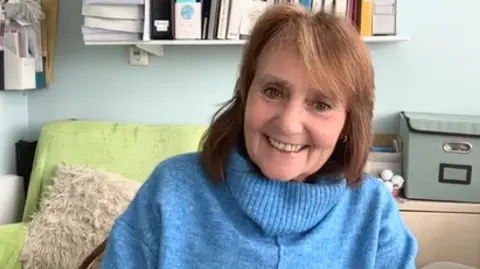
Once the rotors had stopped, Cantrell and one of the crew jumped out, dashing to higher ground to get a radio signal. "I was quietly pleased I got connection before he did," she says with a smile.
But, not wanting to say the helicopter had crashed, she was not sure how to phrase things when she got through, pausing and then saying "the helicopter is... no longer available", and asking for help from another team.
One of the longest-standing members of Wasdale mountain rescue, Richard Warren, was on route with his team and he remembers its former chairman running ahead to be first on the scene.
"Richard Longman was training for the London Marathon at the time and he'd already given the pilot some treatment when we got there," he says. The fallen climber was stretchered to safety.
Warren says what happened was a "really close shave for Judith and the crew" and a reminder of the risks mountain rescue volunteers face.
"When the pager goes off and they leave, their partners wonder if they'll come back safe and well or injured," he says. "It's a pretty risky business, but mountain rescuers are skilled at what they do."
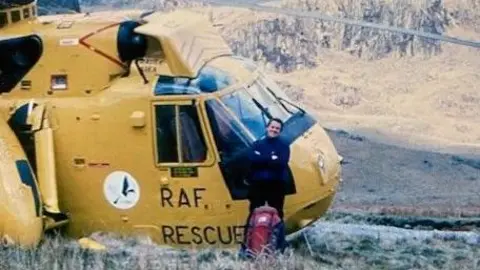 Dave Malkinson
Casualties attended to, a team from RAF Leeming soon arrived to guard the broken helicopter. Survival equipment fitter Dave Malkinson spent several nights sleeping in a tent nearby and remembers the first task being to remove the rotor blades.
It took seven or eight people to load each blade into the Chinook which came to collect them. Other pieces of the Sea King were removed in a large cargo net before the fuselage was taken to Walney airfield in Barrow-in-Furness.
"It was a considerable job being out in the field, but we managed," he says.
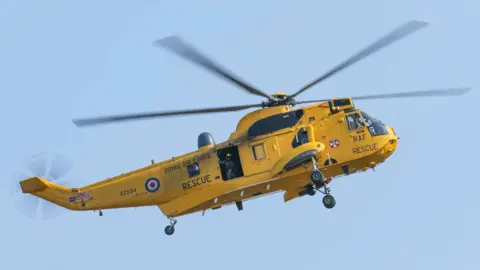
Affectionately known as the "Land Rover of the skies", the final Sea Kings left service in 2018, almost half a century after their first flight in 1969.
"It's incredibly sad that they got taken out of service," Cantrell says. "They're a real characterful, invincible machine."
 Royal Air Force / Ministry of Defence
Although Cantrell's thoughts do not often stray to that day, 35 years ago, she feels lucky to have made it through unscathed.
"People are often amazed," she says. "For me, it's just something that happened to me."
Mountain rescuers can also be found climbing the peaks for pleasure and, by coincidence, Cantrell had plans to be back at Esk Buttress the following day. On her way she visited the helicopter.
Although it was taped off, she says, the recovery team let her in and she has "a confession to make".
"I did pick up a little piece of yellow helicopter," she says. "I must have that somewhere."
