Is this the smallest nature reserve in the country?

 Edd Smith/BBC
Think of Norfolk's wild spaces and you'll probably picture vast marshes, swathes of heathland and meandering waterways under that famous big sky.
But one of the county's lesser-known beauty spots is not so panoramic - it's tiny, in fact.
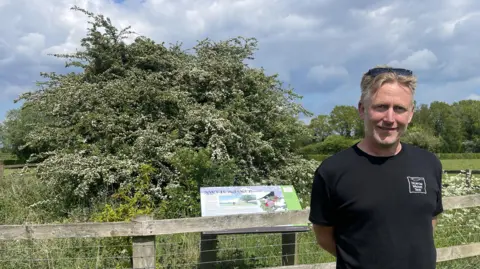
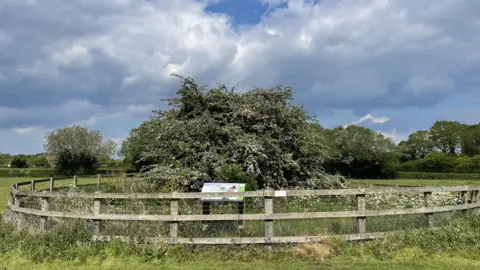
Situated in a beautiful meadow near Wymondham, Hethel Old Thorn consists of a single, ancient hawthorn tree and is believed to be the smallest nature reserve in the UK.
"The reserve is home to a tree and that's about it," said Will Russell of Norfolk Wildlife Trust, whose management of the hawthorn involves "a very light touch".
"When you consider the age of it, when you consider the location, which is absolutely wonderful, and its history, I think it's very difficult to not see it as one of the remarkable trees."
 Edd Smith/BBC
The charity, which celebrates its centenary this year, looks after 42 habitats, some of which have a visitor centre, volunteer guides and acres to explore for hours on end.
By comparison, Hethel Old Thorn is back to basics.
The entire reserve takes up just 600 sq m (6,458 sq ft) and can be walked around in a matter of seconds.
It's no less important for it, as reserves manager Russell explained.
"Hawthorn is one of the really special trees, and this example is really wonderful because of its longevity," he said.
"It's estimated to be around 700 years old, so that's going back to the early 12th Century, possibly the time of King John.
"It's seen the protesters around that time, it's potentially seen Kett's Rebellion [of 1549] .
"Seven hundred years old puts it in the realms of some of the ancient oak trees that we value so much in this country."
In the mid-18th Century, the hawthorn was a "very big tree", Russell said, and measured some 4m (13ft) around its trunk. Over time it has dwindled in size and is now regarded as a bush.
"It doesn't have the majesty of an oak tree, but it has the veteran characteristics that many of our old trees have," he added.
"It's full of cracks and fissures, the bark's really gnarled and open, so it supports a huge amount of wildlife.
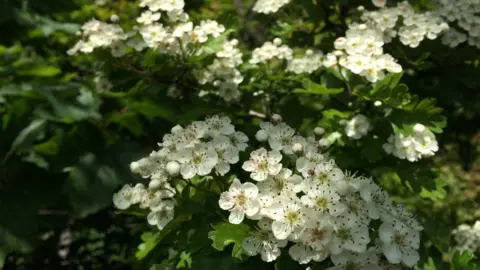
"It's also known as the May tree, it's in flower at the moment and is great for our pollinators. Then, moving through the year, it will have berries in the autumn, which is absolutely superb for migrating birds and our blackbirds."
 Chris Arundel/BBC
Russell said the team had to be "incredibly sensitive" with the ancient tree.
"They grow so slowly that they're very sensitive to rapid change - so even pruning would be a real no-no.
"We don't want to take any of the energy-building leaves away from it, and even things like removing ivy would be something we'd be really concerned about.
"They've grown up in these conditions and if you change them too quickly, the trees often decline."
Small is beautiful, and less is most definitely more.
Do you have a story suggestion for Norfolk? Contact us below.
Follow Norfolk news on BBC Sounds, Facebook, Instagram and X.
