'The real job is at home' - comedian describes life as an unpaid carer

 BBC
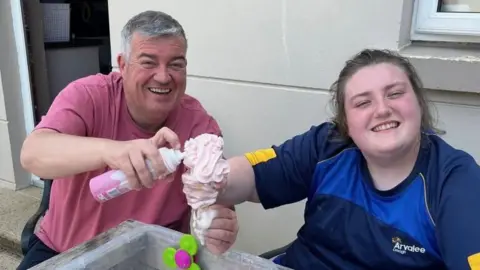
BBCYou might think that standing on stage in front of a crowd and trying to make them laugh would be hard, but for comedian Conor Keys being an unpaid carer for his daughter is "the hardest thing" he has ever done.
His daughter Ruby has severe learning difficulties and he says she can display sudden challenging behaviour.
Keys, who balances life as a performer with full-time caring responsibilities, is calling for more respite services and help to be available for families.
"We need a facility here that can deal with long-term care for children with additional needs," he said.
The Department of Health said additional regional funding was being spent on a range of initiatives to improve family and community support for children with a disability, with the aim of increasing short-break provision and expanding specialist care programmes.
But Keys said the lack of respite care in Northern Ireland has left many families under enormous strain, particularly since the pandemic.
"There are more children going to be in emergency situations and there just is no facility for them," he told presenter Anne-Marie Wallace on BBC Radio Ulster.
The Omagh man described how everyday activities many families take for granted can become impossible at home.
"There was nothing better than my wife and I sitting down and having a cup of tea," he said.
"Something so simple, because we can't have tea if Ruby's around because she could throw the cups or knock it out of our hand."
"One minute they're affectionate and loving, and the next minute they may strike out or become verbally or physically abusive through no fault of their own," he said.
'Comedy is cheaper than therapy'
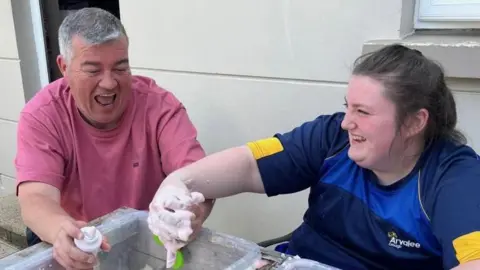
Despite the pressures, Keys said performing stand-up comedy has become an important emotional outlet.
"I'm able to use stand-up to let people see a short glimpse into our family's life," he said.
"It's such a release. It really helps me keep sane."
For Keys, humour has become a coping mechanism and a way of helping audiences understand the pressures carers face behind closed doors.
"One of the best things about Northern Irish people is that we try and find humour in dark moments," he said.
"I try to bring humour to it because comedy is cheaper than therapy."
He added: "You might break down in tears from stress and frustration and then have to go on stage 45 minutes later and make people laugh," he said. "You have to turn that sadness into positive energy, and that's not always easy."
'The real job is at home'
The loss of school routine during holidays can also be especially challenging, he added.
"Never did I think in my lifetime that I would look forward to Monday mornings," he said.
"You're looking forward to going to work for a break, because the real job is at home."
Keys said lockdown was especially difficult for families caring for children with additional needs.
"People were baking and enjoying more family time," he said.
"We were having an absolute nightmare. It was very, very difficult."
'I can't tell Ruby's story, that is her story'
The comedian stressed that while he shares stories from family life on stage, he is careful to draw a distinction between laughing at situations and laughing at his daughter.
"I can't tell Ruby's story, that is her story," he said.
"I can only tell my experience of being in this situation."
In a statement, the Western Health Trust said a short break provision provided by its Children with Disabilities Service had been provided via two residential facilities in the Omagh and Derry/Londonderry area.
But, it said, short breaks were temporarily postponed to support medium term/long-term placements at both facilities.
"The trust is working strenuously to return a short break provision service to the Derry-Londonderry facility within very near future and which will provide short break capacity across the trust area."
The Department of Health said there had been increased service provision across all five geographic trusts that has supported improved access to short breaks.
It said approximately 869 additional overnight short breaks were provided across the region between January 2025 and the end of January 2026, in addition to the development of other support services.
"Whilst the regional investment is beginning to address key areas, short-break services for children with disabilities remain fragile, meaning it can be the case that the long-term placement needs of a small number of children can effectively close off short break accommodation for others," it said.
"It will be necessary to address the significant gap that exists in residential provision alongside preventative community-based services, in order to protect the availability of short-break services. "
