Campaigners concerned by stretch of cycle lane's loss

 Highland Cycling Campaign
Concerns have been raised about the removal of a section of cycle lane in the centre of Inverness.
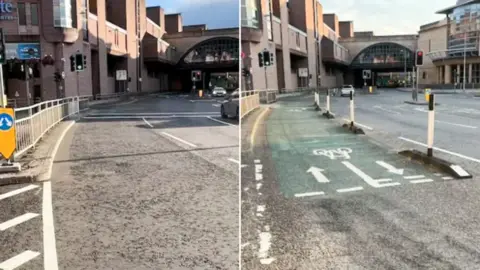
The green lane near the Eastgate shopping centre on Millburn Road was installed during the Covid pandemic in 2020.
However, some bollards and markings have now been removed and the lane has retreated further away from the city centre and now ends opposite Morrison's supermarket.
Campaigners have warned cyclists no longer know where to go on a complex section of dual carriageway. Highland Council said the stretch had been a temporary measure and was removed after a review.
The change has been made at the same time as work is taking place to extend the other end of the cycle lane at the Raigmore Interchange.
The Highland Cycle Campaign said there had been no warning that the lane would be shortened in the city centre.
The group's convener, Emily Williams, said it was a real disappointment.
She said: "Members who cycle with children now actually feel that they are not really that comfortable cycling along here with young kids anymore.
"Cycling infrastructure needs to actively welcome people on to bikes and this at the moment feels pretty hostile if you are not already a pretty confident cyclist."
'Busy access point'
The council said it remained committed to encouraging people to use their bikes.
"The section of protected cycle lane beside the Eastgate car park entrance was removed following a review of the temporary layout," it said.
"This location is a busy access point with frequent vehicle turning movements and a mix of buses, general traffic, pedestrians, and cyclists.
"The change was made to simplify the layout and improve clarity for all road users in this constrained section of Millburn Road."
It said it was still "supportive of safe and accessible active travel provision" and would "continue to take account of feedback from cyclists, disabled users and other stakeholders when considering future improvements in the area".
