'Significant change' needed to tackle agri pollution

 PA Media
Significant change is "urgently needed" to ensure regulations designed to reduce pollution from agriculture improve water quality as intended.
The UK's environment watchdog, the Office for Environmental Protection, assessed the effectiveness and application of the 2019 Nutrients Action Programme (NAP).
It found that, while "considerable progress" has been made, it needs to be "significantly strengthened and better implemented".
Revised regulations are under discussion after farmers said the initial proposals were "out of touch".
The OEP's Chief Scientist Robbie McDonald said it was important changes to tackle the "widening crisis" in our water bodies were not delayed.
'Borrowing from the next generation'

Nutrient pollution has been identified as a top priority for the environment in Northern Ireland by the OEP.
It is already investigating the regulation of wastewater pollution in Belfast Lough.
This latest review has examined the current NAP as the main regulatory framework for managing nutrient pollution from agricultural sources.
It found "gaps in the regulations and areas of legal uncertainty that limit their effectiveness".
And it concluded that the current NAP "will not be able to deliver" strategic environmental outcomes on air, water and land quality.
Professor McDonald said although revising the NAP regulations posed "a challenge" for the Daera minister and the executive, failure to do so would only exacerbate the challenges faced by the next generation of farmers.
"Failing to invest in what needs to be done today is just borrowing from the next generation," he said.
"There is robust evidence that the agri-food industry is a significant contributor to nutrient pollution.
"It must also, therefore, be a significant contributor to reducing pollution."
He added that government, the agri-food industry and its businesses "must play their part" to ensure a just transition for the farming community.
More effort needed
While the review recognises "positive investment and efforts from farmers" since the NAP process began in 2007, it says "further, significant change" is needed.
It added that the agri-food industry has "become heavily dependent" on millions of tonnes of imported animal feed and fertiliser that can provide more nutrient that animals and crops need.
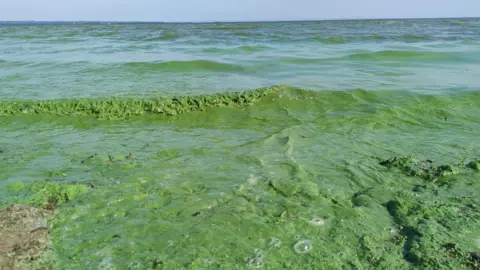
That leads to agricultural run-off which contributes to water pollution, damage to sensitive habitats, and blue-green algal blooms in Lough Neagh and elsewhere.
The OEP has made 12 recommendations to help strengthen the regulations, looking at compliance, technical provisions, and establishing the scale of nutrient pollution reduction required to improve water quality.
They include providing advice and support to farmers, increasing inspections of farms, and future-proofing the regulations for increasing climate change.
The report warns that the deterrent effect of fines for pollution incidents may be relatively limited, but that both civil and criminal sanctions should remain available to regulators in accordance with the scale of each case.
'Top priority' to improve water quality
Agriculture minister Andrew Muir said "improving water quality is a top priority" but it is "critical we work together".
He added that the NAP regulations have an "important role to play as part of the suite of measures required to improve water quality".
"I look forward to receiving the group's final report in the near future as we move towards launching a further public consultation on proposals for the revised NAP in the coming weeks," said Muir.
Farming leaders have questioned the timing of the OEP's report.
Deputy president of the UIster Farmers' Union, John McLenaghan, said farmers were "already actively engaged" in the review of the latest NAP plans to consider proposals for both agriculture and the environment.
"Agricultural policy cannot be developed by looking at environmental outcomes in isolation," he said.
"Policy must also recognise the economic realities of local food production and the importance of rural communities.
"It is impossible to deliver balanced and workable policy if only one input is considered."
He said while the "significant investment and changes" made by farmers had been acknowledged by the OEP, it was "essential that all sectors of society play their part in addressing water quality".
What is the NAP?
The Nutrients Action Programme was launched in 2007, to tackle water pollution from agricultural sources.
It is reviewed every four years.
The new NAP should have been in place from 2024.
A proposed document for 2026-29 was published for consultation last year.
But farmers branded it out of touch.
A "task and finish" group was then announced to review the proposals.
Representatives of the agri-food indstry agreed to take part, to produce a reviewed document that would go to further consultation before the Executive would be asked to sign it off.
The reviewed proposals are expected to be published in 2026.
