Who won the local elections in Southwark?

 Getty Images
What happened in Southwark in the 2026 council election, and who won?
Labour lost overall control of Southwark on 7 May but no party has a majority.
The results were:
Labour: 29 seats (-23)
Green: 22 seats (+22)
Liberal Democrat: 12 seats (+1)
When were the 2026 local elections in London?
More than six million Londoners were eligible to vote in the council elections on Thursday 7 May 2026.
All 32 London boroughs were up for election.
There were also elections for the mayor in five boroughs: Croydon, Hackney, Lewisham, Newham and Tower Hamlets.
 Getty Images
Where is Southwark and who lives there?
The London Borough of Southwark is in south and south-east London and is bordered by Lambeth to the west, Lewisham to the east, and Bromley and Croydon to the south.
Tower Hamlets is located across the river to the north-east and the City of London is north of the borough, across the River Thames.
What's it like? Southwark has both bustling attractions busy with tourists and residential neighbourhoods. The borough has the highest number of social homes in London, with the local authority managing more than 37,000 properties.
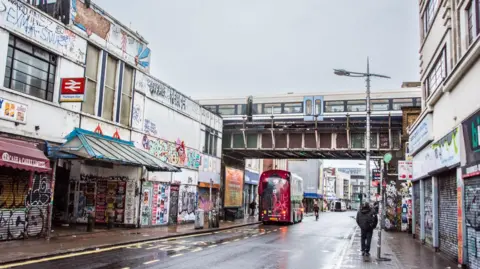
Neighbourhoods: The borough includes the neighbourhoods of Bermondsey, Peckham, Elephant and Castle, Camberwell and Dulwich.
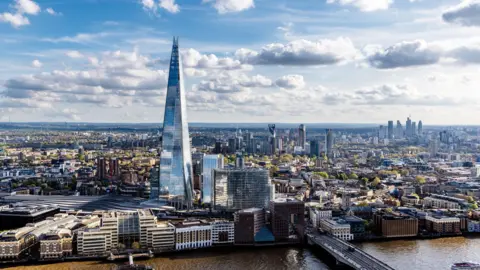
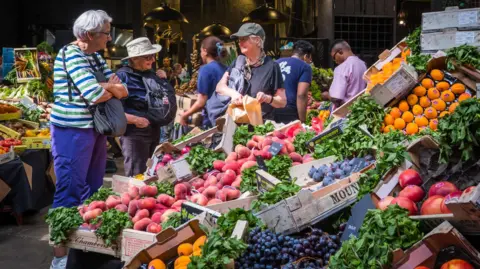
Places of interest: Southwark is home to Tower Bridge, the Tate Modern, the Globe Theatre, Southwark Cathedral, the Shard, and Borough Market.
Pub quiz fact: London's first pie and mash shop, or pie and eel house as it was known, was recorded in 1844 at 101 Union Street, in Southwark.
Population: Southwark's population was an estimated 314,786 people in 2024, according to ONS data.
Demographics: According to the 2021 census, 51.4% identify as white, 25.5% as black, 9.9% as Asian, 7.2% as mixed race and 2.4% as another ethnic group.
Average property price: According to the Office for National Statistics (ONS), the average house price in Southwark in December 2025 was £589,636.
Average monthly rent: The ONS reported that the average monthly rent in January 2026 in Southwark was £2,387.
Council tax: Band D council tax in the borough for 2026/27 is £1,456.75.
Transport: Southwark has six Tube stations, six Overground stations, and about 620 bus stops. There are also 11 stations that serve National Rail trains including London Bridge.
 Getty Images
What is Southwark's local history?
Between the 14th and 16th centuries, Southwark lay beyond the City of London's control and was a hub for banned activities including bear baiting and prostitution.
The borough was also home to numerous playhouses including Shakespeare's Globe and was notorious for its brothels, licensed under the jurisdiction of the Bishop of Winchester.
In the 19th Century it was notorious for its slum-like housing and deep levels of poverty.
In 1900, the Metropolitan Borough of Southwark was formed, bringing the industrial, heavily populated area formally into London.
Destruction caused by World War Two and subsequent redevelopment schemes changed the borough's character, and in 1965 the former metropolitan boroughs, Bermondsey, Camberwell and Southwark were merged to form modern-day Southwark.
Listen to the best of BBC Radio London on Sounds and follow BBC London on Facebook, X and Instagram. Send your story ideas to hello.bbclondon@bbc.co.uk
