'It's made me have an identity crisis': Londoners speak out about racist abuse
A man said something to me and I assumed he needed directions so I took my earbuds out to listen to him.
What I heard shocked me. I completely froze.
He was shouting, swearing and hurling vile racist abuse, telling me: "You need police protection, call the police."
He walked away, I filmed him then he came back - repeating those words once again.
I am a British Asian. This is in London, in my neighbourhood. In the city I deliberately chose to make my home because of its diversity - the first place where I felt a sense of belonging after growing up in a less multicultural part of the country.
That sense of belonging and safety has now been badly shaken, and I'm not alone in this. After I shared what happened on social media, messages started coming in from people who have had similar experiences.

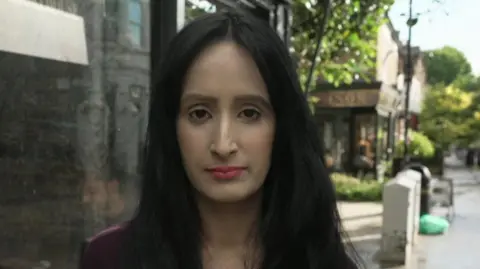
One of them is Uzma Hussain, who had opened the Axe and Ember Smokehouse with her husband in Walthamstow Village just before Christmas.
A few days later, a woman stood outside the window – gesturing a thumbs down.
Uzma thought she didn't like meat or was perhaps a vegetarian, so went out to speak to her.
"She just started saying some really, really horrible things. She was like, 'You don't belong here.'
"And then she called me, the P-word. I've never been called that before.
"I went from surprised, shocked, not believing what had happened to really angry at one point."
'It's not fair'
Uzma, who was born and bred in Walthamstow, says the abuse went on for at least 30 minutes.
Uzma, who works as a lawyer, became tearful as she described the emotional toll it's taken.
"I think it's affected me far more than I thought it would because ultimately it's just words.
"You know why do I care what someone... who doesn't know me thinks about me?"
Uzma says the abuse left her questioning where she belongs after being told she wasn't welcome in the place she calls home.
"It's kind of made me almost have an identity crisis, you could say. It's not fair how I have gone away feeling and that's going to be with me forever."
She says the support she has had from the local community has been "absolutely phenomenal" and some had their own stories of racism.
"I've had hundreds of people come in and share their experience and some of them have got evidently very emotional about it and I'm glad that I have been someone who has been able to almost support them."
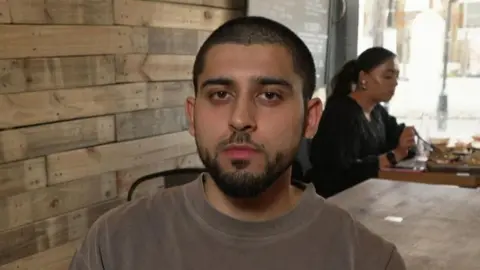
Jimmy Bapu, who is a food influencer, was inside the restaurant that night where he was filming a video.
When he realised something was wrong, he stepped out to help – but was also racially abused.
"Look at the state of you," the woman said to him before using racist abuse.
Jimmy told her he was British-born and from east London, and then a passer-by chimed in: "Take those opinions home. They don't belong in Walthamstow. Go home.
But the racist abuse carried on.
"I lost sleep because of it," Jimmy says, "I haven't been the same since."
He posted the video to his TikTok.
"The first three hours, it was just, like, full of hate. Like, pure hate as well, like, they're agreeing with what she's saying.
"It's like, 'Wow, they really don't like us because of the colour of our skin.'"
What do the numbers say?
Figures from the Metropolitan Police show racist hate crimes in London are up 9% in the past 12 months, with nearly 18,000 reported offences.
Outcomes are improving, with around one in eight reported offences going through the justice system in the past year - compared with fewer than one in 10 in 2025.
But campaigners say the true scale is likely to be higher, as many incidents go unreported.
The incidents in Balham, where I was targeted, and Walthamstow are currently being dealt with by the justice system.
In terms of my case, the police response has been speedy.
A man was arrested the same week and has since been charged with a racially aggravated public order offence.
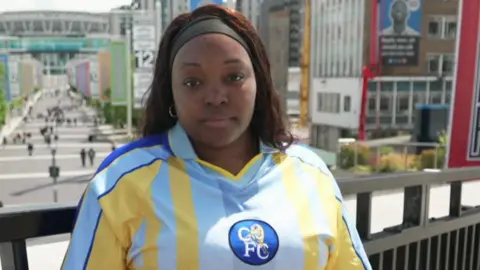
But Ashlee Moyo is still waiting for answers after being singled out by a Leeds fan who made racist gestures at her as she was leaving the club's FA Cup semi-final against Chelsea at Wembley in April.
She says the man first made monkey gestures towards another black football fan before targeting her.
"He literally looks right at me and then starts doing monkey gestures at me as well.
"And that was when I was like, my goodness, this is definitely not an accident, it's intentional and it's on purpose.
"I was just shocked. I was in a lot of disbelief. And then I was quite upset.
"And no-one said anything. Nobody flinched."
As an avid Chelsea fan, Ashlee is used to going to matches on her own but now feels more wary.
"I've been to several different stadiums in England to watch England and Chelsea play.
"I've never had this experience ever in my life.
"So it did make me start to feel a little bit anxious about going to games by myself again, but I kind of was like, I don't want to let people like that win.
"I don't want it to take away my love for the sport. It's disappointing that now I'm thinking a bit more about it."
'We have to make a fuss'
The Met acknowledges that hate crimes, including racist hate crimes, have a serious and lasting impact.
The force says it is setting up a new detective-led hate crime team to improve investigations.
In a statement, Supt Owen Renowden, the Met's hate crime lead, said: "We're adapting our approach to improve both the speed and quality of our response, while strengthening outcomes for victims."
A common theme running through all these stories is the disbelief that the racist abuse endured by our parents' and grandparents' generations is still a reality in modern London.
Jimmy said: "I mean, we've been here generations in the UK and even though my parents have experienced racism, my grandparents have experienced racism, now I'm part of that, I guess, pain and I guess, all of that trauma."
Ashlee and Uzma say they feel a responsibility to speak up.
"Perhaps in our parents' generation, they would have just shrugged it off," Ashlee says.
"I think that's what is different now is that our generation, when something is wrong, we are going to call it out."
Uzma says: "We've got to make a fuss about it so it's really clear that this behaviour is not OK. As a generation, we're not going to put up with it.
"Our parents did. We are not going to. We have no reason to."
Listen to the best of BBC Radio London on Sounds and follow BBC London on Facebook, X and Instagram. Send your story ideas to hello.bbclondon@bbc.co.uk
