Malawians repatriated from South Africa amid xenophobia concerns

 Malawi government
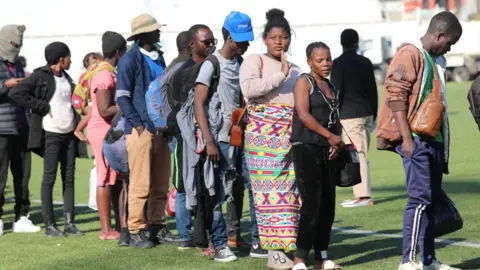
A group of 171 Malawians repatriated from South Africa amid growing worries about xenophobia arrived in their home country on Tuesday, Malawi's government has said.
The repatriation follows violence in South Africa's Western Cape Province where there were reports just over a week ago of door-to-door intimidation, as well as the deaths of two Mozambicans in Mossel Bay.
The Malawians were "among a number of foreign nationals" who had "sought refuge in temporary camps" in Mossel Bay, according to a statement from Lilongwe.
Ghana, Nigeria and Zimbabwe have also organised repatriation flights and transport after raising concerns about xenophobia in South Africa.
Images shared on X by Malawi's government on Tuesday show a long line of people queuing in an empty stadium. They appear to be waiting to be registered.
The government, which had earlier said the returnees would be arriving on Monday, described them as the first group of nationals displaced in the Western Cape to come back home through a "voluntary repatriation exercise".
They included 115 men, 43 women and 13 children, officials said.
In South Africa, anti-migrant groups are demanding undocumented migrants leave the country - and have set 30 June as a deadline.
In a national address on Sunday aimed at easing tensions, South African President Cyril Ramaphosa announced a raft of new measures to crackdown on illegal migration.
But he also warned South Africans not to take the law into their own hands. He said there was "no space for xenophobia, racism, sexism, Afrophobia or any other forms of intolerance" in the country.
A group of 74 Zimbabweans arrived home on Sunday after being driven from Mossel Bay in transport organised by the Zimbabwean authorities. Some families with young children say they fled the Western Cape fearing for their safety.
At the end of last month, Ghana organised a repatriation flight from Johannesburg for nearly 300 of its citizens. A group of about 680 more arrived in Ghana's capital, Accra, at the weekend.
On Saturday, South Africa's Foreign Minister Ronald Lamola accused his Ghanaian counterpart of spreading misinformation about xenophobia in South Africa.
In a post on X, linking to an interview that Ghana's Foreign Minister Samuel Okudzeto Ablakwa gave to a news station in Accra, Lamola described what he heard as "deeply disappointing".
Ablakwa told Joy News that he was proud of the solidarity that Ghanaians had shown in supporting their fellow nationals.
He also talked about reports of foreigners being killed after being attacked in South Africa and reiterated a call for the African Union (AU) to investigate what was happening.
In response, Lamola disputed that two Nigerians and five Mozambicans had died in separate acts of violence.
On Ablakwa saying that a number of Ghanaians were being treated in hospital in South Africa after being attacked, Lamola said his government had "no information of that nature whatsoever".
Ablakwa also said that his government had asked South Africa to compensate the Ghanaians who had been repatriated for the property that they had left behind.
As part of Ramaphosa's plan to deal with illegal migration, the president said the deportation of undocumented migrants would be sped up.
In order to help pay for the removals South Africa is now looking into asking the various receiving countries for money to cover the cost, Deputy Home Affairs Minister Njabulo Nzuza told Radio 702.
Meanwhile, Nigeria has postponed the first planned evacuation flight for 270 of its citizens that was due to leave on Monday.
Nigeria's foreign affairs spokesperson Kimiebi Imomotimi Ebienfa said the evacuation "has been rescheduled for Wednesday... due to unforeseen logistical considerations".
Officials say more than 500 Nigerians have so far been screened and cleared for return as part of a wider government response to the anti-migrant tensions in South Africa.
Nigeria's President Bola Tinubu has approved five evacuation flights in total, with screening and registration of affected citizens extended to Wednesday as authorities continue processing applicants.
Additional reporting by Makuochi Okafor and Shingai Nyoka
 Getty Images/BBC
Go to BBCAfrica.com for more news from the African continent.
Follow us on Twitter @BBCAfrica, on Facebook at BBC Africa or on Instagram at bbcafrica
