Storks released in Cornwall rewilding plan

 Tom Mason
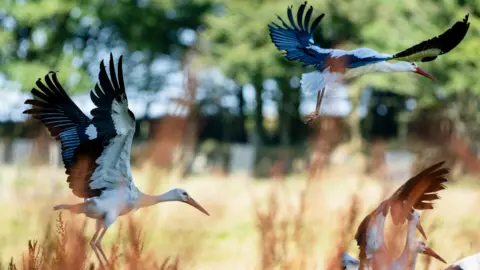
A total of 21 white storks have been released into the wild as part of a charity's aim to reintroduce them in the county.
Yan Swiderski, founder of the Cornwall Stork Project, released the storks from the project's base at Hamatethy, St Breward, near Wadebridge last week.
It is hoped the birds will eventually return to their roots when they are ready to breed, going on to raise their young in Cornwall and recolonising the area.
Swiderski said the species "get imprinted on the place they first fly from" meaning they will "return from their migration and go back to almost exactly the same place they came from" when they decide it is time to nest.
 Tom Mason
The first wild white stork chicks in the UK for hundreds of years hatched at the Knepp Estate in West Sussex in 2020.
Swiderski said the storks released from his land will likely be ready to breed in three or four years time.
In the meantime, the birds are "going to be exploring" with reports of one already 80 miles away in Devon.
"There are about 13 of them still hanging around the edge of Bodmin Moor and there have been others spotted in different places," he told BBC Radio Cornwall.
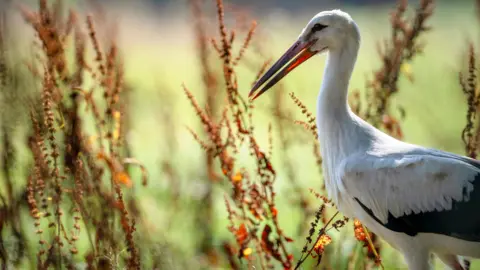
He noted the birds - for which he did not require a licence to release because they are historically native to Britain - are ringed with a black ring and white lettering, beginning with a 'K' for Kernow.
"When these storks come back they need food on the landscape in order to thrive," Swiderski explained.
"They need insects, small mammals, reptiles and amphibians - earthworms they eat as well, so if we can do all those things then the storks can do really well."
In order to help their habitats, he is also carrying out a separate project to reintroduce beavers to the whole of Cornwall.
Beavers, he said, create "amazing wetlands" full of "all those creatures".
"The beavers will create habitat not just for the stork but for many other things," Swiderski said.
To help track the birds' movements, anyone who sees one of the ringed storks is encouraged to report their sighting via the Cornwall Stork Project website.
Follow BBC Cornwall on X, Facebook and Instagram. Send your story ideas to spotlight@bbc.co.uk.
