Key points as MPs question ex-senior aide about Mandelson appointment

 UK Parliament/ PA
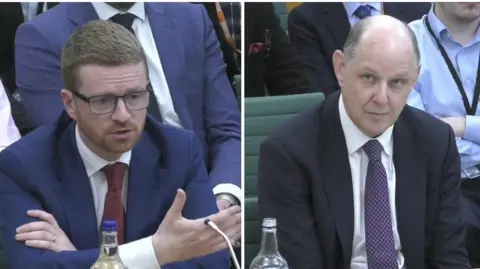
The Foreign Affairs Committee has been hearing evidence about the vetting of Lord Mandelson to be the UK's ambassador to the United States.
The prime minister sacked Lord Mandelson from the role in September 2025 over his links to the convicted sex offender Jeffrey Epstein, but has been facing ongoing questions about the appointment ever since.
The committee first heard from Sir Philip Barton, who was the senior civil servant at the Foreign Office when the PM decided to send Lord Mandelson to Washington DC.
The MPs then questioned Morgan McSweeney, Sir Keir Starmer's chief of staff from 2024 until February 2026, when he quit over his role in the Lord Mandelson appointment.
Here are the key points from the evidence.
No consultation on Mandelson appointment
Sir Philip said the first time he was aware of the decision to appoint Lord Mandelson was on 15 December 2024 - five days before the prime minister publicly announced it.
Asked if he believed he should have been consulted, Sir Philip said the job was one of the UK's "major" diplomatic posts and that he thought it was "reasonable" that he should have been involved.
But he also noted that it was a political appointment rather than an internal civil servant recruitment and concluded he was "a bit conflicted" on the question.
He said that there had been "no space or avenue or mechanism" to express any concerns he might have felt about the appointment.
Concerns about 'toxic' Epstein links
Conservative MP Aphra Brandreth asked Sir Philip if he'd been asked, would he have expressed worries about picking Lord Mandelson.
He replied he was concerned that Lord Mandelson's links to Epstein "could become a problem".
He said that at the time he had not known what further information would come out about the friendship between the two men but he had identified that Epstein was "a toxic hot potato subject" in the US.
He added that Donald Trump's team had been "happy" with the existing UK ambassador Dame Karen Pierce and had been "blindsided" by the Lord Mandelson appointment.
No 10 'uninterested' in Mandelson vetting
Last week, Sir Philip's successor at the Foreign Office Sir Olly Robbins said Downing Street had been "dismissive" of the vetting process.
Asked about that description, Sir Philip said: "The word I would use is uninterested."
He said the focus was on making sure Lord Mandelson was able to start his job by the time of Trump's inauguration.
Sir Philip said that no-one had asked him, given the risks, to ensure that the vetting process was "rigorous".
'Absolutely' pressure to get vetting done
Sir Philip partly backed up Sir Olly's assertion that the Foreign Office faced "constant pressure" to complete the vetting process.
He said there were two areas where pressure could have been applied - on the substance of the vetting case, and on the speed of the vetting.
On the substance, he said that he was "not aware" of any pressure but there was "absolutely" pressure to "get it done by a particular time scale".
"The top of the government is saying the prime minister has decided he wants Mandelson and he wants it done in that timescale, so that's what creates the pressure."
Last week in the House of Commons, the prime minister said "no pressure existed whatsoever" on the case.
Over the weekend, he expanded on his comment, telling the Sunday Times there were "different types of pressure".
"There's pressure - 'can we get this done quickly?' – which is not an unusual pressure. That is the everyday pressure of government."
In his evidence, McSweeney echoed this stance telling the MPs that there was "a real difference between asking people to act at pace and asking people to lower standards - and we never did that."
Mandelson appointment was 'serious error'
Morgan McSweeney began his evidence by apologising to the victims of Epstein for the distress caused by the controversy surrounding Lord Mandelson's appointment.
He said giving Lord Mandelson the job was "a serious error of judgement" and that he had been "wrong" to advise the prime minister to do so.
He said that at the time he could "see pros and cons and I worried it could go wrong so I didn't try and push anything through".
'Knife through my soul'
McSweeney said that at the time of the appointment he "understood" that Lord Mandelson's relationship with Epstein was "not a close friendship" but "a passing acquaintance".
"What has emerged since then was way, way, way worse than I had expected at the time," he added.
He said that seeing pictures of Lord Mandelson with Epstein, which appeared to document a close relationship between the two men, was "like a knife through my soul".
Lord Mandelson has apologised for maintaining a friendship with Epstein. In January, he told the BBC: "I was never culpable or complicit in his crimes. Like everyone else I learned the actual truth about him after his death."
Would have been 'better' for ethics team to ask Epstein questions
McSweeney said that both he and Lord Doyle (then the prime minister's director of communications) asked Lord Mandelson about his links to Epstein during the appointment process.
Asked if it that was appropriate given the men had known Lord Mandelson for many years, McSweeney replied: "I think that when I look back on it, I certainly think it would have been much, much better if I'd asked PET to ask those follow-up questions."
PET (the Propriety and Ethics Team) sits in the Cabinet Office and provides advice on standards.
McSweeney said: "I guess my thinking at the time was I'd put follow-up questions to him in writing, and that if a senior member of staff did that, that he would feel more obligated to give the truth and the full truth."
Later in the hearing, he said: "At the time, I thought I got the truth back from him.
"When I saw the emails and the pictures that came out and that were published from the Epstein files in September last year, that's when it really dawned on me that I did not get the full truth from him."
Mandelson 'not some hero'
McSweeney dismissed suggestions that he had pushed for Lord Mandelson to get the job because he had been his "mentor".
He said that during his career in politics he had frequently angered friends by turning them down from jobs.
Lord Mandelson was "not some hero I was trying to get a job for" he said but rather a man he believed had the right skills for the job.
"My motives were always in the national interest," he added.
Badenoch demands PM faces Privileges Committee
In the Commons, Conservative leader Kemi Badenoch opened the debate demanding Sir Keir Starmer face the Commons Privileges Committee for allegedly misleading MPs, claiming Labour backbenchers are being made "complicit in a cover-up".
She's backed by Liberal Democrat leader Sir Ed Davey, who says former Conservative Prime Minister Boris Johnson allowed a free vote on whether he should face the same committee over the Partygate scandal.
Some Labour Party MPs spoke to back their leader and dismiss Badenoch's call as politicking ahead of next week's local elections, with Gurinder Singh Josan branding the move "clearly political and partisan".
But fellow MP Emma Lewell told the Commons she believed Sir Keir should "clear his name" at the committee, suggesting she could abstain on today's vote.

Sign up for our Politics Essential newsletter to keep up with the inner workings of Westminster and beyond.
