Why are so many babies born by IVF in Jersey?

 Reuters
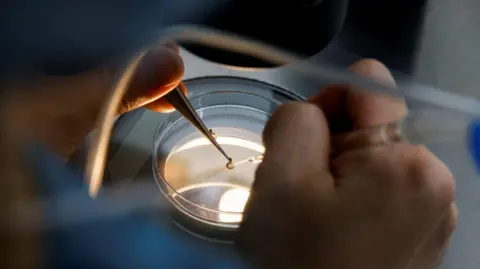
One in thirteen babies born in Jersey last year was conceived via IVF - more than double the rate of England and Wales.
Figures shared by fertility charity Tiny Seeds revealed that 52 out of 698 babies born in Jersey in 2025 were conceived by IVF - 7.4% of all births. The charity said it had been calling for specific IVF details as part of birth rate figures, provided by Jersey's government and Women's Health Hub, to be released for five years.
Comparatively, the most recent data for England and Wales found that 1 in 32 babies born in 2023 - about 3% of all births - were conceived via IVF.
So why is this figure higher in Jersey and what might it reveal about wider challenges facing the island?
Older mothers
Neil MacLachlan is a gynaecologist at the independent Women's Health Hub, which provides assisted reproductive support to Jersey couples.
He said the prominence of IVF was down to women being older when they give birth.
In Jersey, the average maternal age is 32, while in England and Wales it is 31.
MacLachlan said: "We've known certainly over the last 30 years that the number of women having babies over the age of 35 is much higher in Jersey than in the UK.
"Once you get into your mid-30s the quality of eggs decline quite rapidly and therefore the ability to conceive.
"Miscarriage rates go up and women find themselves having to have IVF treatment or assistance to have that family they so desperately want."

Cost of living
MacLachlan said mothers were having children later for a "number of reasons" with the most significant the cost of living.
He added: "The cost of living in Jersey is some 30% more than the UK and therefore women are having to delay starting a family.
"So really they are starting a little bit too late but that's probably because of the economic climate that they live in... people cannot afford to start a family earlier."
Natalie Fosse said she delayed having her second child until her first was at school because of the cost of living in Jersey.
She said: "Everything is just really expensive here, housing, rent, mortgages, childcare and even day-to-day living.
"So I think a lot of people feel like they need to be completely financially secure before they can even think about starting a family."
Lifestyle factors
MacLachlan added that there were also "lifestyle reasons" why people in Jersey were affected by infertility.
He said, for example, people eating ultra-processed food was causing higher obesity levels, which affects ability to conceive.
He also said lifestyle factors were likely to affect male fertility, which is often overlooked when it comes to IVF statistics.
He said: "Male factor infertility is probably as equal to female numerically and that probably is more lifestyle related.
"There's been very good data on the quality of men's semen over the last 50 years and it's probably halved in that time.
"We do know that men starting a family later - maybe over the age of 50 - cannot be a great thing with regards to quality of sperm."
Katie Rollings from the UK charity Fertility Action echoed sentiments about male fertility.
She said: "We are definitely seeing from research that when lifestyle is really focused on, so that's good diet, healthy lifestyle and exercise, avoiding things like vaping, smoking, drinking... these can all have an effect on production of sperm."
Rollings said there has been research suggesting that endocrine disrupting chemicals - seen in plastics and chemical sprays, such as perfumes and hairsprays - are also linked to declining fertility.
She added that the cost of housing and childcare was also making the decision to have children difficult.
Funding for IVF
In Jersey, couples can access up to three government funded cycles of IVF, depending on household income and maternal age.
The criteria was expanded last year to include same-sex female couples and couples where one partner has a child from a previous relationship.
However, parents and charities have criticised the government for excluding single parents, same-sex male couples, those needing IVF via surrogacy and couples who have previously had children.
In England, local NHS organisations, known as integrated care boards, set their own eligibility criteria.
A recent report found NHS-funded cycles across the UK have decreased in recent years from 35% in 2019 to 27% in 2023, with some people describing access as a "postcode lottery".
Rollings said part of the issue was a lack of political understanding that infertility is a medical diagnosis.
She said: "It's just still not being treated like that within the UK and it seems to be an optional extra to have fertility treatment rather than the absolute medical need that we're seeing from patients."
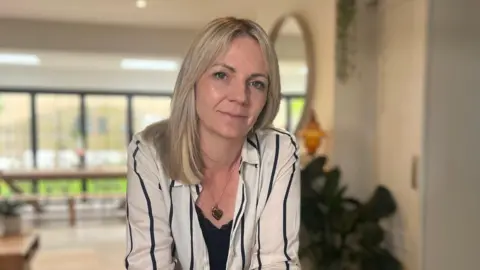
Chloe Fosse from Tiny Seeds said there was a similar lack of understanding from politicians in Jersey.
"It still feels like this very strange area of healthcare that just is being overlooked," she said.
When asked whether more people in Jersey might be accessing IVF than in England and Wales because more people can afford it, Fosse said it was difficult to compare access to funding between the jurisdictions.
She highlighted that two-thirds of IVF cycles in Jersey last year were not supported by the government - similar numbers to the UK.
"I don't think people appreciate just how much a cycle of IVF costs to privately fund it," she added.
"People will afford it if they have to, one way or another, whether that's taking out a loan, whether it's borrowing from family members.
"You know, in my personal situation, when our car broke down, my husband cycled to work for two years because rather than replace the car, we wanted to try and have more IVF. It's not simply a case of, well, they can afford it, so that's okay."
Is there a wider issue?
Rollings is one of many who has suggested there is a global fertility issue, something she has said needs widespread policy and cultural change.
Figures released earlier this week revealed the total fertility rate (TFR) in England and Wales, the average number of children women are expected to have, fell to 1.39 - the lowest ever recorded.
In Jersey, the TFR has fallen to 1.14.
The replacement rate, or number of children women need to have to maintain a stable population, in the UK and in Jersey is about 2.1.
Fosse said future Jersey governments need to "stop looking at IVF funding as a problem and a barrier".
She has called on candidates standing in Jersey's June election to "recognise the growing importance of fertility care".
She said: "I think that we need to be looking at fertility as part of the wider population conversation and the wider picture and taking it into account alongside things like those high nursery fees, high cost of living costs, high housing costs, and seeing the direct impact that having funded IVF and potentially widening that funded IVF could have."
MacLachlan said politicians need to focus on policies that encourage people to have children, such as earlier assistance with childcare costs.
"My message to the government would be to review the way that the current health service is being funded, it's not fit for purpose and only by reviewing the funding can we give help to those young parents, potential parents, so that they can start having a family at an age where they're much healthier and less likely to need IVF," he added.
Jersey's government has previously said a women's health strategy was a requirement of the Government Plan and is due to be published later this year.
Follow BBC Jersey on X and Facebook. Send your story ideas to channel.islands@bbc.co.uk.
