Two US troops killed and one missing after Iranian attack in Jordan

 Getty Images
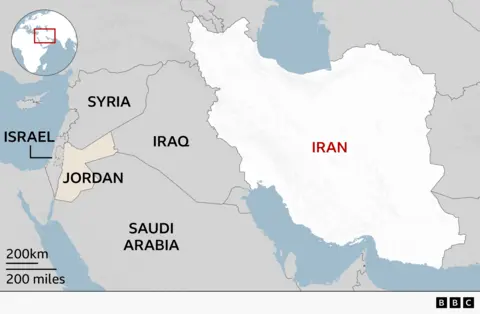
Two US service members were killed and one remains missing after Iranian ballistic missile and drone attacks in Jordan on Friday, military officials said.
The US Central Command (Centcom) said four US service members were medically evacuated to Jordan hospitals but have since been discharged. Others who had minor injuries have returned to duty.
US military officials did not disclose the identities of those killed, nor provide details about the circumstances or location of the incident.
On Saturday night the US launched another round of air strikes against Iran at President Donald Trump's direction, Centcom said.
The strikes - for the eighth night in a row - are "designed to further degrade Iran's ability to threaten commercial shipping in the Strait of Hormuz", the statement said.
The strikes aim to "swiftly punish Islamic Revolutionary Guard Corps forces who launched attacks against American service members in Jordan last night," the statement continued, without providing further details.
It followed a week of renewed hostilities in which Washington reimposed its blockade of Iranian ports and Tehran declared the Strait of Hormuz closed, as their preliminary ceasefire collapsed less than a month after it began.
Late on Saturday, Iran's Supreme Leader Mojtaba Khamenei said in a written statement that America's "repeated breaches" of the agreement had "laid bare a fundamental truth: the signature of the US president is utterly worthless and devoid of credibility".
Khamenei, who has not been seen in public since the attack which killed his father at the start of the war, accused the US of seeking to "escalate the conflict" and said Iran had "unforgettable lessons in store for it".
Jordan's military earlier said it had intercepted 10 Iranian missiles fired into its airspace overnight, without reporting any damage.
The US death toll in the conflict has now risen to 16 after an American Navy pilot who went missing earlier this month was declared dead, marking the second increase in the toll this week.
In a statement on Saturday, Centcom said: "Two US service members in Jordan were killed in action as US Central Command (Centcom) and partner forces defended against Iranian ballistic missile and drone attacks. Additionally, one service member is currently missing.
"Out of respect for the families, Centcom will withhold additional information, including the identities of the fallen warriors, until 24 hours after the next of kin have been notified."
Responding to the announcement of the deaths, US Defence Secretary Pete Hegseth wrote on X: "Godspeed, heroes. Their sacrifice only stiffens our resolve."
The Islamic Revolutionary Guard Corps (IRGC) said it had destroyed at least two US fighter aircraft early on Saturday on Al-Azraq base in Jordan, according to Iranian state media.
The BBC contacted Centcom regarding this report but it declined to add further details.
Separately on Saturday, the US Department of State issued a notice advising Americans worldwide, but particularly in the Middle East, to exercise "increased caution".
The travel notice urged those in the region to "monitor the news for breaking developments", adding: "Due to heightened tensions in the Middle East, the security environment remains complex with the potential for unforeseen escalation."
Washington and Tehran struck a preliminary deal to end the war in June, but the agreement unravelled within weeks - with Trump declaring the agreement "over" on 8 July.
At least 50 people have been killed and more than 500 injured in US strikes over the past three weeks, Iranian state media reported citing the country's health ministry.
Thousands more have been killed across the Middle East since the US-Israeli war with Iran began on 28 February, official figures show, with the vast majority coming from Iran and Lebanon.
As well as military targets, both Iran and the US have been accused of striking critical infrastructure in recent days.
The US denied Iranian accusations that it had hit bridges, a train station and an airport earlier this week. Washington said it had exclusively struck military targets. BBC Verify confirmed an attack on a bridge in Hormozgan province.
Trump had threatened on Tuesday to strike Iran's bridges and power plants next week if the country did not return to talks.
Meanwhile, the Gulf Cooperation Council accused Tehran of deliberately targeting civilian infrastructure in the region. After Iran said it had responded to US strikes by targeting American Gulf allies on Saturday, Kuwait said a power plant and a water distillation plant had been hit.
Jasem Mohamed Albudaiwi, who leads the council representing Saudi Arabia, Kuwait, Qatar, Bahrain, the United Arab Emirates and Oman, said such action amounted to "war crimes".
Under international law, attacking civilians or civilian areas is illegal. However, in certain circumstances, civilian objects - like a bridge or a power plant - lose their protection if they are used to support the enemy's war effort.
This week also saw Trump reimpose the US blockade of Iranian ports, under which Centcom said five commercial vessels had been "redirected" and one had been disabled as of Saturday.
Iran meanwhile declared the Strait of Hormuz shut, causing traffic to grind to a halt through the vital shipping channel through which around a fifth of the world's oil and liquefied natural gas ordinarily passes.
Trump said on Monday that all vessels transiting the strait - including those of US allies - would have to pay a 20% fee to do so, before abandoning the proposal altogether on Tuesday, saying it would instead be replaced by trade deals with Gulf allies.
