Dry weather creates 'brilliant' conditions for ospreys

 Leicestershire and Rutland Wildlife Trust
Extended periods of dry weather over the summer have created "absolutely brilliant" feeding conditions for ospreys at Rutland Water, the Leicestershire and Rutland Wildlife Trust has said.
The Rutland Osprey Project began in 1996 and saw young osprey chicks relocated from Scotland to Rutland Water, with the aim of creating a self-sustaining breeding colony.
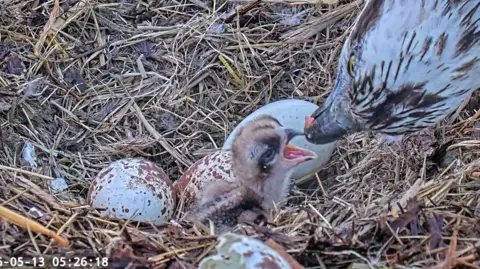
Since then, 333 ospreys have been born as part of the project and in 2025 a new record was set when 11 breeding pairs produced 31 chicks.
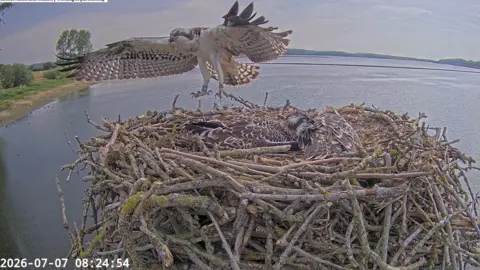
Tim Sexton, from the trust, said recent dry weather had "increased fishing opportunities" for adult birds and he had "seen a lot of the chicks fledge a little bit earlier" as a result.
 Leicestershire and Rutland Wildlife Trust
Sexton said: "I think its just the adult birds have had better opportunities to fish throughout the summer.
"In a typical year we have lots of wet spells - the adults find it harder to fish in wet conditions.
"It is harder for them to fly when it is wet and to see the fish through the water surface when it is raining harder.
"The adults need to dry their feathers more frequently before they can fly."
The number of chicks hatched this year at Rutland Water was lower than 2025, with 24 chicks from 12 nests.
However, Sexton explained this was because two "experienced" birds had not returned to the colony this year and had been replaced by younger breeding birds.
 Leicestershire and Rutland Wildlife Trust
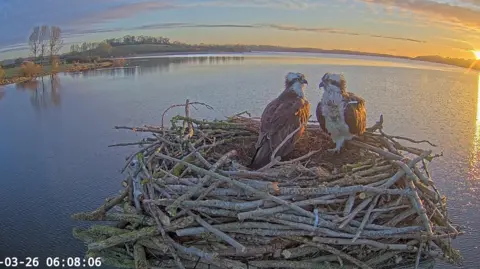
Sexton said some of the chicks had been "very healthy" and "well-fed" including a bird called 8R5 from the Manton Bay breeding pair – Maya and 33 – who was believed to have already begun its migratory journey to the west coast of Africa for the winter months.
Sexton said: "8R5 hasn't been seen since 31July.
"Normally we would expect all the chicks to be around until well into September.
"They have had long days of sunshine, very little rain or bad weather that is going to set them back.
"So really, they have been able to feed well.
"In some years we lose chicks in adverse weather conditions particularly when the chicks are very young."
Sexton said members of the public would be able to see the fledglings until about mid-September when they begin their journey to Africa.
He said the birds would settle in either Senegal or The Gambia because of the "good fishing opportunities" and once there, set up "winter territories" on beaches.
Once they reach breeding maturity at two to three years of age they will return to UK, Sexton added.
Listen to BBC Radio Leicester on Sounds and follow BBC Leicester on Facebook, on X, or on Instagram. Send your story ideas to eastmidsnews@bbc.co.uk or via WhatsApp on 0808 100 2210.
