What comes next for US and Canada passengers evacuated from hantavirus-hit cruise ship
Eighteen American and seven Canadian passengers from a virus-hit cruise ship that docked in Spain's Canary Islands have returned to North America to isolate and be evaluated at quarantine facilities.
The group of Americans were flown by a plane chartered by the US government, and the majority are due to be screened at the University of Nebraska Medical Center in the city of Omaha, while two are isolating in Georgia.
One of the group has tested positive and another has "mild symptoms", according to the United States Department of Health and Human Services (HHS).
The pair travelled in the plane's biocontainment units "out of an abundance of caution", HHS added.
Medical officials in Nebraska are next expected to determine whether others in the group are ill and in need of treatment, or healthy enough to return to their homes.
A British national who resides in the US was evacuated along with the 18 Americans.
Seven other US passengers had already returned, and are being monitored in their home states.
In Canada, four passengers returned to their home province of British Columbia on Sunday night, where they will be self-isolating for at least 21 days.
Three others have arrived in Ontario, where they are also self-isolating, Canadian authorities said.
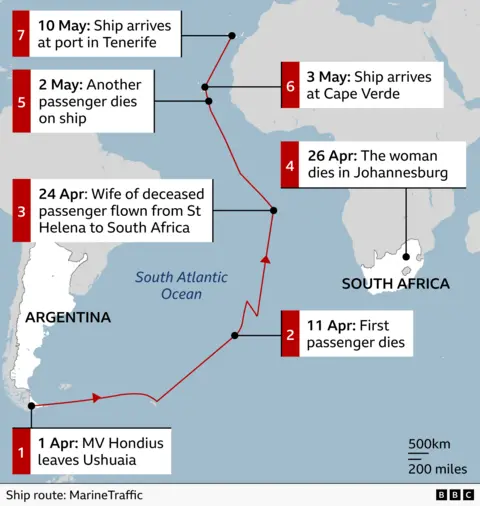
Dozens of passengers from a number of countries are in the process of being returned to their home countries from the MV Hondius ship.
Officials say the risk of a major outbreak is very low.
Here is what we know about what happens next to the repatriated North Americans.
US passengers assessed for risk
In its update late on Sunday, HHS said the group would be taken to a regional emerging special pathogen (RESPTC) treatment centre in Omaha.
The passenger with mild symptoms will be taken to a separate RESPTC.
The acting director of the US Centers for Disease Control and Prevention (CDC), Jay Bhattacharya, earlier said that the officials in Nebraska would first "assess them for risk" to the public.
The passengers will only be considered a threat to public health if they were in close contact with someone experiencing hantavirus symptoms, which is the only way the virus can spread between people.
"If they weren't in close contact with someone who was symptomatic, then we're going to deem them a low risk," Bhattacharya told CNN on Sunday, before the US hantavirus case was confirmed.
"If they were in close contact, we're going to deem them a medium or high risk."
'We will offer them alternatives'
It appeared from Bhattacharya's comments to CNN that some of the group could be given a choice after the initial risk assessment was made.
"We will offer them alternatives," he explained.
This will include an "offer to stay in Nebraska, if they'd like, or if they want to go back home, and their home situation allows it, to safely drive them home without exposing other people on the way", Bhattacharya said.
Once back home, they will continue to be monitored by local health officials, "with the CDC support all the way", said Bhattacharya.
The latest CDC guidance for treating those who have potentially been exposed to the virus states that "the recommended monitoring period is for 42 days after the last potential exposure".
The CDC adds that a person in that situation should "self-isolate immediately" if they develop a fever or other symptoms.
State-of-the-art facility
The state-of-the-art Nebraska Medical Center, where the passengers will be taken, contains the National Quarantine Unit (NQU) - the only federally-funded quarantine unit in the US.
The 20-bed facility opened in November 2019, just months before the Covid-19 pandemic began.
The rooms are fitted with negative air pressure systems designed to prevent the spread of communicable diseases.
A spokeswoman for the medical centre said the passengers were expected to arrive there "early Monday morning".

 University of Nebraska Medical Center
Speaking on Friday, before the US hantavirus case was confirmed, officials at the facility said they did not "expect to see any of these passengers transported off on a gurney".
Instead, the group would "walk off a plane and walk into a vehicle and get driven over here and head into their quarantine room", said the centre's director, Professor John Lowe.
Officials said a quarantine period had not been determined.
Any passenger who does end up staying there can expect a degree of freedom, according to comments from Dr Michael Wadman, director of the NQU.
"It's pretty much like living in a hotel room with delivery of food," he said. "They can use their exercise devices in the room, we do daily symptom and monitoring as well as vital sign checks."
If anyone was found to be ill, they would be taken to the Nebraska Biocontainment Unit, which is housed at the same medical facility, Wadman said. That facility is for patients with "high-consequence infectious diseases".
"No-one who poses a risk to public health is walking out the front door onto the streets of Omaha," Nebraska Governor Jim Pillen said at a news conference alongside health officials on Monday.
Also on Monday, HHS confirmed that two passengers from the airlift flight were taken to a specialised facility at Emory University in Atlanta, Georgia. One person is symptomatic and the other is that person's partner.
They were taken there in an effort to preserve space at the facility in Nebraska, said the CDC's Brendan Jackson.
Canadian passengers in 21-day quarantine
In Canada, passengers who were aboard the cruise ship have not displayed any symptoms of the hantavirus, but have been ordered to self-isolate out of precaution.
The four who have arrived in British Columbia will be quarantining at a "pre-determined" location for a minimum of 21 days, the Public Health Agency of Canada said.
Dr Bonnie Henry, British Columbia's health officer, told reporters on Sunday that the passengers would be monitored daily, and that their self-isolation period could be extended up to 42 days if necessary, citing the hantavirus' incubation period.
"At no point during their arrival or isolation period will they be in contact with the public," Henry said.
Three other Canadians are self-isolating at home in Ontario, said Ontario Health Minister Sylvia Jones on Monday.
Jones said they are not being tested in the interim, adding that it may not be an effective way to judge whether they have been infected because they have not developed symptoms.
"That's why these three individuals are self-isolating so we can see if there are any symptoms that come forward," she told reporters.
Officials urge calm
Officials continue to emphasise that hantavirus should not be compared to Covid-19, which was much easier to spread.
"This is not Covid," said Bhattacharya. "And we don't want to treat it like Covid."
"We don't want to cause a public panic over this.
"We want to treat it with the hantavirus protocols that were successful in containing outbreaks in the past."
"Let me be crystal clear: the risk of hantavirus to the general public remains very, very low," said Admiral Brian Christine of HHS. "The Andes variant of this virus does not spread easily, and it requires prolonged close contact with someone who is already symptomatic."
Henry, British Columbia's health officer, echoed that sentiment. But she said she understood why people may feel anxious over news of the hantavirus in the aftermath of Covid-19.
"I absolutely get that feeling," she said, adding that hearing about passengers getting sick aboard a cruise ship "made my stomach clench".
At least seven passengers from the same cruise ship had returned to the US before the group of 17 were taken to Nebraska.
State health departments are monitoring that earlier group for possible infections: two in Georgia, two in Texas, one in Virginia, one in Arizona and two in California.
California public health officials on Monday said that two California residents who were exposed to the virus - one who disembarked before the outbreak and another who came into contact with someone with hantavirus - were told by health officials stay home and limit interactions with others.
The two other California residents who were exposed to the virus are among those being monitored in Nebraska.
