Met culture improves but more work needed - report

 Getty Images
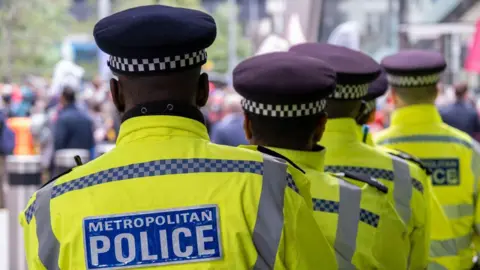
The Metropolitan Police has made progress in sacking unsuitable officers, but further work is needed to improve vetting, professional standards and anti-corruption arrangements, the police inspectorate has said.
Inspectors monitored the Met's efforts to clean up the force following a series of scandals involving officers, such as the murder of Sarah Everard by a serving police constable.
His Majesty's Inspectorate of Constabulary (HMIC) said the Met had made "significant efforts" to improve workforce culture but must do more to ensure the "right people" joined and remained.
The force said it was only part way through a five-year programme and that it would continue to make progress.
Unfit officers rooted out
The inspection by His Majesty's Inspectorate of Constabulary and Fire and Rescue Service (HMICFRS) follows a scathing 2023 report by Baroness Casey. She found that racism, misogyny, and homophobia were rife in the force and that it had failed women and children.
The Met Police Commissioner Mark Rowley has since promised to get rid of officers who were unfit to serve.
On Wednesday, HM inspector Lee Freeman said the Met had made "considerable investment in its integrity arrangements", so far rooting out 1,500 officers who should not have been in policing.
"It demonstrates the commitment and priority that Sir Mark Rowley has placed on raising standards and changing the cultures and behaviours that have been evident and widely reported on... it's pleasing to see the impact of that that," Freeman said.
However, he added: "The Met needs to make sure only the right people can join and remain in the service more consistently.
"Just one police officer who shouldn't be serving is one too many, and can cause a lot of harm."
In the report, inspectors detailed continuing issues with vetting officers, staff and contractors.
They identified a large backlog of vetting applications, with more than 4,000 that had not been started yet.
Nearly 2,000 contractor vetting applications were awaiting processing and the Met did not know how many contractors did not have clearance, the HMICFRS said.
Some 182 people, including 129 officers, were working without the correct level of clearance, the report said.
Inspectors said vetting interviews were not always carried out, with the force instead relying on written applications.
Complaints against officers
Other areas of improvement highlighted were the handling of public complaints and subsequent investigations, intelligence use to combat corruption, gifts and hospitality and secondary employment rules.
Where that had been complaints about officer's conduct, inspectors said the Met was not always suspending them or moving them to restricted duties when it was appropriate to do so, the report said.
These included allegations of sexual assault against junior colleagues, sexualised domestic abuse and the harassment of female personnel, the HMICFRS said.
It also noted a Met Police policy that meant officers accused of serious offences could potentially resign and and seek employment with another force, without being detected.
Freeman said that despite these concerns, he believed significant progress had been made.
"Undoubtedly the Met has a lot of work to do to rebuild trust with the public," he said.
"At our inspection, we found there were already improvements with how the force manages poor culture and poor behaviour.
"It's undergoing a significant internal transformation... and I look forward to commenting on the results of those changes in our next inspection."
 Hertfordshire Police
The inspection, carried out from September to November last year, follows a series of high-profile scandals at the Met.
In 2021, Sarah Everard was kidnapped, raped and murdered by serving office Wayne Couzens. The Met later admitted he had not been properly vetted.
Following the murder of sisters Bibaa Henry and Nicole Smallman in north west London in 2020, officers who were assigned to protect the scene were later found to have taken and shared images of the bodies in a series of misogynistic messages.
A police watchdog report in February 2022 identified misogyny, harassment, and bullying behaviour - including racist, sexist and homophobic messages - among officers based at Charing Cross police station between 2016 and 2018.
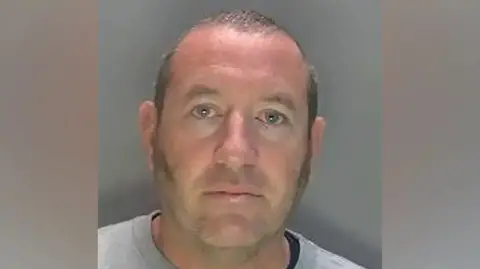
And former Met Police officer David Carrick was unmasked as one of Britain's most prolific sex offenders - another case that revealed failings in the vetting process. prior allegations.
Responding to the findings of HMICFRS's report, the Met's Assistant Commissioner Rachel Williams said: "We have consistently acknowledged that transforming our culture is not something we can achieve overnight.
"We are partway through this five-year journey and expect to see further significant progress as we continue our work to create a Met that Londoners deserve.
"The Met is continuously adapting and improving its efforts to maintain integrity. We have already made significant changes since this inspection was carried out."
She said nearly 1,700 unsuitable people had been sacked since 2022 and the force was reviewing 1,636 cases related to sexual and domestic abuse allegations against Met Police employees.
Listen to the best of BBC Radio London on Sounds and follow BBC London on Facebook, X and Instagram. Send your story ideas to hello.bbclondon@bbc.co.uk
