'Elephant in the room' Trump looms over European attempt at unity

 PA
PADonald Trump once again loomed large over the European Union's latest attempts to demonstrate unity, despite leaders not specifically mentioning the US president by name.
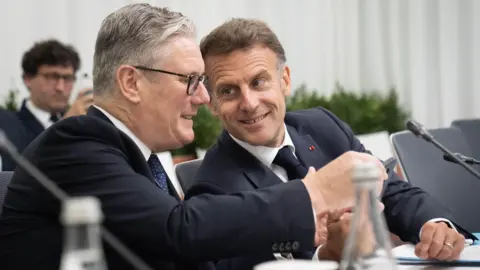
Increasing US indifference to European security is "the elephant in the room", French President Macron told the European Political Community (EPC) summit on Monday.
Europe has an "over-reliance on the US security umbrella", Macron also said at the gathering of European leaders in Armenia.
Meanwhile UK Prime Minister Keir Starmer admitted that Europe's alliances "are not where we want them to be" - comments apparently aimed at the US. He again urged the bloc to move at pace in bolstering its defences.
EPC gatherings are supposed to be less formal than their more rigid multilateral counterparts.
The aim of this latest one, at a sports complex in Yerevan, was to discuss energy security, the protection of democracy and continued support for Ukraine.
It was also an acknowledgement of the westward-looking political ambitions of the host country, which is hosting its first-ever direct meeting with the EU on Tuesday.
Nearby Russia has already expressed its discontentment.
Trump's own irritation at European defence spending levels isn't new.
But fuelling a sense of urgency at the event was the US president's announced removal of 5,000 troops and long-range missiles from bases in Germany.
The missiles were placed there by his predecessor Joe Biden to deter future Russian aggression.
Germany's Chancellor Friedrich Merz wasn't present in Yerevan, but his suggestion that Trump's war on Iran lacked strategy is making Europe's already steep political challenges with the White House seem vertical.
Berlin has tried to cool the row with the US president, who has since said Merz was "doing a terrible job".
Nato Secretary General Mark Rutte - no stranger to a charm offensive directed towards the US leader - said they "had heard" his frustrations.
But the hurdles for the EPC don't stop at Trump. They are also navigating the endless economic ripples from the US-Israeli war on Iran and subsequent blocking of the Strait of Hormuz.
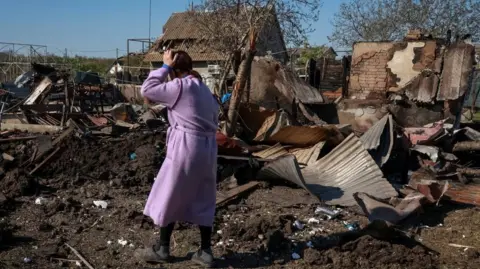
There is also Russia's continued invasion of Ukraine.
Ukrainian President Volodymyr Zelensky has urged Kyiv's allies to maintain pressure on the Kremlin.
"This summer will be a moment when Vladimir Putin decides what to do next," he argued. "We must push him towards diplomacy. They can't afford military equipment, it shows they are not strong now."
 Reuters
Also telling was how Starmer is making less of a secret of his desire to deepen the UK's co-operation, even alignment, with the EU.
The UK is currently negotiating joining a EU-led £78bn (€90bn) loan scheme to support Ukraine.
It has long been one of Ukraine's most loyal supporters in its defence against invading Russian forces, but it's now increasingly doing so through a European framework.
"It's of great benefit to Ukraine, but also the jobs it'll create in the United Kingdom," claimed the prime minister, who wouldn't be drawn on the reported EU demands that Britain pay it £1bn ($1.3bn) a year in exchange for a relationship reset.
As some experts put it, "you have to pay to play" to gain access to the single market, for example.
But these negotiations will take time. Europe's desired "strategic autonomy" or independence from US military strength, and subsequent strong-arming, would take decades.
The bloc's hope, perhaps, is that the continent develops military capabilities to the US president's satisfaction.
Or to at least keep him onside enough to still combat the growing challenges it faces.
Additional reporting by Kostas Kallergis
