Seagrass revival scheme 'seeing growth'

 Cumbria Wildlife Trust
A project aiming to revive an area of coastal seagrass beds to help tackle climate change is "seeing the start of growth", the team behind the venture say.
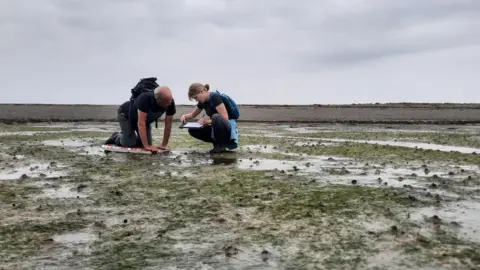
Cumbria Wildlife Trust is bidding to restore a meadow covering 5.5 hectares in the Barrow area and has so far planted about 16,000 seeds.
The scheme, which got under way in 2024 and will run until at least 2029, involves planting near Roa Island in the Walney Channel.
Seagrass helps mitigate global warming through its ability to lock away carbon, according to the United Nations.
The county has approximately 100 hectares of seagrass, which the trust says is a drop of 55% from the level seen in the late 1990s.
Both species of UK seagrass, common eelgrass and dwarf eelgrass, are found in the area, with the Walney Channel project focusing on the latter.
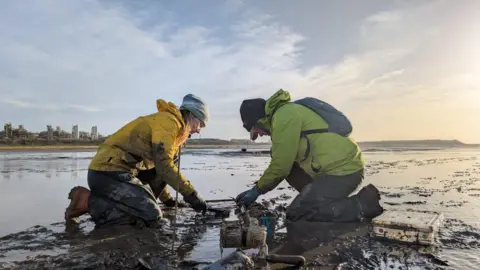
Conservation officer Amber Gould says different planting techniques are being tried.
These include direct seed planting as well as 55 transplants, with plants taken from an existing part of the meadow and put into the area being restored.
"We are seeing the start of growth," Gould said.
"We've seen some growth from the parts we did last December, which is really exciting and means we're on the right track.
"We're not seeing the growth of full meadows that we'd like to see as the end point [though].
"But all of this work is giving us answers we really need.
"When we first planted, we did so in some drier areas because we didn't want the plants to be washed away.
"Then we had a really hot and dry spring, which worked against us, so this year we've gone for some wetter areas with standing water to see if the seeds prefer those conditions."
 Cumbria Wildlife Trust
As well as helping in the fight against climate change, the trust says seagrass meadows provide shelter for some fish species and are a "rich habitat" for crabs and anemones as well as being foraging ground for waders and wildfowl.
Gould added: "Ultimately, we really want to see some ecosystems that have suffered quite a bit in the last century - either from changing conditions or physical development along the coastline - come back.
"Then there'll be benefits like coastal protection through trapping sediment and making those areas more robust, or acting as nurseries for fish.
"They're knock-on effects of having these ecosystems brought back into a healthier state.
"We're still discovering so much not only about how this species works, but also where it is along the UK coastline."
