Benefits and pensions rise as two-child cap ends

 Getty Images
A host of benefits and the state pension are rising as the new financial year begins, including more money for larger families on universal credit.
The two-child benefit cap has now been scrapped, meaning some 480,000 families with three or more children will get an average rise of £4,100 a year.
One mum told the BBC the rise was a "massive help" in dealing with the rising cost of living, while charities have described the move as a "gamechanger".
But some critics have suggested the government could spend the money better elsewhere.
For the past nine years, parents have only been able to claim universal credit or tax credits for their first two children, a policy that is estimated to have saved the Treasury about £3.6bn a year.
Tracey Morris, from Huddersfield, is a single mum with five children aged between six and 19. The youngest two, Luna and Harlie, were born after the cap was introduced.
Like 59% of families who will now receive more, she is working - in her case, full-time for the local council and doing occasional extra shifts at a pub to top-up her income.
"I've always had to be careful what I spend and how I spend it. The cost of living got so high, it's a struggle," she said.
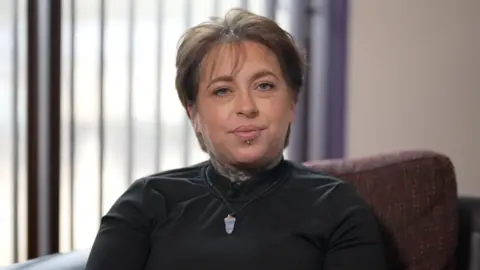
She depends on her local food pantry The Bread and Butter Thing to ensure she is able to buy basic groceries.
"It's so draining. I'm exhausted worrying about money all the time. As a mum, sometimes you feel like you're failing, but I'm not failing, it's just the situation, unfortunately, that we are in," she said.
Many bills have risen at the start of April, but Tracey will now receive just under £300 extra each month for each of three children.
The child element of universal credit will automatically increase from May onwards, owing to the workings of the scheme so eligible parents do not need to apply.
Other changes to the basic allowance for universal credit, paid to all claimants of the benefit, mean about three million families will receive an average increase of £120 this year, according to figures from the Institute for Fiscal Studies think tank.
However, the health element of universal credit, paid to claimants whose disability restricts their ability to work, is being halved. The 2.8 million existing claimants of the health element will be protected, with the cut only affecting new claimants.
Other benefits, including all the main disability benefits, such as personal independence payment, attendance allowance and disability living allowance, as well as carer's allowance have now risen by 3.8%, in line with rising prices.
The state pension is also rising by 4.8% in line with average wages, owing to the triple-lock, which means:
- the new flat-rate state pension - for those who reached state pension age after April 2016 - is increasing to £241.30 a week, or £12,547.60 a year, a rise of £574.60
- the old basic state pension - for those who reached state pension age before April 2016 - is going up to £184.90 a week, or £9,614.80 a year, a rise of £439.40
In general, you need 35 years of qualifying contributions to get a full state pension.
However, the age at which people receive their state pension is rising gradually over the next two years, from 66 to 67.
Various other changes also come into force at this time of year, including alterations to inheritance tax on farms, tax on dividends, tax relief on venture capital trusts, and homeworking tax relief.
It also marks another year in which income tax thresholds have been frozen.
This means more people start paying tax - or move into higher tax brackets - as wages rise.
The Conservatives initially froze thresholds until 2028-29 and then in November Labour extended that until 2031.
The move raises additional revenue to pay for public services but is often called a stealth tax by economists because it increases the tax take without a government having to put up rates.
The BBC has created a calculator to see how your pay could be affected.
The calculator applies to employees in England, Wales and Northern Ireland. Tax bands in Scotland are different, and self-employed workers are taxed differently.
