Schools cutting subjects due to teacher shortage 'crisis'

 PA Media
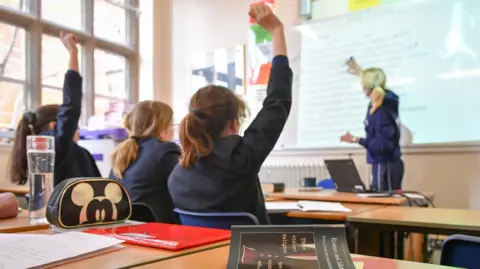
Secondary schools are reducing timetables and cutting whole subjects from the curriculum due to a lack of specialist teachers, education leaders have told BBC Scotland News.
The Association of Directors of Education in Scotland says a national action plan is needed urgently to increase recruitment and address the "crisis".
It says there are particular shortages in maths, science, design technology and computing, and that pupils are not accessing the full range of subjects in every year.
The Scottish government says Scotland has the lowest pupil/teacher ratio and some of the smallest class sizes of any country in the UK.
Analysis by BBC Scotland News has revealed that more than 4,000 spaces on the secondary postgraduate teacher training course, the PGDE, have not been filled in the past nine years.
Training recruitment targets have not been met in most subjects, with particular issues in maths, English and sciences.
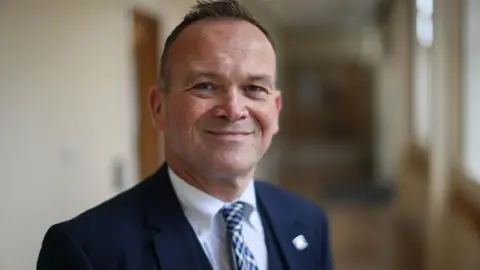
Laurence Findlay, president of the Association of Directors of Education in Scotland, said there was a "persistent and worsening shortage" of specialist teachers.
He said that as a result, some schools had not been able to offer home economics, computing and technical studies classes to certain year groups.
Findlay, who is director of education at Aberdeenshire Council, said head teachers were having to make difficult decisions because the situation had become a "crisis".
"I think it is a real crunch point and we need to see some decisive action on this very soon," he said.
He said it was time to look at the rules around how teachers could be recruited, as well as the attractiveness of teaching as a profession.
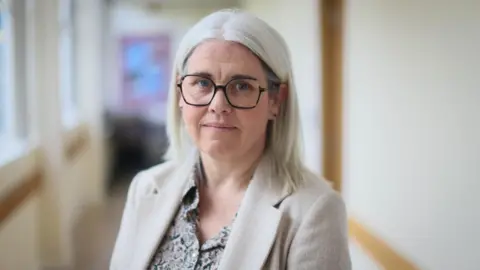
Louise Moir is head teacher of Mackie Academy in Stonehaven and vice-president of School Leaders Scotland.
She said schools were struggling to recruit teachers in both urban and rural areas.
Moir said head teachers were increasingly being forced to change timetables to fit the teachers they could recruit, rather than running the full range of subjects.
"Supply teachers are quite often going to classes in which they are not specialists, and they can't provide that knowledge and understanding that a subject specialist would," she said.
"I can't magic people out of thin air to do these jobs.
"We are fast approaching a point whereby educational provision, as it is recognised by the general public, is not going to be able to continue the way it is because we fundamentally will not have enough people in secondary schools on the ground to do that."
Moir said it took three to four years to fully staff the modern languages department at Mackie Academy.
Pupils currently have to learn home economics on rotation, something which has happened with other subjects in the past.
"Where we've been short-staffed in computing science, for example, we've had computing science in S1 but we haven't had it in S2 and then it comes back on board in S3 as an option," she explained.
"There's different models that schools will use to try and make sure that young people are not having parts of the curriculum obliterated because you don't have those staff - but sometimes it's really difficult."
How many teachers are there in secondary schools?
Last year, there were 359 mainstream secondary schools in Scotland, employing nearly 27,000 fully qualified teachers – representing a whole time equivalent of 25,067.
That has risen from 23,552 in 2019, but fallen from the total of 26,067 in 2008.
There are shortages in certain specific subjects.
Last year there was only one teacher in the state education sector whose main subject was economics when the Scottish government's annual teacher census was carried out.
Each year the government sets targets for the number of student teachers it needs to recruit in each individual secondary school subject.
This is done through its main secondary teacher training course, the PGDE.
Analysis by BBC News shows that there were 4,347 unfilled places on the course between 2016 and 2024-2025.
To calculate the shortfall, the intake target for each subject was compared with the actual intake number each year for the past nine years.
Most subjects were affected, with the most dramatic shortfalls in maths, English, languages and sciences.
For example, the national recruitment target for PGDE chemistry was 159 in 2024/25 - but only 54 students joined the course.
The target for English was 248, but the intake was only 138.
And the figures were worse for maths, where only 75 trainee postgraduate teachers were recruited towards a target of 250.
Figures for the 2025 intake have not yet been published by the Scottish government.
However, statistics published by the government's own workforce planning group show that for the past nine years, universities have consistently recruited too many primary teachers and not enough secondary teachers in most subjects.
PE and history have seen recruitment above the target, producing a surplus in these subjects.
There has also been an over-recruitment of trainee primary teachers.
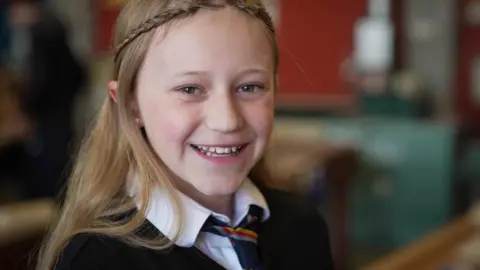
First-year pupil Olivia loves learning woodwork at Mackie Academy.
But the class will not be on offer to S1 pupils next year because of a shortage of design technology teachers. The school advertised twice and received no applicants.
As a result, there will be no practical workshop classes for S1 next year. Pupils will study with art teachers instead.
Olivia, 12, said that learning how to work with wood was "so important" to the subject.
"If we didn't have enough teachers I'd feel quite sad," she added.
Louise Moir says the introduction of a four-day week for schools is one of the options that needs to be discussed in an effort to tackle teacher shortages.
She admits that would be controversial, and that it's not a "one size fits all" option.
Moir said a four-day week could operate with compressed hours over four days, or a fifth day of online learning.
This could allow certain subject specialist teachers to be shared across schools, while pupils from multiple schools join the class from home.
Online learning is already used for some subjects at Advanced Higher level to share specialist teachers.
Katrina Suèr, who chairs the parent council at Mearns Academy in Aberdeenshire, said a four-day week would be impractical for parents.
"Having a child at home for one day a week every week would really impact you as a working parent," she said.
"I don't think it would be achievable for parents and would mean children missing out on a fifth of their education."
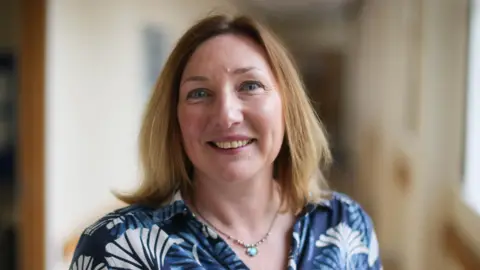
In 2024, the chairpersons of 17 parent councils in Aberdeenshire wrote to the Scottish government asking for urgent action to tackle the teacher shortages in the north east.
The then education secretary, Jenny Gilruth, said the issue would be looked at.
However, Ms Suer said things had got worse rather than better.
Local authorities organisation Cosla said it recognised there was an issue with teaching shortages in particular subject areas across the country.
A spokesperson said: "This provides local authorities with real challenges to delivering subject choice to learners and fill timetables.
"We are working with Scottish government and our trade union partners to identify solutions to overcome these challenges."
The Scottish government said the country's teachers were the best paid in the UK.
"Teacher numbers have increased by more than 2,700 over the last decade thanks to Scottish government investment," said a spokesperson.
"Scotland already has the lowest pupil-teacher ratio and smallest class sizes anywhere in the UK, and ministers are committed to at least maintaining this ratio over the lifetime of this parliament."
The spokesperson added that the yearly teacher training targets took into account the number of teachers who were starting training.
"Any shortfall in one year doesn't simply carry over in full to the next, because targets and modelling are adjusted based on actual recruitment," they said.
