'Misogyny and fetishism' - the story of the last woman to be hanged in Wales

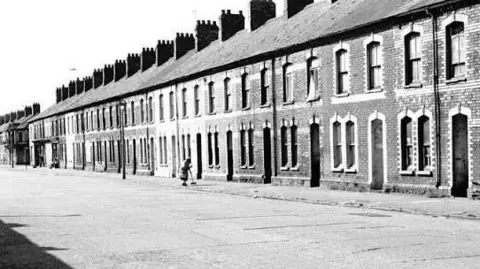 John Briggs from his illustrated book ‘Before the Deluge’
As Leslie James was marched to the gallows on the morning of her 40th birthday, she could never have known her death would put her name in the history books.
On 14 August 1907 at 08:00, James was led from the women's block of Cardiff Prison to a shed which housed the gallows, suspended above a 15ft-deep (4.5m) pit.
There waiting for her were Henry and Tom Pierrepoint - a surname synonymous with the noose - and with that pull of the lever, James would become the last woman to be hanged in Wales.
In June of that year, she was accused of deliberately smothering a day-old baby girl as part of what the police and press called a "baby farming" conspiracy.
But a new book by author Mary Jones casts doubt on details surrounding the case, highlighting James's previously unreported brain injury, and how her looks were as much the focus of the press attention as her crime.
In The Execution of Leslie James, Jones documents how in the months leading up to her crime, Leslie James, or Rhoda Willis as was probably her real name, was hit by a bike, giving her such severe concussion that she was in hospital for three months.
She argues: "Whatever Leslie's culpability in her crimes, this surely ought to have been taken into account."
James stood trial at the July 1907 Swansea Assizes accused of murdering baby Treasure, who was only identified by the surname of her mother, Maud Treasure from Fleur-de-lis in Caerphilly.
The prosecution claimed James responded to a newspaper advert asking for someone to take care of an unwanted baby, offering £6 initially, and a further £2 at a later date.
At the time, "baby farming", where "inconvenient" children were offered up for money, was seen as a social scandal.
After collecting the child, it was alleged that James smothered her on the train journey back to Cardiff, most likely around Llanishen.
Most damningly for James, evidence emerged that she had previously taken on two other babies in similar circumstances.
 Richard Sutcliffe - Geograph
After a trial lasting one-and-a-half days, the all-male jury took just 12 minutes to convict her, in what must have seemed like an open-and-shut case in those days.
In passing sentence, the judge said: "Don't let anyone suppose that because you are convicted of murder that nobody pities you, nobody prays for you.
"I implore you to employ the short time that is left to you to prepare for death and for that mercy which you will undoubtedly find in heaven, but which you cannot expect here."
Jones believes there were serious flaws in the trial, most importantly that James's brain injury was not mentioned as an explanation for her reckless behaviour.
"Her barrister, Ivor Bowen, was only appointed on the morning of the trial on the judge's orders and, as such, there was no time to speak to Leslie or call any defence witnesses.
"Had they have done so, then the jury would have heard what baby Treasure's family told the police, that the child was already frothing from the mouth, possibly because of the indigestible sugar-water mix which they had given her because her mother was unable or unwilling to breastfeed her, and also that she had been extremely tightly swaddled, so that neighbours could not tell that the package being handed over to Leslie was a baby.
"Either of these could have led to baby Treasure choking or suffocating, though Leslie didn't help her own defence insofar as she was an alcoholic and, I believe, honestly couldn't recall how the infant died on that journey home."
Jones added that, while James's two previous forays into baby farming were used in evidence against her, the counter argument was never put forward.
She left a note requesting medical assistance for the first child, who she left on the steps of the Salvation Army, and the second was thriving after being adopted by her landlady, Mrs Wilson at 132 Portmanmoor Road in Splott, Cardiff.
On the evening of 3 June 1907 James returned home but couldn't sleep in her own bed, and instead bunked up with fellow lodger Rose Smith.
The following day she went out and got "paralytically drunk".
As Mrs Wilson tried to help her into bed, she discovered a tightly-wrapped parcel, which at first she thought to be a cut of meat, only to discover the truth and informed the police.
James's tragic past quickly unravelled.
"She is most likely to have been born in Sunderland in 1863, though she claimed to have been educated in a London boarding school," said Jones, who believes there may be evidence to support this.
"Rhoda/Leslie appears from the records to have been a highly literate and articulate lady and far removed from the common-or-garden 'hussy' or 'fallen woman' which the press chose to stereotype such so-called baby farmers."
Jones said when James was arrested she gave her name as Leslie James, but on previous public documents she was variously listed as Rhoda Willis/Dalzell/Lascelles, daughter to a jeweller, Ernest Dalzell, which may have provided her with a more affluent background.
While living a "blameless life" prior to the bike accident, by 1907 she had fallen into "troubled ways".
She was locked in a love triangle with Scottish-born brothers Stewart and McGregor McPherson, between whom she bore two babies.
Jones said that by the time she sought lodgings at Portmanmoor Road, she was already deeply damaged.
"The way she sought shelter in Rose Smith's neighbouring room shows that she knew something terrible had happened, but it also lends evidence to the conclusion that she hadn't intended for it to happen.
"Surely, if Rhoda had have been guilty of murder, then she wouldn't have drawn such attention to herself."
Cardiff council, her own solicitor Harry Lloyd, and the general public raised a petition of about 50,000 names to spare her life.
A 1,000-strong crowd outside the prison were mortified when a guard pinned the notice of her death to the gates.
Home Secretary Herbert Gladstone had, the night before, concluded that she be made an example of because of the "despicable practice of baby farming prevalent in south Wales".
Jones said: "I am seeking an apology for the fact that such a troubled woman was hanged without evidence that she'd ever committed murder.
"It is beyond doubt that baby Treasure died while in the care of Rhoda, but her degree of culpability is very debatable, at the very most she is guilty of manslaughter."
Jones said a degree of misogynistic fetishism saw James go to the gallows.
"All the press reports and even the hangman Henry Pierrepoint remarked on her beauty and composure.
"No male's demeanour had ever been commented upon so much in the papers: 'From the way in which the sunlight caught her auburn hair to her composure at the moment the lever was pulled.'
"She was made to stand out for some sort of message."
Now, 119 years after she died, the only physical record of James's grave is an etched cross next to a potato patch within the walls of Cardiff Prison.
Correction 20 August 2026: An earlier version of this story included pictures that had been modified using generative AI, and were not clearly labelled. We have removed them from the article as they did not meet the BBC's standards for the appropriate use of AI in news content.
