'I swapped driving a tractor for a dumper truck'

 BBC
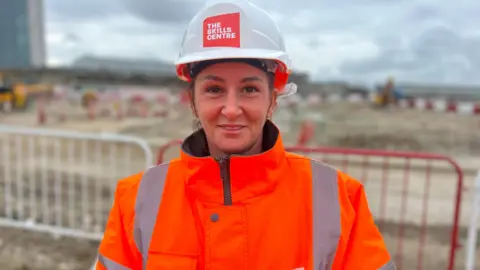
BBCOn a dusty development site in Earls Court, west London, Charlie Lillington is learning how to operate a heavy JCB dumper truck, something she describes as a "dream".
The 39-year-old mother-of-six used to work as a farmer until her nephew, who works as a scaffolder, encouraged her to get into the sector.
"He told me to go for it - and I did."
The transition was natural, she explains: "I've basically just switched from driving a tractor to a dumper."
 Charlie Lillington
After starting in groundwork, she's now enrolled on a brand new women-only course specialising in heavy machinery training - the first of its kind in London, and run by the Skills Centre.
It's normally a rare sight to find women working on a construction site.
Females make up just 14-15% of all construction workers and 1-2% of practical roles, according to its training board.
With the sector facing a significant skills shortage, and a looming target of 1.5 million new homes proving a challenge, efforts are being made to encourage more into the industry.
In recent years, more women have been entering construction apprenticeships, according to the Construction Industry Training Board (CITB)'s analysis of government figures.
In 2018, 340 women completed apprenticeships and 1,450 started; by 2025, 910 completed and 2,410 started - an increase of over 160%.
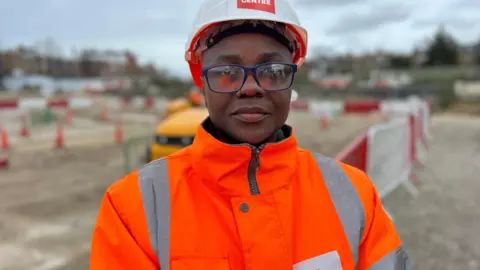
Among those is Happy Konete who completed an apprenticeship in framework and shuttering six years ago and has since worked as a carpenter.
"We are pioneers," says the 59-year-old, who is now learning to become dumper driver.
She believes that many women lack access to the information and opportunities needed to enter the industry, but her course helps improve visibility.
"Many men aren't used to seeing women in construction," Konete explains. "That needs to change.
"They need to get used to seeing more of us - on site, in offices, and operating machinery like dumpers and rollers."
CITB's Deb Madden says that while progress is being made, "there is still a lot more to do".
She highlights a persistent skills gap, warning that excluding groups such as women, ethnic minorities, and people with disabilities limits the industry's ability to address it.
Noting how many sites still fail to meet women's needs, Madden says change is needed such as introducing PPE which is more appropriately-sized for women, having onsite toilets for women, and the need to talk more openly about pregnancy, menstrual health and menopause.
"It can be difficult for women to be open about what they need, and can ultimately make them feel excluded," says Madden.
She adds that without supportive conditions and inclusive facilities, "too many women leave for entirely preventable reasons".
Construction also remains the sector with the largest gender pay gap. This means that female employees earn around 79p for every £1 earned by men, according to 2025 data from The Chartered Institute of Personnel and Development.
In addition, just 7% of the sector's executive roles are held by women according to Simian, one of the country's leading construction and scaffolding specialists
"Women will come into the industry but don't stay in the industry," says Madden.
"If we're closing off whole groups... because the culture or the way we operate on site doesn't lend itself to them, we are really closing down the opportunity to really shut down that skills gap."

Sam Downton, one of the founding directors from the Skills Centre, which provides construction training across the UK, says it's important to be "innovative" to get more people working in the industry.
"We need to get more women in construction across London and across the UK. We have a responsibility," he says.
"The industry has a huge skills gap. It's an ageing industry with an ageing workforce."
He adds that while "we have broken the back of it in terms of getting people in", if it is only men who stay in construction "it's not enough".
In 2024/25, there were 1,600 female learners on construction planning and built environment apprenticeships, with a 56.2% achievement rate, according to government figures.
A government spokesperson said: "Our £600m investment will tackle skills shortages in the industry and create up to 60,000 more engineers, bricklayers, electricians, and joiners by 2029.
"We are determined to continue supporting women into the construction industry, including through our Skills Bootcamps which are delivering practical construction training across England."
Listen to the best of BBC Radio London on Sounds and follow BBC London on Facebook, X and Instagram. Send your story ideas to hello.bbclondon@bbc.co.uk
