Children taught to spot scams and money laundering

 Getty Images
Children as young as 10 are to be taught how to recognise scams and avoid being drawn into money laundering, using new lessons developed by police in the South West.
The move follows growing concern about the number of young people being targeted by criminals – sometimes with lasting consequences. One victim told the BBC he spent six years without a bank account after being unknowingly used as a so-called "money mule" as a teenager.
The lessons, designed by the South West Regional Organised Crime Unit (SWROCU), aim to stop children being exploited before they become victims of fraud.
They are expected to be available to schools nationwide from this autumn.
Money muling is when criminals move money gained from crime through someone else's bank account to make it appear legitimate, often leaving the account holder to face the consequences.
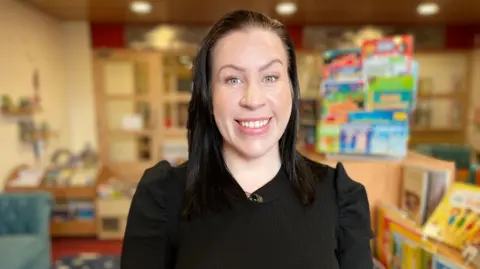
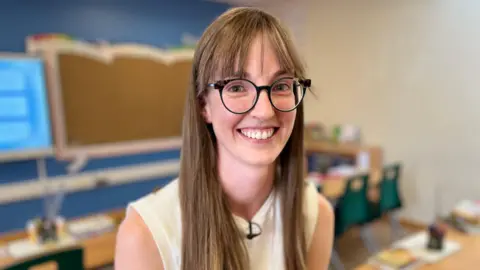
Jordan Coates, from SWROCU, who helped develop the lessons, said children were increasingly exposed to content online with "hidden criminality".
"There are videos showing luxury goods, designer clothing and huge amounts of cash, promoted on social media as quick money, risk‑free, even labelled as completely legal - and they're incredibly enticing," she said.
She warned many scams appear harmless at first, often arriving through social media, gaming platforms or messaging apps.
"They look risk-free. They look so inviting. And young people have no idea that by sending that text... they're going to find themselves in a cycle that is really hard to break out of."
The lessons are currently being accredited by the Personal, Social, Health and Economic (PSHE) Association.
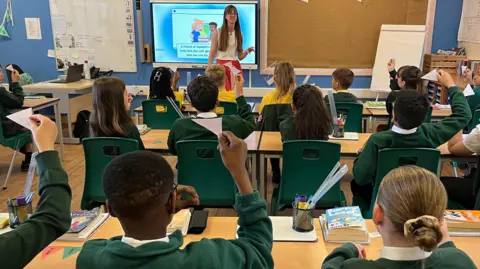
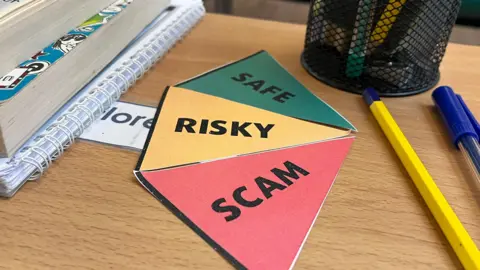
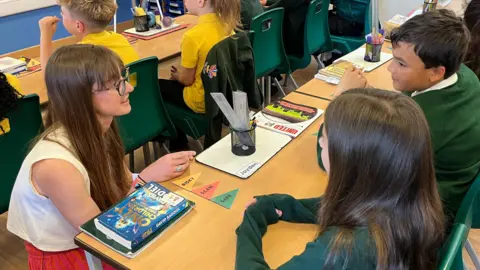
At King's Forest School in Kingswood, year five and six pupils are asked to judge real-life scenarios as "safe", "risky" or a "scam".
The pilot lesson covers financial exploitation, why you should never lend your bank card and how to spot different types of scams - topics even some adults would struggle with.
Lily, who was in the class, said the lesson was "great" as she had not known about money laundering before.
She said money muling is when someone with "dirty money… wants you to have the blame so they don't get into trouble".
Another pupil, Shamar, said he understood that money linked to crime could be traced and that if you spent it, "the bank could find out what kind of money it is" and you could get in big trouble.
There were 207,889 cases of money muling in 2024, according to the Financial Conduct Authority.
More than half of those reported to the National Fraud Database last year were under 30, with 18% under 21.
The BBC reported in February how young people are often recruited through online job adverts that appear too good to be true. Education is just one approach to try to tackle the issue.
'You can't live a normal life'
Pavan, not his real name – who is just 23 – knows from bitter experience about the risks.
His bank account was closed and he was credit blacklisted at 17 after lending his bank card to someone he trusted. He then spent six years without an account, relying on others to help him pay for everyday essentials.
"You can't get a job. You can't go anywhere. You can't go on holiday with your family. You can't even do the basic things that a lot of people take for granted," he said.
He opened his first account at 16 and says he was naive about how banks worked.
"I didn't really know much about the basics," he said.
"Your salary gets paid in, and you take money out, and that's probably the basic outline of what I knew about finance."
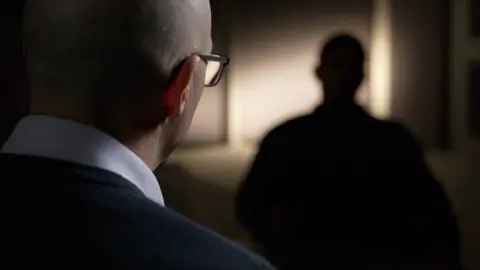
Months later Pavan, who is from the West Midlands, lent his card to a family friend who said money needed to be paid into the account.
About £2,500 passed through it over two weeks before it was frozen.
"I was literally stressed, under pressure," he said.
"How do I fix this? What do I do? There was a large gap of context that was missing. But you don't think at that time it's that serious."
He was later refused a new account after fraud markers were placed against his name on multiple databases.
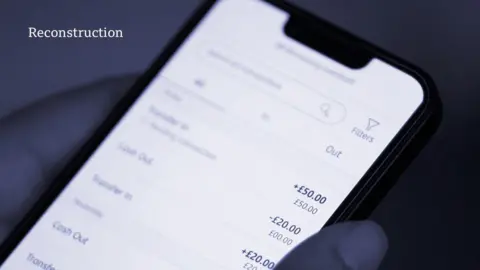
To this day, Pavan says he doesn't know where the money came from – or where it went, but the pattern is consistent with money muling.
He has spent six years trying to clear his name.
The stress has been so great, he's suffered depression and even hair loss as a result.
He said: "It takes a big toll mentally, and it makes you vulnerable.
"You lose all your faith. You lose faith in the justice system, you lose faith in life itself.
"Because when you're at that particular position, you're going to think, well, if I can't work, I can't open an account. What is the point in me being here?"
Credit blacklisted
Michelle Pilsworth, Head of Fraud and Customer Experience at Santander, told the BBC they assess each case on its merits.
"First of all, we speak to the customer," she said.
"We have complex detection systems that will flag to say if there's something unusual on the account.
"It's really important that if the bank calls, you are honest with the bank... We then make a decision on an individual basis about the action that we take."
But, she adds: "People [should] realise the seriousness of the crime that they're involved in. They're allowing people, criminals, to move money that they've stolen from other people through the banking system".
The three fraud markers against Pavan have now been removed.
Fraud prevention service CIFAS said fraud markers were necessary to prevent crime but "must meet strict standards of fairness, lawfulness, transparency and accuracy".
It added that "individual circumstances" are considered, including "proportionality, vulnerability and evidence of coercion".
Other database providers said records are based on thorough investigation and that individuals can challenge decisions through the relevant organisations.
'A massive step'
Pavan said he would be willing to speak to young people about his experience.
"If you're a child who got themselves in a situation like this, you shouldn't treat them like a criminal, especially when schools don't even add on fraud awareness into the curriculum," he said.
"When I left school they don't teach you that."
He added: "The fact that now this is being rolled into the curriculum.. is such a massive, important step.
"Not only is it protecting the banks from fraud, but it's also protecting the children themselves from being exploited, just because they're unaware."
If you want to contact us regarding this story, email westinvestigations@bbc.co.uk
Follow BBC West on Facebook, X, and Instagram. Send your story ideas via WhatsApp on 0800 313 4630.
