Commuters welcome second year of Translink fare freeze

 BBC
BBCTranslink fares will be frozen for the second year in a row Stormont's Infrastructure Minister has decided.
Liz Kimmins acknowledged that the decision was taken against a difficult funding backdrop for the public transport company.
Data from the NI Consumer Council suggests diesel prices in Northern Ireland have risen by almost 40% since the Iran war began.
That adds to Translink's costs, although it will have "hedged" some of that by buying some diesel in advance at lower prices.
An increasing share of Translink's bus fleet is powered by electricity rather than diesel.
Its spokesperson said: "Translink manages our fuel costs efficiently and effectively through fuel hedging, which is consistent with the approach undertaken by other transport operators."
They added it gives the company "some protection against short-term volatility in the market".
However, they also warned that as the "current global volatility continues Translink will inevitably face higher costs on fuel and materials".
Fare freeze could 'benefit Translink'
Kimmins said she had decided to prioritise consumers during the current crisis but will "work with Translink to manage pressures responsibly".
"Everyone is struggling financially. Even across my own department, we all have pressures," she told the BBC's Evening Extra programme.
The minister explained freezing fares could drum up more custom for Translink as it will keep costs down for new and existing passengers.
"A bit of common sense will show that if you make it more expensive for people to travel, they're less likely to use that [service]," she said.
The minister acknowledged that there are "real challenges" for the transport company and insisted she was "not trying to underestimate that by any stretch".
But Kimmins pointed out that Translink saw "record passenger growth" after fares were frozen last year.
"If we can encourage more people to use public transport, that increases the demand for the services that are already existing," she said.
"So I would hope that actually would be a benefit to Translink."
What do commuters think?
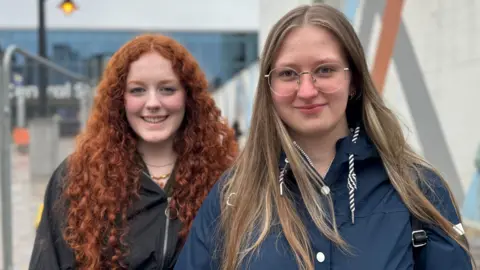
Erin Crozier and Katie Quinn frequently use Translink services when travelling from their homes in Newry to Belfast.
The pair can benefit from reduced fares as they are yLink student pass holders, but this only applies to single journey tickets. They said it usually works out cheaper to buy a return ticket.
Crozier said bus tickets "cost a lot" and are "overpriced", particularly for students on a budget.
Quinn believes her £13.10 return ticket is "very expensive" but as long as the prices remain frozen she can "live with it".
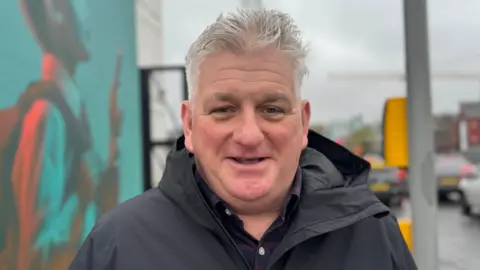
David Gibson said his one-way train ticket from Bangor to Belfast on Tuesday was "expensive enough" and was "disappointed" he could not qualify for a return ticket as he is travelling home on Wednesday.
Gibson said "you could imagine getting a return ticket in any other European city, so a bit of flexibility would be good".
He praised the reliability and cleanliness of the service but urged the company to "keep prices low".
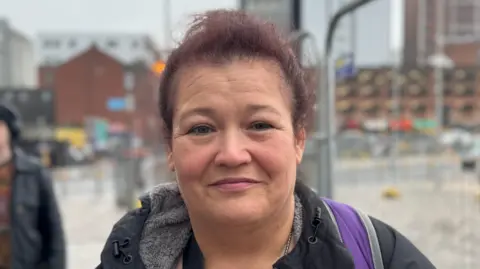
Margie is on a trip from Scotland to Dublin, but got the train up to Belfast for the day.
She thinks train fares are "extortionate in all of the UK cities".
"In other European cities you can get tickets last minute for a fraction of the price they cost here."
She said the cost of the bus and trains in Northern Ireland "doesn't encourage people to use public transport".
 Pacemaker Press
The minister said: "This is an extremely constrained budget environment and there are no easy choices. Freezing fares for a second year has required careful consideration.
"I will keep working with Translink to manage pressures responsibly and to ensure the best possible services within the funding available.
"I do not believe it would be right to increase public transport fares and place further pressure on workers and families."
Translink is publicly owned but operates at arms length from the Department of Infrastructure.
The company needed additional funding to save it from collapse during the pandemic when passenger numbers fell dramatically.
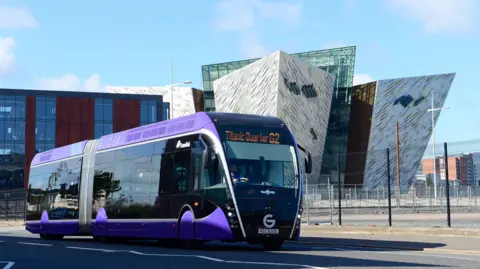
Passenger numbers have largely recovered since the pandemic, particularly the Glider service in Belfast.
However budgets have remained under pressure and the company has had to dip into its financial reserves to continue operating services.
