Warning after man dies while awaiting surgery

 Google
A coroner has issued a warning to NHS organisations in a bid to prevent future deaths after a delay in treating a patient with a "time-critical surgical emergency".
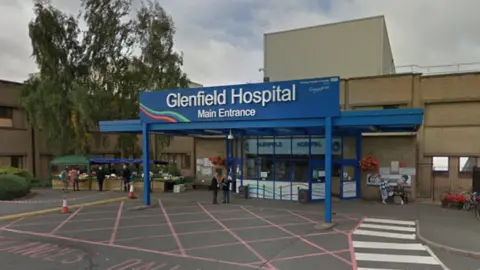
Malcolm Budd, 65, died at Glenfield Hospital in Leicester before surgeons could operate on a tear in the artery - known as an aortic dissection - in February.
He had been transferred there from the Royal Derby Hospital after it was established the procedure could not be performed in Derby or Nottingham.
Coroner Dianne Hocking said a "lack of agreement between local hospitals" had led to "delays" in transferring patients with acute aortic dissection.
Budd, known as Granpy to his family, had arrived at Royal Derby Hospital at 12:26 GMT on 24 February this year and was sent straight to the streaming room due to severe pain in the jaw, neck, and back.
A junior doctor suspected an aortic dissection and arranged a CT scan to diagnose the condition.
The mortality risk for the condition increases by 1% to 2% every hour, the Local Democracy Reporting Service (LDRS) said.
The inquest heard scans showed Budd had an artery tear of about 5cm (1.9in) and the diagnosis was confirmed as soon as he was out of the scanner at about 18:00.
However hospitals in Nottingham or Derby did not have the capability to carry out the required operation, and it was arranged for Budd to be taken to Glenfield Hospital.
The adult critical care transfer service was at his bedside by 19:30 and he arrived in Leicester at 20:26.
The inquest was told that while Budd was on the stretcher awaiting the lift to theatre, he displayed signs of a cardiac arrest and despite efforts to resuscitate him, Budd died at 20:45.

Hocking, assistant coroner for Leicester City and South Leicestershire, concluded on Tuesday his death was due to natural causes.
The coroner told representatives from Nottingham and Leicester hospitals that while she was not the "referee" for arranging a plan of action for dealing with aortic dissection referrals from Derby, they needed to "make sure this gets sorted out".
She said if a single point of contact had been there to oversee the case, Budd could have got to theatre earlier, although this would not necessarily have changed the outcome.
In a prevention of future deaths report, Hocking said she was aware of other instances where patients had been redirected to Glenfield Hospital only after "significant deterioration in their condition".
The report added this was "despite the clinical understanding that, in acute aortic dissection, each hour of delay was associated with a measurable increase in mortality risk".
Copies of the report have been sent to Budd's family, hospital trusts in all three cities and NHS England.
NHS England responded by expressing "deep condolences to Mr Budd's family and loved ones".
"NHS England is keen to assure the family and yourself that the concerns raised about Mr Budd's care have been listened to and reflected upon," it said.
It added local health bosses were "working closely and co-ordinating" with relevant providers to establish agreed pathways with the intention of improving transfer times for patients requiring time critical emergency surgery at a specialist site.
Malcolm's wife Alison Budd, a senior nurse and midwife, praised the efforts of hospital staff in Derby and Leicester but told his inquest the process felt "chaotic".
"For me, this isn't about blame - it's about what we can learn from it," she said.
"I get he was poorly and it was a hard diagnosis, but I think he deserved the chance to fight.
"I do feel that if we had got him there a bit earlier, he would have had the chance."
Additional reporting by Dan Hunt
Listen to BBC Radio Leicester on Sounds and follow BBC Leicester on Facebook, on X, or on Instagram. Send your story ideas to eastmidsnews@bbc.co.uk or via WhatsApp on 0808 100 2210.
