Developers say hydro power 'being missed' because of wind focus

 BBC
BBCDevelopers of small scale hydro-energy projects say Scotland is missing out on investment because of a focus on wind and solar power.
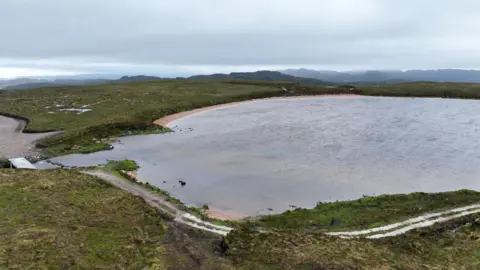
Foster Turner Hydro has halted construction of a scheme in the Highlands because it sees no way of securing a contract to provide its electricity to the grid.
It wants funding for small scale hydro projects to be ring-fenced in government auction rounds - in the same way as wave and tidal power - to make them financially viable.
The UK government says the funding structure for the next round of bidding will be confirmed before the process begins next month.
Scotland has long been a pioneer of cheap hydro-electricity, but companies say contracts to supply power are squeezing them out of the market.
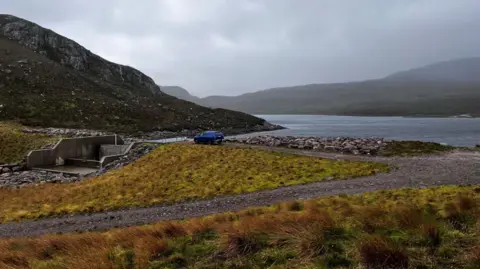
The Gaineamhach scheme – near Gairloch - would generate up to five megawatts of electricity and is due to come online around 2028/29.
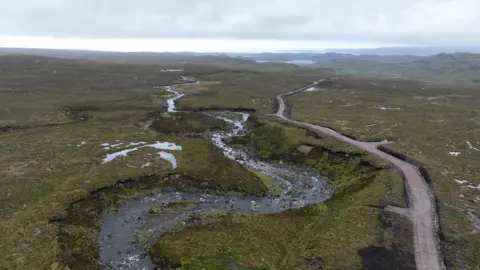
But work has come to an end after the construction of a seven kilometre access track across the moor.
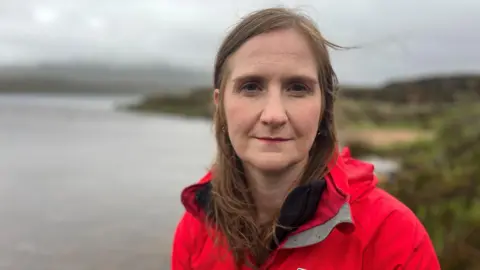
Projects director Toni Ramage says the scheme has the potential to provide up to 4,500 local homes with clean, green electricity.
That is now all on hold.
"Because we don't have price certainty, we've been unable to finish construction so we've downed tools now for over a year," she said.
The Contracts for Difference process guarantees a price for selling electricity to the national grid.
It is seen as a key driver in the shift to renewables and is being replicated by other countries.
The process operates as a closed auction, with developers bidding for the right to supply their electricity at a fixed price.
While some forms of generation such as wave and tidal power bid into a ring-fenced pot of money, small-scale hydro schemes have to bid from the same fund as wind and solar, which is cheaper to generate.
Energy generators often operate on tight margins and some say they are already struggling with high transmission costs in Scotland.
The industry says small-scale hydro could play an important role in providing grid stability by generating a fairly continuous stream of electricity in contrast to the intermittency of wind and solar.
The UK already has about 1800 hydro schemes, around 80% of them in Scotland according to the British Hydropower Association (BHA).
'Winter generator'
The technology brought rapid deployment of electricity to rural communities after the Second World War with the North of Scotland Hydro Electric Board connecting half of all rural farms and crofts by 1955.
Glens were flooded to support the turbines. The largest hydro power station - Sloy, on Loch Lomond - was completed in 1951 and is still operational.
The BHA argues that hydro is a "winter generator" which can provide additional power when shorter days mean solar power is operating below capacity.
BHA chief executive Kate Gilmartin says the different forms of generation should be regarded as complementary rather than being in competition.
"Solar is cheap and that's great and we need lots of that, but we also need winter generation and the stability of hydro power," she said.
Earlier this year, the West of Orkney wind farm developer effectively shelved its plans for a 125-turbine offshore scheme, saying transmission charges made it unviable.
The charges are imposed to carry electricity to consumers from where it is generated, with developments in the north of Scotland seeing some of the UK's highest rates.
Shifting to renewables like hydro is the UK government's longer-term plan to bring bills down in the next five years.
The Clean Power 2030 Mission exists largely to squeeze gas out of the electricity generation market, which the UK government says will bring down bills.
But conflict in the Middle East, which is pushing up prices for oil and gas, has intensified the debate around energy security.
The department for energy security and net zero says all projects which qualify for a Contract for Difference must show value for billpayers.
It points out that a pricing mechanism has been introduced for long duration electricity storage, which includes pumped storage hydro projects, and that the funding structure for the next allocation round will be confirmed ahead of bids opening next month.
A spokesperson said: "We welcome the supportive role hydro power could play in our clean power mission, as a small-scale technology.
"The lesson of yet another fossil fuel crisis is the UK needs to get off the fossil fuel rollercoaster and onto clean homegrown power we control."
The Scottish government says it is supportive of hydropower projects in Scotland and open to discussing the needs of the sector.
