Houthi attacks reportedly kill at least 30 Yemeni government forces

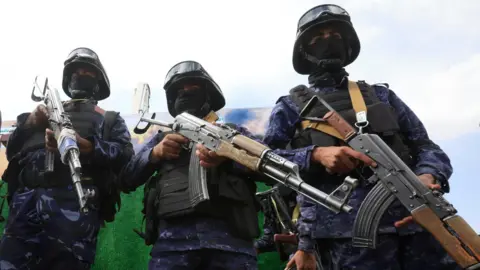 EPA
EPAAt least30 Yemeni government troops have reportedly been killed in Houthi rebel attacks on military camps in central Yemen.
The defence ministry said ballistic missiles and drones struck several camps in the provinces of Marib and Hadramawt, resulting in the death and injury of a number of Yemeni personnel. It did not give an exact toll.
The ministry denounced the attacks as "treacherous" and vowed to "respond to this aggression at an appropriate time and place".
The Houthis, who control much of north-western Yemen and are backed by Iran, said they had targeted "large Saudi military build-ups" preparing for an offensive. A Saudi-led coalition has supported the government during the civil war.
In a separate attack, the coalition's spokesperson said that 11 civilians had been wounded in the Saudi Arabian border region of Najran, in what they described as a Houthi strike.
In their statement, shared to X, they said the wounded included seven Saudi nationals, including a woman and a four-year-old child who both suffered second-degree burns.
The other four civilians were from Yemen, Pakistan and Egypt.
The Houthi attacks in central Yemen happened at 10:40 local time (07:40 GMT) on Thursday, according to Yemen's defence ministry.
A military official told AFP news agency that missiles and drones hit a camp in the al-Ruwaik area of Marib province, as well as camps in the al-Abr and al-Wadiah areas of Hadramawt, near the border with Saudi Arabia.
At least 30 have died but the exact death toll was has not been verified. AFP cited a military source as saying at least 58 Yemeni troops had been killed, an increase from the 38 dead it had previously reported.
Military sources have told the pro-government newspaper Aden al-Ghad and the anti-Houthi Belqees TV website that more than 40 troops were killed.
Houthi military spokesman Yahia Sarea claimed the attacks caused the death and injury of "hundreds of Saudi enemy mercenaries", and destroyed a large number of buildings, weapons and military vehicles at camps in the al-Ruwaik, al-Abr and al-Thaniyah areas.
He said the camps belonged to the Saudi-backed Yemeni Emergency Forces and that the Houthis had observed "large Saudi military build-ups in their final stages, aimed at escalating the aggression against the liberated provinces and the Yemeni people".
Deputy UN spokesperson Farhan Haq called on all parties to "exercise restraint and refrain from actions that could lead to further military escalation".
"Renewed fighting risks reversing the hard-won gains made towards reducing violence in the past years," he told reporters.
The US mission to Yemen said the Houthis' attacks were "cowardly" and another example of what it called "their terrorism against the Yemeni people".
Yemen has been devastated by a civil war that began in 2014, when the Houthis ousted the government from Sanaa, the capital. The conflict escalated in 2015, after the Saudi-led coalition of Arab states intervened in an attempt to restore the government's rule.
The fighting has reportedly left more than 150,000 people dead and triggered one of the world's worst humanitarian crises, with more than 22 million people in need of some form of aid, according to the UN.
A UN-brokered ceasefire has largely held since 2022, but there has been a significant escalation in recent weeks.
The Houthis announced a "maritime embargo" against Saudi Arabia on 20 July and began launching missile and drone attacks on Saudi airports, oil facilities and tankers in the Red Sea.
The group said it was retaliating for a Saudi blockade of ports and airports in the territory they control, as well as an air strike on Sanaa airport that they blamed on the kingdom despite a claim from the Yemeni government.
Saudi Arabia has responded with strikes targeting Houthi positions and by forming a new naval coalition to protect shipping in the Red Sea and the Gulf of Aden.
On Thursday, representatives of 43 countries attended the coalition's founding meeting, where the new commander stressed it was "purely defensive in nature and does not target any country, organisation or coalition", Saudi state media reported.
